


Offshore and nearshore software teams differ mainly in time-zone alignment, cost structure, and how collaboration is operationalized across distributed delivery. Offshore teams are typically located far from the hiring company’s time zone, often across oceans, while nearshore teams are in a closer region with stronger working-hour overlap. The best choice depends on how much real-time collaboration the work needs, how quickly the company must scale, and what level of cost advantage is required.
Nearshore teams often reduce decision latency because overlap hours are higher, which can help with discovery-heavy work. Offshore teams often unlock larger cost advantages and larger talent pools in certain markets, which can help with scaling execution. Both models can deliver high quality when ownership is clear and engineering standards are consistent.
Why Compare Offshore and Nearshore Software Teams?
Comparing offshore and nearshore software teams matters because the choice changes coordination cost, delivery speed, and total cost of ownership over multiple release cycles. The team model defines how work is planned, how fast decisions are made, and how reliably output ships with consistent quality. A clear comparison prevents choosing a model based only on geography labels.
To fully understand the tradeoffs between location models, it’s useful to also compare onshore vs offshore software engineering teams and how cost, control, and scalability differ.
The Main Tradeoff Is Time Overlap Versus Cost Leverage
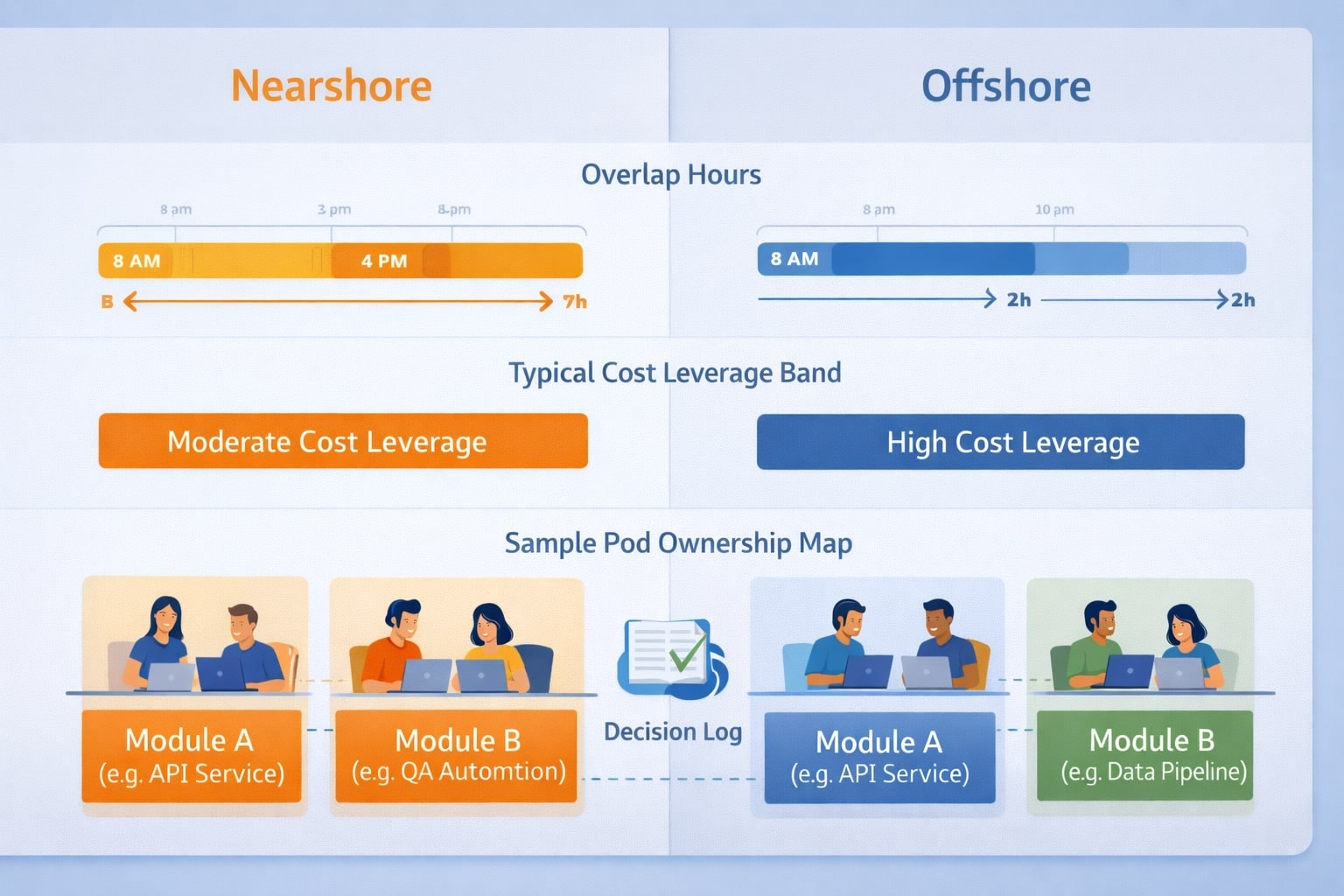
The main tradeoff is time overlap versus cost leverage because overlap improves real-time collaboration while cost leverage improves scaling economics. Nearshore setups typically provide more overlap, which lowers waiting time for approvals. Offshore setups typically provide stronger cost advantages, which increases sustainable headcount for the same budget.
The Choice Determines Operating Design Requirements
The choice determines operating design because low overlap requires stronger asynchronous systems. Offshore teams usually need clearer written specs, decision logs, and stable ownership boundaries. Nearshore teams can rely more on real-time alignment, but still perform best with the same discipline.
The Model Impacts Risk During Different Product Phases
The model impacts risk because discovery work and execution work behave differently. Discovery work benefits from fast feedback loops and more overlap. Execution work benefits from stable interfaces, repeatable processes, and parallelization..
What Is the Difference Between Offshore and Nearshore Software Teams?
The difference between offshore and nearshore software teams is primarily geographic proximity to the hiring company’s time zone. Nearshore teams operate in nearby regions with stronger workday overlap, while offshore teams operate farther away with limited overlap. This difference changes meeting patterns, escalation speed, and how much execution depends on written context.
Nearshore Provides Higher Real-Time Collaboration Potential
Nearshore provides higher collaboration potential because teams share more working hours with stakeholders. This makes it easier to run live design sessions, pair programming, and rapid iterations. Higher overlap often reduces the need for late-night meetings across time zones.
Teams that follow best practices for running agile with offshore teams can mitigate many collaboration concerns typically associated with offshore models.
Offshore Relies More on Asynchronous Clarity and Handoffs
Offshore relies more on asynchronous clarity because partial overlap increases the cost of missing context. Strong documentation, clear acceptance criteria, and written decisions reduce dependency on real-time conversations. Offshore teams are most effective when they own stable modules end-to-end.
Engagement Models Can Be Similar, but Operations Differ
Engagement models can be similar because both nearshore and offshore teams can be hired as contractors, employees through an Employer of Record, or employees in a local entity. Operations differ because payroll, compliance, and security workflows depend on the specific country and corridor. The complexity level is driven by jurisdiction, not by “near” versus “far.”
Offshore Versus Nearshore Is Not the Same as In-House Versus Outsourced
Offshore versus nearshore describes location, while in-house versus outsourced describes control and ownership. A nearshore vendor team can still be low-ownership if it only receives tasks. An offshore integrated team can be high-ownership if it participates in planning and owns outcomes.
How Do Costs Differ Between Offshore and Nearshore Software Teams?
Costs differ because nearshore markets are often closer to the hiring company’s salary bands, while offshore markets often offer stronger labor arbitrage. The true comparison is total cost per shipped outcome, not hourly rates. Total cost includes coordination overhead, vendor margins, compliance operations, and rework.
Nearshore Often Costs More Than Offshore, but Less Than Onshore
Nearshore often costs more than offshore because nearshore regions frequently serve similar customer markets and reflect similar demand pressures. Nearshore can still be lower cost than fully onshore hiring in high-cost markets. The cost advantage is typically moderate rather than extreme.
For companies prioritizing long-term value over short-term proximity, the benefits of hiring offshore dedicated development teams often outweigh the advantages of nearshore setups.
Offshore Often Provides Larger Budget Leverage for Scaling
Offshore often provides larger leverage because compensation and operational costs can be lower in certain markets. This can allow the same budget to support more seniority coverage or larger pod count. The leverage becomes valuable when roadmaps require sustained parallel execution.
Coordination Cost Can Narrow the Gap
Coordination cost can narrow the gap because low overlap increases the need for stronger process, clearer writing, and more structured handoffs. Nearshore reduces some coordination overhead by increasing overlap hours. Offshore regains advantage when the organization builds strong asynchronous systems.
Total Cost Comparison Table
|
Cost Element |
Nearshore (Typical Pattern) |
Offshore (Typical Pattern) |
What Drives the Difference |
|
Base Compensation |
Moderate |
Lower to moderate |
Local market bands and demand |
|
Hiring Speed |
Often fast |
Often fast |
Talent pool depth by stack |
|
Vendor Margin (If Applicable) |
Moderate |
Moderate |
Partner model and scope |
|
Coordination Overhead |
Lower than offshore |
Higher baseline |
Time overlap and clarity |
|
Compliance and Payroll Ops |
Medium |
Medium to high |
Country-specific rules |
|
Rework Risk |
Depends on process |
Depends on process |
Requirements and quality gates |
|
Total Cost per Outcome |
Moderate |
Often lower at scale |
Ownership stability and rework rate |
What Skill Differences Exist Between Offshore and Nearshore Software Teams?
Skill differences exist mainly as market distribution differences rather than quality ceilings. Nearshore markets often develop talent that is closely aligned to hiring-country work culture and communication norms due to regional proximity. Offshore markets often provide larger pools and stronger specialization density in certain stacks. Both can supply senior talent when evaluation standards are consistent.
Nearshore Often Aligns Better to Customer Context and Business Hours
Nearshore often aligns better to customer context because engineers can participate in customer-facing discussions and cross-functional meetings in shared hours. This improves speed for ambiguous product work. Better alignment reduces delays during requirement changes.
Offshore Often Offers Greater Depth in Specific Specializations
Offshore often offers greater depth in certain specializations due to larger markets and mature engineering ecosystems. This can improve hiring speed for roles like platform engineering, QA automation, data engineering, and cloud operations. The advantage is strongest when hiring uses consistent evaluation scorecards.
Seniority Mix and Leadership Coverage Matter More Than Geography
Seniority mix matters because senior engineers define standards and reduce rework. Both nearshore and offshore programs underperform when leadership coverage is thin. Strong leadership coverage increases productivity in any location.
A Consistent Hiring Rule for Distributed Programs
Flexiple’s distributed hiring rule is framed as: “Specialization wins only when ownership is stable.” This quote is attributed to Flexiple’s engineering screening practice and reflects a common pattern in scaling pods.
How Does Time Zone Alignment Impact Offshore vs. Nearshore Teams?
Time zone alignment impacts speed and collaboration because it changes decision latency, meeting load, and the cost of resolving blockers. Nearshore teams typically share more overlap hours with stakeholders, which supports faster real-time feedback. Offshore teams usually operate with limited overlap, which increases the value of asynchronous clarity and structured handoffs.
Nearshore Reduces Waiting Time for Decisions
Nearshore reduces waiting time because stakeholders and engineers can clarify requirements and unblock work during the same workday. This supports rapid iteration and faster issue resolution. Lower waiting time is often the strongest operational advantage of nearshore.
Offshore Can Improve Throughput With Follow-the-Sun Execution
Offshore can improve throughput when handoffs are designed intentionally and work is modular. Work can progress across time zones without requiring constant real-time meetings. This benefit appears when teams share clear runbooks, stable APIs, and strong definition of done.
Offshore Needs Explicit Overlap Windows and Escalation Paths
Offshore needs explicit overlap because limited shared hours must be protected for high-value discussions. Escalation paths prevent work from stalling when blockers occur outside overlap windows. A predictable overlap schedule reduces frustration and keeps sprints stable.
Time Zone Differences Can Increase Meeting Cost If Not Managed
Meeting cost increases when teams schedule meetings across personal time repeatedly. This reduces morale and increases attrition risk. Strong distributed teams use overlap windows for decisions and rely on written updates for everything else.
What Communication and Collaboration Differences Exist?
Communication differs because nearshore teams can rely more on synchronous collaboration, while offshore teams rely more on asynchronous communication and documented decisions. The goal in both models is lower rework and faster decisions, not more meetings. The model that fits best is the one that matches the organization’s decision cadence needs.
Nearshore Supports More Synchronous Collaboration by Default
Nearshore supports synchronous collaboration because overlap makes live discussions easy. This benefits design reviews, debugging sessions, and rapid product iteration. It can also increase meeting load if boundaries are not enforced.
Offshore Performs Best With Strong Asynchronous Systems
Offshore performs best when updates, requirements, and decisions are written in a consistent format. This reduces repeated questions and supports continuity across time zones. Asynchronous systems also scale better as team count grows.
Decision Logging Becomes More Important as Distance Increases
Decision logging matters because distributed work creates more “why” questions over time. A simple decision record prevents debates from restarting each sprint. Decision logs also reduce onboarding time for new engineers.
Collaboration Improves When Ownership Is End-to-End
End-to-end ownership improves collaboration because it reduces handoffs and clarifies accountability. Teams collaborate more smoothly when they negotiate interfaces rather than share the same tasks. This principle applies equally to nearshore and offshore.
How to Choose Between Offshore and Nearshore Software Teams?
Choosing between offshore and nearshore teams depends on the required overlap for decision-making, the level of cost leverage needed, and the organization’s ability to run distributed execution. The best choice is the one that reduces the most likely failure mode for the current product phase. Many organizations use a hybrid approach with nearshore for discovery-heavy work and offshore for scalable execution.
Step-by-Step Selection Process
- Define the next 90-day work type: discovery, iteration, platform build, or maintenance.
- Estimate required synchronous overlap for key decisions and stakeholder alignment.
- Map dependencies and define what can be owned end-to-end by a remote pod.
- Decide the engagement model that matches control and compliance preferences.
- Select nearshore if decision speed depends on frequent real-time collaboration.
- Select offshore if work can be modularized and cost leverage is critical for scale.
- Pilot one pod for two release cycles and measure cycle time, rework ratio, and defect escape.
- Scale only after ownership boundaries remain stable and quality gates are consistent.
Selection Criteria That Should Not Be Skipped
- Required overlap hours for product and architecture decisions
- Ability to write clear requirements and maintain decision logs
- Need for cost leverage to scale pod count
- Availability of senior technical leadership for standards and reviews
- Security sensitivity of systems and required access controls
- Expected pace of scope change across the next two release cycles
- Preference for vendor-managed teams versus direct control
Choosing between offshore and nearshore teams ultimately depends on how well the offshore model is implemented. When organizations hire dedicated offshore teams, they benefit from greater talent access, stronger cost efficiency, and long-term team stability. This makes offshore a compelling alternative to nearshore for growing product teams.
India has emerged as a preferred offshore destination compared to many nearshore regions due to its scale and expertise. Many companies choose to hire offshore dedicated software development teams in india to access top-tier engineers while maintaining predictable costs and delivery timelines.
Offshore vs Nearshore Software Teams: Choosing the Right Outsourcing Model
Offshore vs nearshore software teams represent two core outsourcing models that companies now use to handle complex projects and ongoing software development tasks. Offshore outsourcing and offshore software development tap a global talent pool and offshore talent across multiple offshore locations, offering substantial cost savings, attractive offshore rates, and access to highly skilled developers and tech talent. Nearshore outsourcing and nearshore software development, on the other hand, focus on nearby countries or the same region—such as Latin America or Western Europe—where cultural affinity, similar business practices, overlapping time zones, and fewer language barriers support smoother project management and fewer communication barriers.
A nearshore software development team or outsourced team often works in neighboring countries and can collaborate in real time with in house teams, project managers, and software engineers, ultimately affecting project deliverables in a positive way. Nearshore outsourcing companies and nearshore partners tend to be chosen when cultural alignment, data security, and adherence to data protection laws matter as much as cost reduction and cost efficiency. Offshore software development teams and offshore providers remain attractive where developer hourly rates and significant cost savings are the priority.
In practice, nearshore and offshore outsourcing, onshore outsourcing, and hybrid nearshore models all play a role in outsourcing software development. The right outsourcing model, outsourcing partner, or outsourcing provider depends on software development needs, required specialized skills, time zone differences, cultural differences, and how closely an organization wants its software development team, nearshore teams, offshore developers, or nearshore developers—to mirror its own business processes and same-country practices.
FAQs About Offshore vs. Nearshore Software Teams
1.Is nearshore always better than offshore for communication?
Nearshore is not always better, but it often reduces decision latency because overlap hours are higher. Offshore communication can be equally strong when written clarity, decision logs, and structured updates are consistent. Communication quality depends more on operating discipline than on distance.
2.Does offshore always provide the highest cost savings?
Offshore often provides higher cost savings than nearshore, but total savings depend on rework and coordination overhead. When offshore work is modular and ownership is stable, cost per outcome is often lower. When offshore work is ambiguous and decision speed is slow, savings can shrink.
3.Which model is better for fast-moving startups?
Fast-moving startups often benefit from nearshore during discovery-heavy phases because real-time collaboration is frequent. Offshore can work well when the startup has stable modules that can be owned end-to-end. Many startups use a hybrid model as they mature.
4.Which model is better for enterprise product delivery?
Enterprise delivery often works well with offshore models when standards, security controls, and process discipline are mature. Nearshore can be valuable for stakeholder-heavy programs and frequent cross-functional alignment. The right choice depends on decision cadence and dependency complexity.
5.How much time overlap is usually enough?
Effective collaboration is often possible with 3–5 hours of overlap when asynchronous systems are strong. Nearshore can provide this overlap more naturally. Offshore can succeed with less overlap when decision-making is predictable and written context is strong.
6.What is the biggest factor that decides success in either model?
The biggest factor is stable ownership with clear interfaces. Stable ownership reduces rework and improves accountability in both nearshore and offshore setups. Success is usually driven by operating design, not by geography labels.