


Benefits of hiring offshore dedicated development teams include lower costs, faster product delivery, and access to global technology talent. By leveraging a global talent pool of skilled developers, companies can tap into a diverse range of expertise through offshore dedicated development teams. Companies use these teams to keep engineering capacity high without inflating fixed payroll. Offshore partners also help businesses stay competitive when digital products are central to growth.
Remote work, cloud platforms, and mature collaboration tools make offshore dedicated teams easier to manage than ever. Clear processes, shared metrics, and stable cross-border squads give leaders predictable output. Strong project management is essential for coordinating offshore teams and ensuring alignment with business goals. The result is a development engine that scales with demand while protecting quality and security.
Flexiple gives you instant access to world-class offshore teams who deliver real results. Whether you’re growing fast or need specialized skills, Flexiple makes hiring simple, flexible, and consistently high-quality. Flexiple also offers comprehensive offshore development services that cover end-to-end project needs.
Why Should Businesses Consider Hiring Offshore Dedicated Development Teams?
Businesses should consider hiring offshore dedicated development teams because they offer a strategic mix of cost efficiency, talent reach, and delivery speed. Instead of fighting local hiring bottlenecks, companies build long-term global squads aligned with their roadmap. This model is especially powerful for product-led organizations that need continuous innovation.
Offshore dedicated teams are not ad-hoc freelancers or short projects. They are stable groups of engineers, testers, and product specialists who understand your domain. Over time, they become an extension of your in-house team, sharing the same goals, standards, and release cadence.
Offshore Teams Align With 2026 Business Priorities
Offshore teams align with 2026 priorities such as digital transformation, AI adoption, and platform modernization. Offshore development team services support these business priorities by providing scalable and innovative solutions that enable organizations to accelerate transformation and deploy technology efficiently. Companies must ship features quickly while controlling burn. Dedicated offshore squads help leaders deliver new capabilities without overloading local staff.
Dedicated Model Reduces Operational Friction
The dedicated model reduces operational friction because you work with one consistent team. You avoid constant onboarding and context loss that often comes with project-based outsourcing. Stable teams can own entire modules, microservices, or product lines end-to-end. Additionally, you have the flexibility to adjust team size as project needs change, enabling efficient scaling up or down without legal or staffing complications.
Global Delivery Supports Strategic Growth
Global delivery supports strategic growth by enabling expansion into new regions and verticals. Offshore engineers can localize products, integrate with regional platforms, and support different customer time zones. Eastern Europe is a leading region for offshore software development, offering a large pool of skilled developers and cost advantages, making it a strategic choice for many companies. This makes your technology stack more adaptable as strategy evolves.
To maximize benefits, follow our tips for managing offshore development teams.
Key Benefits of Hiring Offshore Dedicated Development Teams
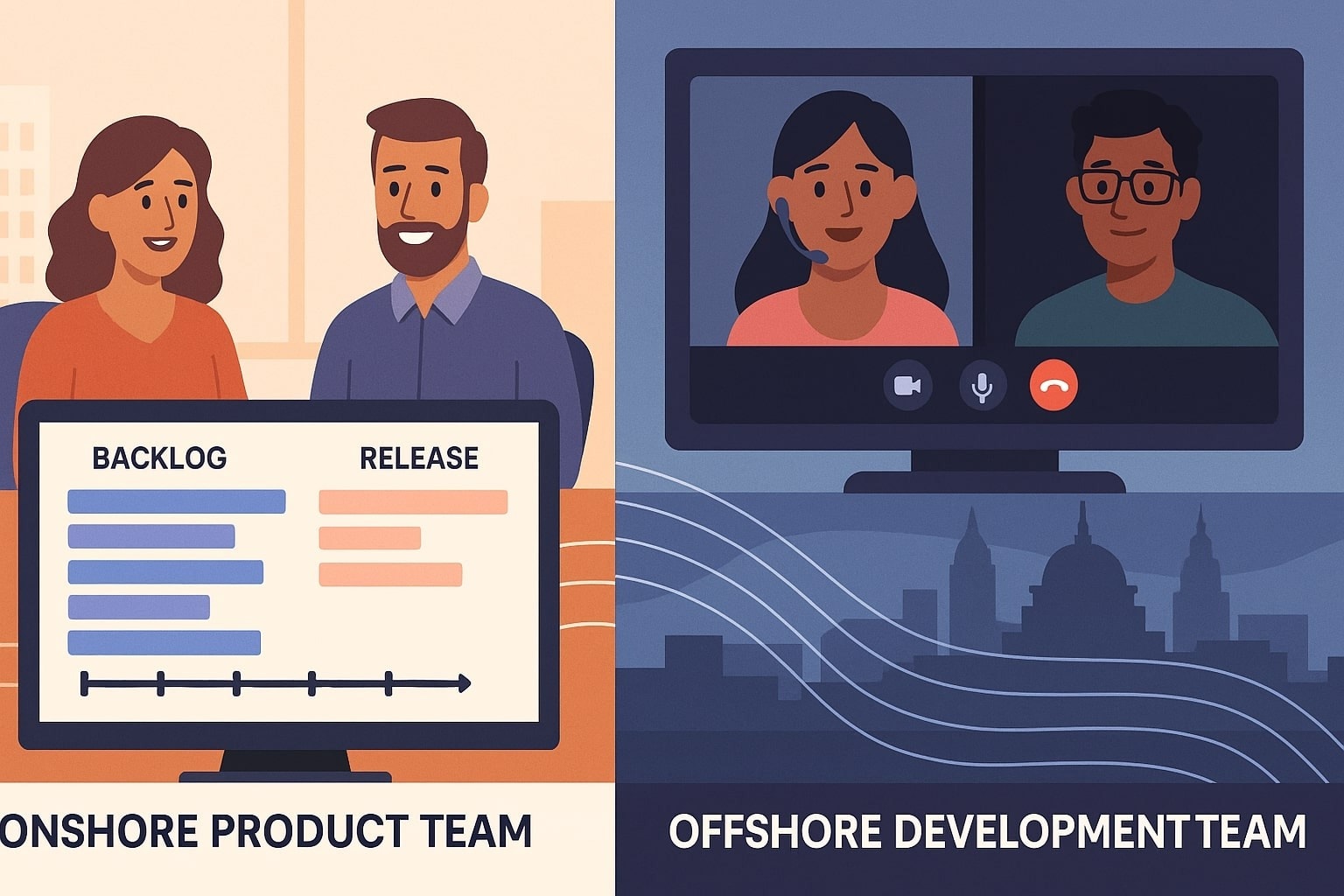
The key benefits of hiring offshore dedicated development teams are:
- Lower and more predictable development costs
- Access to rare or niche technical skills
- Faster release cycles and shorter lead times
- Better coverage across time zones and markets
- Increased resilience through distributed teams
These benefits compound over time as the offshore team gains deeper product knowledge.
One major advantage is that you can design the exact mix of roles you need. You may combine backend, frontend, QA, DevOps, and data specialists in one coherent unit. This balance makes delivery pipelines smoother and reduces bottlenecks.
Dedicated teams work especially well when combined with best practices for running agile with offshore teams.
Lower Total Cost of Ownership for Greater Cost Efficiency
Lower total cost of ownership comes from labor arbitrage, leaner office requirements, and efficient staffing. Offshore dedicated teams eliminate the need for physical office space, further reducing operational costs. You pay competitive local rates in offshore locations while keeping global quality standards. Over a year, this often frees the budget for new product experiments or marketing.
Access to Specialized Skills
Access to specialized skills is a major reason to choose offshore dedicated teams. Many regions have strong communities around specific technologies such as cloud-native development, cybersecurity, or data engineering. Offshore teams also offer diverse expertise, enabling access to a broad range of technical skills and knowledge across different fields.
You can hire experts in these areas faster than in crowded local markets, and benefit from skilled offshore developers as a key advantage.
Faster Time to Market
Faster time to market happens when a dedicated offshore team works in parallel with your core office. By leveraging time zone differences, you can enable continuous development cycles and achieve faster turnaround times, as work progresses even when your local team is offline. Backlog items move through design, build, and test more quickly because there is more capacity. In competitive industries, even a few weeks of speed advantage can influence market share.
Stronger Business Continuity
Stronger business continuity comes from geographical and organizational diversity. If one office faces disruptions, the offshore team can keep critical systems running. Offshore software engineers located in different regions ensure continuous support and rapid response to incidents, maintaining operations around the clock. This distributed model supports disaster recovery and reduces single-point-of-failure risks.
How to Reduce Development Costs With Offshore Dedicated Teams?
You reduce development costs with offshore dedicated teams by optimizing team structure, choosing cost-effective locations, and standardizing processes. The goal is to balance price with quality rather than chasing the lowest possible rate. Smart design can cut expenses while improving output.
Many companies treat offshore teams as long-term investments instead of short-term savings hacks. They focus on lifetime value, productivity, and retention. When teams stay together, the cost per feature or per release drops over time.
Optimize Team Structure for Value, Not Headcount
Optimizing team structure for value means building cross-functional squads that can deliver features independently. Dedicated team models enable efficient delivery by providing stable, integrated teams tailored to project needs, making them ideal for ongoing or large-scale development efforts with evolving requirements. You avoid scattered individuals who depend heavily on onshore staff for every decision. A balanced squad reduces coordination overhead and rework.
Leverage Cost-Effective Locations
Leveraging cost-effective locations allows you to pay fair local salaries while reducing overall spend. Regions with strong engineering education and growing tech ecosystems often offer the best balance. Partnering with providers who know these markets prevents hidden costs and attrition. Working with established offshore development centers in these regions provides access to reliable infrastructure and qualified teams, further enhancing efficiency and stability.
Standardize Processes and Tools
Standardizing processes and tools reduces waste and miscommunication. When every team uses the same coding standards, CI/CD pipelines, and documentation templates, handovers are smoother. Implementing standardized quality assurance processes is also essential to ensure consistent, high-quality deliverables across all teams. Time saved on coordination becomes direct cost savings.
Sample Cost Comparison Between Onshore and Offshore Teams
|
Cost Area |
Onshore In-House Team (Annual) |
Offshore Dedicated Team (Annual) |
Typical Savings Range |
|
Developer Salaries |
High |
Moderate |
30–50% |
|
Office and Facilities |
High |
Low |
40–60% |
|
Hiring and Onboarding |
High |
Shared with partner (offshore partners streamline the recruitment process, reducing both time and costs) |
20–40% |
|
Tools and Infrastructure |
Similar |
Similar |
0–10% |
|
Total Development Cost |
Baseline 100% |
Reduced |
25–45% overall |
What Talent Advantages Come With Hiring Offshore Development Teams?
The talent advantages that come with hiring offshore development teams include broader candidate pools, deeper tech stack coverage, and more resilient staffing. You are no longer limited to one city’s labor market. Instead, you tap multiple regions with complementary strengths.
Offshore teams also help you design better succession plans. When knowledge is spread across locations, it becomes easier to cover departures or extended leave. Over time, this creates a healthier engineering organization.
Reach Wider Talent Pools
Reaching wider talent pools makes it easier to staff urgent or niche roles. You can find developers experienced in specific frameworks, domains, or tools that are rare locally. By accessing global talent, businesses can hire remote software developers from around the world, ensuring a diverse range of expertise and perspectives. This leads to richer discussions and more innovative solutions on complex projects.
With knowledge spread across multiple locations, offshore developers become a key part of this distributed model, bringing cost advantages and scalability to your team.
Strengthen Tech Stack Coverage
Strengthening tech stack coverage means having specialists for each layer of your architecture. For example, offshore squads might provide strong data engineers while local teams focus on product and UX. Offshore teams bring technical expertise to handle complex technology stacks, ensuring high-quality, scalable, and innovative solutions. Together, they cover backend, frontend, cloud, and analytics without overloading any one group.
Build Follow-the-Sun Expertise
Building follow-the-sun expertise lets your organization operate almost 24/7. Engineers in different regions can handle incidents, deployments, and customer escalations in their own business hours. By leveraging a remote team structure, you enable continuous operations and global responsiveness. This model improves responsiveness and reduces burnout from night shifts.
Read how to work with offshore teams for cultural and communication tips that support dedicated setups.
How Do Offshore Teams Improve Scalability and Flexibility?
Offshore teams improve scalability and flexibility by allowing you to adjust engineering capacity without heavy structural changes. You can scale squads up when demand spikes and scale down after peak periods. This agility is crucial when product roadmaps shift quickly.
Scalability also means you can launch new product lines without disrupting existing ones. Instead of stretching the same team across many initiatives, you spin up new offshore squads with clear mandates. This keeps focus and quality high.
Scale Headcount Up or Down Responsively
Scaling headcount up or down responsively helps match spend to revenue. When you secure a large client or launch a new feature set, you add engineers. This flexibility allows you to allocate development tasks efficiently, ensuring the right resources are assigned to match project demands. When a project completes, you reduce capacity without complex layoffs in your home market.
Test New Products and Markets Safely
Testing new products and markets becomes safer when offshore teams handle prototypes and experiments. You can run pilots, gather data, and iterate without hiring a large permanent team. If the idea works, you expand; if not, you pivot with minimal sunk cost. Offshore teams are also ideal for long term projects that require sustained collaboration and expertise, making them suitable for ongoing development with evolving requirements.
Support Seasonal or Project-Based Demand
Supporting seasonal or project-based demand is easier with a flexible offshore model. Industries such as retail, travel, and fintech often see periodic surges. Offshore squads can absorb these surges, allowing in-house teams to maintain steady workloads. Offshore teams can also adapt to varying levels of project complexity, ensuring the right expertise is available for each project phase.
How Can Offshore Dedicated Teams Accelerate Software Delivery?
Offshore dedicated teams accelerate software delivery by enabling parallel workstreams, maintaining deep product context, and investing in automation. With the right setup, features move smoothly from idea to production across time zones. This acceleration helps companies respond quickly to customer feedback.
Speed is not about rushing. It is about removing friction in planning, building, testing, and deploying. Offshore teams that understand your architecture and business rules become expert at shipping small, safe increments.
Parallel Workstreams Across Time Zones
Parallel workstreams across time zones mean that progress continues while one office sleeps. This model accelerates software development cycles and improves delivery speed. User stories can move from design in one region to implementation in another. This shortens cycle time and increases throughput.
Stable Teams With Product Context
Stable teams with product context make fewer mistakes and require less supervision. Because they stay with the same codebase, they understand edge cases and hidden dependencies. This knowledge lets them estimate better and avoid rework. A dedicated software development team maintains deep product knowledge, which helps deliver higher quality outcomes.
Automation and DevOps Practices
Automation and DevOps practices enable frequent, reliable releases. Offshore engineers often manage CI/CD pipelines, automated testing, and infrastructure as code. These practices reduce manual work and keep delivery fast regardless of location. They are also integral to effective software engineering in offshore teams, ensuring comprehensive and scalable technical solutions.
What Productivity Benefits Can Offshore Teams Provide?
Offshore teams provide productivity benefits such as longer daily coverage, clearer ownership, and stronger process discipline. When designed well, they do not replace local teams; they free them to focus on high-value work. Both sides gain from this partnership.
Productivity gains often show up in metrics like cycle time, throughput, and defect rates. Leaders see more features shipped per quarter without burning out employees.
Longer Daily Coverage for Support and Development
Longer daily coverage means bugs and incidents can be addressed within hours instead of days. Offshore squads handle tasks during their day while onshore teams rest. This allows local teams to focus on core business priorities, such as product innovation and customer experience, rather than being tied up with technical issues. This continuous flow reduces wait times and keeps backlogs under control.
Clear Ownership and Focus
Clear ownership and focus arise when offshore teams own specific modules or services. They become experts in these areas and can make decisions quickly. Local teams then focus on strategy, customer interviews, and high-level architecture. This allows the internal team to dedicate more time to innovation and customer engagement.
Process Discipline and Measurable Outputs
Process discipline and measurable outputs come from defined ceremonies, SLAs, and KPIs. Offshore teams often adopt structured Agile practices to stay aligned with clients. This discipline ensures reliable development services and measurable results. Over time, this creates predictable delivery patterns and reliable performance data.
FAQs About Hiring Offshore Dedicated Development Teams
1. How Do You Communicate Effectively With Offshore Teams?
You communicate effectively with offshore teams by setting clear channels, cadences, and response expectations. Use video calls for key ceremonies, chat for quick questions, and shared documents for decisions. Written summaries ensure everyone stays aligned even when they miss a meeting.
2. How Do You Maintain Quality With Offshore Development?
You maintain quality with offshore development by enforcing shared coding standards, automated tests, and code reviews. Quality gates in CI pipelines catch defects before they reach production. Regular retrospectives help both sides refine practices and reduce recurring issues.
3. What Types of Projects Fit Best With Offshore Dedicated Teams?
Projects with ongoing roadmaps, multiple releases, and evolving requirements fit best with offshore dedicated teams. Platform builds, product suites, and complex integrations benefit from stable long-term squads. Very short, one-off tasks often suit simple outsourcing rather than dedicated teams.
4. How Long Does It Take to Onboard an Offshore Team?
Onboarding an offshore team usually takes four to eight weeks to reach steady productivity. The first weeks cover environment setup, domain training, and process alignment. After two or three sprints, velocity becomes more predictable.
5. Are Offshore Teams Safe for Sensitive Data and IP?
Offshore teams are safe for sensitive data and IP when you use strong contracts, access controls, and compliance standards. Limit access to only the systems each role needs, and log all changes. Many offshore partners follow strict security certifications to protect client assets.