


Onshore and offshore software engineering teams differ in location, cost structure, time-zone overlap, and the operating model required to deliver consistently. Onshore teams work in the same country as the hiring company, while offshore teams work from another country and collaborate remotely across borders. The better choice depends on product phase, required speed of decision-making, budget constraints, and process maturity.
Both models can produce excellent quality when ownership is clear and engineering standards are enforced. Both models can fail when requirements are vague and decision rights are unclear. The practical comparison is not geography versus geography; it is execution design versus execution design.
India remains one of the most popular destinations for offshore software engineering due to its deep talent pool and cost efficiency. Many companies choose to hire offshore dedicated software development teams in india to balance quality, speed, and long-term engineering ownership.
Why Compare Onshore and Offshore Software Engineering Teams?
Comparing onshore and offshore software engineering teams matters because the choice changes speed, risk, and total cost over multiple release cycles. The team model influences how quickly hiring scales, how decisions flow, and how reliably work ships with consistent quality. A clear comparison also prevents short-term cost decisions from creating long-term operational debt.
The Delivery Model Shapes Risk More Than Talent Does
The delivery model shapes risk because coordination patterns define how fast blockers get resolved and how often rework occurs. Offshore delivery becomes predictable when interfaces are stable and requirements are written clearly. Onshore delivery becomes predictable when stakeholders protect focus and avoid constant priority changes.
The Choice Impacts Hiring Speed and Scale Limits
The choice impacts hiring speed because local markets can become saturated for specific skills. Offshore hiring often expands the accessible talent pool, which can reduce time-to-hire for certain roles. Onshore hiring can still be fast in strong markets, but competition tends to push cost and attrition upward.
The Model Affects Compliance, Security, and Audit Burden
The model affects compliance because cross-border employment and contracting introduce different legal obligations. Security posture also changes because access, device controls, and data-handling policies must remain consistent across locations. A comparison should include these operational realities, not only hourly rates.
A Practical View From Flexiple’s Delivery Playbook
Flexiple’s delivery playbook frames the decision as an operating choice: “Teams scale when ownership is stable and decisions are fast.” This principle reflects a repeatable pattern seen in distributed programs. The quote is attributed to Flexiple’s Engineering Operations team and is used internally to guide onboarding.
Choosing between onshore and offshore teams depends heavily on how well the offshore model is structured. When companies hire dedicated offshore teams, they gain better cost control, faster scaling, and access to global engineering talent. This approach makes offshore collaboration feel far closer to an in-house experience.
What Is the Difference Between Onshore and Offshore Software Engineering Teams?
The difference between onshore and offshore software engineering teams is that onshore teams are located in the same country as the hiring organization, while offshore teams operate from another country and collaborate across borders. This difference changes time-zone overlap, payroll and legal setup, and how collaboration must be structured. The core engineering work can be identical, but the system around the work often differs.
Location Changes Stakeholder Access and Decision Speed
Location changes stakeholder access because onshore engineers often share more working hours with product, design, and customer-facing teams. This increases real-time alignment and can reduce decision delays during ambiguous work. Offshore teams can match decision speed when overlap windows and escalation paths are designed explicitly.
Employment and Contracting Models Differ More Offshore
Employment and contracting models differ because offshore teams may be hired through a local entity, an Employer of Record, direct employment in the offshore country, or contractor arrangements. Each model changes payroll handling, benefits expectations, and compliance ownership. Onshore teams typically operate under simpler local employment rules.
Offshore Execution Requires Stronger Written Interfaces
Offshore execution requires stronger written interfaces because partial overlap increases the cost of missing context. Clear acceptance criteria, defined APIs, and decision logs reduce repetitive clarification loops. Onshore teams benefit from the same discipline, but offshore setups rely on it more heavily.
Offshore Can Be Integrated or Outsourced, and the Difference Matters
Offshore can be integrated or outsourced, and the difference matters because “offshore” describes geography, not ownership. An integrated offshore team owns outcomes and participates in planning, reviews, and on-call. An outsourced team often receives tasks with limited context and limited decision rights, which usually increases rework.
How Do Cost Structures Differ Between Onshore and Offshore Software Engineering Teams?
Cost structures differ because compensation bands, benefits, payroll taxes, and overhead vary by country, and because offshore delivery introduces additional coordination and compliance costs. The most accurate comparison is total cost of delivery, not base salary alone. Total cost includes management time, tooling, quality control, and the cost of rework.
Direct Labor Cost Often Differs by Market, Not by Skill Ceiling
Direct labor cost often differs because local market dynamics shape compensation expectations. High-cost markets typically require higher base salaries and benefits packages. Offshore markets can offer lower cost for comparable experience, though top offshore talent still commands premium compensation.
Indirect Costs Shift Between Categories
Indirect costs shift because onshore teams often carry higher office, benefits, and local recruiting costs, while offshore teams often carry higher onboarding, documentation, and cross-border payroll operations costs. Offshore programs may also add vendor management or security tooling overhead. These costs usually drop after the operating model stabilizes.
The Most Important Cost Variable Is Rework
Rework is the most important variable because it converts saved labor cost into wasted delivery time. Rework increases when requirements are unclear, edge cases are missing, or ownership boundaries shift frequently. Reducing rework typically produces a larger cost improvement than changing payment rails or negotiating small vendor discounts.
Total Cost Comparison Table
|
Cost Element |
Onshore Teams (Typical Pattern) |
Offshore Teams (Typical Pattern) |
What Moves the Number Most |
|
Base Compensation |
Higher |
Lower to moderate |
Role leveling and market calibration |
|
Benefits and Payroll Burden |
Higher, simpler |
Varies by model and country |
Employment model selection |
|
Recruiting and Time-to-Hire |
High in competitive hubs |
Often faster in larger pools |
Funnel quality and process speed |
|
Management Overhead |
Moderate |
Moderate to higher early |
Clarity of ownership and autonomy |
|
Coordination and Documentation |
Lower baseline |
Higher baseline |
Templates and decision discipline |
|
Compliance and Payroll Operations |
Lower complexity |
Higher complexity |
EOR vs entity vs contractor governance |
|
Quality Costs (Bugs, Incidents) |
Depends on standards |
Depends on standards |
CI, review rigor, test coverage |
|
Rework and Churn Risk |
Depends on clarity |
Depends on clarity |
Requirements quality and decision speed |
Engineering teams that follow best practices for running agile with offshore teams often experience fewer coordination issues than fully onshore setups.
What Skill Differences Exist Between the Two Models?
Skill differences between onshore and offshore models appear mostly as distribution differences, not capability limits. Onshore teams often have faster access to business context and stakeholder intent. Offshore teams often provide wider access to certain specializations due to larger or more concentrated talent pools in specific regions. Both models support senior technical leadership when hiring standards are high.
Domain Context Tends to Accumulate Faster Onshore
Domain context tends to accumulate faster onshore because product discussions, customer feedback, and informal alignment happen more naturally in shared time zones. Offshore teams build the same depth when product narratives, roadmap context, and decision records are shared consistently. Context becomes a system input rather than a proximity benefit.
Specialization Availability Varies by Regional Ecosystems
Specialization availability varies because some regions produce dense talent in certain stacks such as mobile engineering, QA automation, cloud infrastructure, or data platforms. This affects hiring speed for specific roles. A skill map tied to the product roadmap usually prevents mismatches.
Seniority Mix Changes With Market Supply
Seniority mix changes because some onshore markets have tighter supply of experienced engineers for specific domains. Some offshore markets have strong supply at the senior level, especially in global product ecosystems. A balanced mix matters because senior engineers stabilize standards and reduce rework.
Flexiple’s hiring standardization rule is framed as an operating constraint: “A senior hire is proven by ownership stories, not by years.” This quote is attributed to Flexiple’s Screening and Evaluation team and is used in scorecards to reduce false positives across geographies.
How Does Communication Compare in Onshore vs. Offshore Software Teams?
Communication differs because onshore teams usually share more working hours with stakeholders, while offshore teams often operate with partial overlap. This changes how quickly questions get answered and how decisions are recorded. The best offshore communication patterns increase written clarity and reduce meeting dependency.
Offshore Communication Leans More on Asynchronous Clarity
Offshore communication leans more on asynchronous clarity because daily progress cannot depend on real-time conversations. Well-written tickets, structured updates, and searchable decisions reduce delays. This approach also scales better as headcount grows.
Onshore Communication Can Solve Ambiguity Faster, With a Tradeoff
Onshore communication can solve ambiguity faster because stakeholders can align in the moment. The tradeoff is meeting expansion and context switching, which can reduce deep work time. Strong onshore teams use the same written clarity to avoid turning alignment into constant interruption.
Decision Latency Is the Practical Metric
Decision latency is the practical metric because it determines how long work sits idle. Offshore teams usually need a defined escalation path to keep decision latency low outside overlap windows. Onshore teams usually need a defined decision owner to prevent decisions from drifting across meetings.
A Simple Communication Operating Agreement
A simple operating agreement stabilizes communication when it defines response expectations and decision recording. Flexiple often uses the principle: “If a decision changes scope, it is written once and referenced forever.” The quote is attributed to Flexiple’s Program Management practice and is used to prevent repeated re-explanation across time zones.
Which Model Is Better for Productivity: Onshore or Offshore Software Engineering Teams?
Neither model is inherently more productive; productivity depends on clarity, autonomy, and how well the work is structured. Onshore teams tend to be more productive during high-ambiguity phases where rapid iteration and continuous alignment are needed. Offshore teams tend to be more productive during execution phases where work can be parallelized with stable interfaces and clear acceptance criteria.
Onshore Often Wins During Discovery and Fast Pivots
Onshore often wins during discovery because feedback loops are tight and decision-making is immediate. This matters when product assumptions are still being tested and priorities shift weekly. The productivity advantage comes from reduced waiting, not from higher individual skill.
Offshore Often Wins During Modular Execution and Sustained Build
Offshore often wins during modular execution because stable ownership and clear interfaces allow parallel workstreams. Productivity rises when backlog items are well-scoped and engineering standards are enforced. Offshore delivery also supports extended coverage when handoffs are disciplined.
Productivity Drops When Ownership Is Fragmented
Productivity drops when ownership is fragmented because work becomes dependent on repeated approvals and unclear boundaries. This happens in both models, but it becomes more visible in offshore setups due to time-zone friction. Stable ownership is usually the fastest path to higher throughput.
Flexiple’s Original Productivity Scorecard for Distributed Teams
Flexiple uses an internal scorecard to predict productivity fit without relying on stereotypes. The scorecard rates five factors from 1 to 5: scope clarity, dependency count, required real-time collaboration, security sensitivity, and senior leadership availability. Higher total scores favor offshore execution, while lower scores favor onshore execution during that phase. This scorecard is original operational analysis intended for planning.
How to Choose Between Onshore and Offshore Software Engineering Teams?
Choosing between onshore and offshore teams requires matching product phase, risk tolerance, and operating maturity to a team model with clear ownership. The most reliable choice is the one that reduces the most likely failure mode for the current phase. Many organizations choose a hybrid model that assigns discovery-heavy work onshore and execution-heavy work offshore with clean interfaces.
A Step-by-Step Selection Process
A step-by-step process improves outcomes because it forces clarity on what the team must own and how success will be measured.
- Define the dominant work type for the next 90 days: discovery, iteration, platform build, or maintenance.
- Map dependencies: number of teams, systems, approvals, and external stakeholders involved.
- Decide the engagement model: direct employment, EOR, local entity, or contractors.
- Choose ownership boundaries: services, modules, or product areas that can be owned end-to-end.
- Set overlap expectations and escalation rules to control decision latency.
- Standardize quality gates: code review rules, CI requirements, testing minimums, and release checks.
- Pilot with a single pod for two release cycles and evaluate rework, cycle time, and incident rate.
- Scale only after ownership remains stable and delivery metrics stay consistent.
The One Bullet List of Decision Factors That Should Not Be Skipped
- Product phase stability across the next 90 days
- Required time-zone overlap for key decisions
- Clarity of module boundaries and API contracts
- Availability of senior engineering leadership for standards and reviews
- Compliance model preference: entity, EOR, or contractor governance
- Security constraints tied to data access and deployment rights
- Tolerance for coordination overhead in exchange for cost advantage
Hybrid Models Often Perform Best at Scale
Hybrid models often perform best because they place high-ambiguity work close to stakeholders while scaling execution through offshore ownership. The model works when boundaries are explicit and work does not bounce between locations. The model fails when both teams share responsibility for the same surface without clear decision rights.
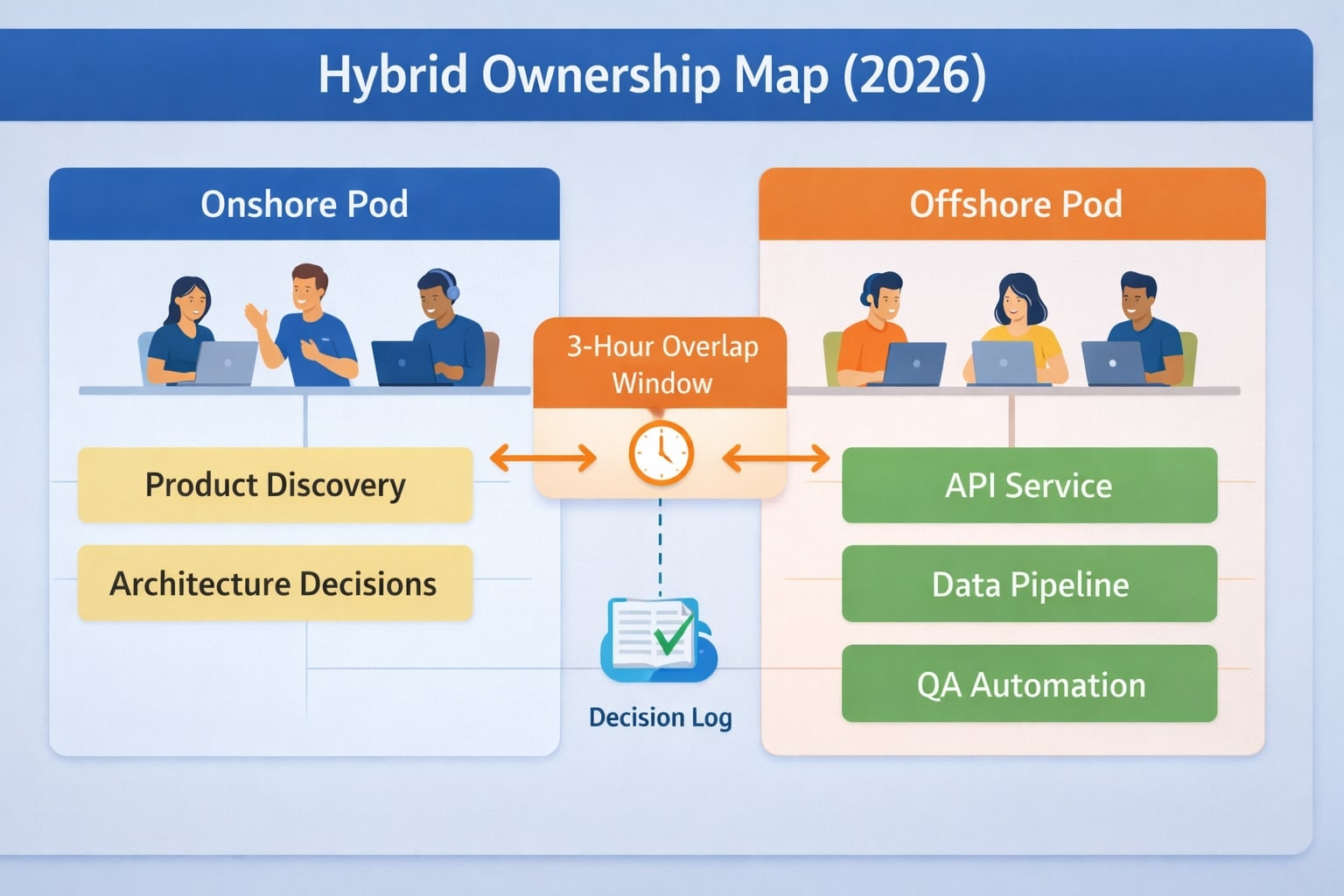
When comparing cost, scalability, and long-term ownership, the benefits of hiring offshore dedicated development teams often outweigh traditional onshore hiring models.
Onshore vs Offshore Software Engineering Teams: Choosing the Right Development Model
When deciding between onshore and offshore software development, businesses must carefully evaluate their development model, team structure, and overall software development strategies. Onshore software development teams work within the same country and time zone, offering seamless communication, minimal language barriers, cultural alignment, and closer collaboration. This supports real-time collaboration, stronger quality control, and faster responses during complex projects. Onshore development services also align more naturally with local business hours, local laws, and regulatory compliance, which helps protect intellectual property and ensures international data protection regulations are met.
Offshore software development, on the other hand, provides access to a broader global talent pool, specialized skills, and significant cost savings. Offshore development teams and offshore developers help reduce development cost and enable businesses to scale faster while maintaining technical expertise. However, offshore software development teams may face challenges such as time zone differences, communication barriers, language barriers, cultural differences, and potential communication and reporting delays. Clear communication strategies, strong project management tools, and flexible project management approaches are essential to manage offshore teams effectively.
A hybrid onshore and offshore development model can combine the strengths of both onshore and offshore teams. This approach supports agile software development, enhances quality control processes, improves project management, and balances cost efficiency with effective oversight. Ultimately, choosing the right development process depends on project complexity, business practices, software development tasks, and the need for quality assurance, real-time collaboration, and reliable offshore development services.
FAQs About Onshore vs. Offshore Software Engineering Teams
1.Is offshore development lower quality than onshore development?
Offshore development is not inherently lower quality than onshore development. Quality is driven by standards such as code review rigor, CI gates, test coverage, and stable ownership. Weak process produces weak outcomes in any geography.
2.Does offshore always reduce total cost?
Offshore does not always reduce total cost, even when it reduces direct labor cost. Total cost depends on coordination overhead, compliance setup, rework rates, and retention stability. A productivity-adjusted cost view usually produces the most accurate conclusion.
3.Which model ships faster for new product work?
Onshore teams usually ship faster for new product work when requirements are still evolving and decisions change frequently. Offshore teams ship faster when work is well-scoped and interfaces are stable enough to parallelize. Speed is mainly controlled by decision latency and clarity.
4.What work fits offshore teams best?
Offshore teams fit best for modular execution such as owning services, maintaining platforms, building QA automation, and delivering roadmap slices with clear acceptance criteria. The fit improves when the team owns a surface end-to-end across multiple release cycles. The fit weakens when the work is primarily ambiguous discovery.
5.Can an organization start offshore-first and add onshore later?
An organization can start offshore-first and add onshore later when ownership boundaries and quality standards are defined early. The transition succeeds when documentation and decision logs already exist as habits. The transition becomes painful when early shortcuts become permanent and rework becomes the default.