


Effective strategies for offshore BPO teams focus on clear communication, structured processes, and smart use of technology to deliver consistent results. When you treat offshore BPO centers as strategic partners rather than cost centers, you unlock higher quality, better customer experience, and stable margins.
Offshore BPO operations now handle complex tasks like customer success, finance operations, and technical support. To keep performance high across geographies, leaders must design how work flows, how teams talk, and how success is measured. This article explains why strategy matters, what the most effective strategies are, and how to implement them in day-to-day operations.
Effective BPOs invest in continuous training offshore teams to keep service quality consistent.
Why Effective Strategies Matter for Offshore BPO Teams?
Effective strategies matter for offshore BPO teams because they directly determine service quality, client satisfaction, and long-term profitability. Without a clear strategy, even skilled agents struggle under unclear expectations and inconsistent workflows.
Offshore BPO providers often work across 3 or more regions, strict SLAs, and complex compliance requirements. A strong strategy aligns recruitment, training, scheduling, quality assurance, and technology around the same goals. When this alignment exists, teams meet SLAs more reliably, reduce rework, and create better experiences for end customers.
Strategic clarity also helps reduce attrition. Agents who know why their work matters, how they are measured, and how they can grow feel more engaged. In 2026, where customer expectations are high and labor markets are competitive, this engagement becomes a key differentiator for offshore BPO operations.
What Are the Most Effective Strategies for Offshore BPO Teams?
The most effective strategies for offshore BPO teams combine outcome-focused management, strong governance, and a culture of continuous improvement. These strategies give teams a clear north star and a practical path to reach it.
-
Anchor everything on customer and client outcomes
Define 3–5 core outcomes such as first-contact resolution, average handling time, customer satisfaction, and compliance accuracy. Align hiring profiles, training content, dashboards, and incentives with these outcomes so everyone focuses on the same targets. -
Design a clear operating model and governance structure
Decide which work stays onshore, which moves offshore, and how handoffs happen. Set up governance forums—weekly operations reviews, monthly performance reviews, and quarterly strategy sessions—to keep leaders aligned. -
Create a culture of ownership and accountability
Give team leads in India, the Philippines, or other locations real decision-making authority over staffing, scheduling, and local improvements.
When offshore leaders own metrics, they proactively solve problems instead of waiting for instructions. -
Invest in robust quality assurance and coaching
Use calibrated QA scorecards, regular call or ticket reviews, and structured coaching sessions.
Focus feedback on specific behaviors agents can change, such as empathy statements, verification steps, or closing scripts. -
Leverage automation and AI where it adds value
Use chatbots, self-service portals, and AI-assisted responses to handle simple queries or suggest next best actions.
Free human agents to focus on complex interactions that require judgment and empathy. -
Plan for risk, compliance, and business continuity
Document contingency plans for power outages, network issues, or sudden volume spikes.
Regularly test backup sites, remote-work setups, and data-security procedures so clients feel confident in your resilience.
Communication and Workflow Alignment Strategies
Communication and workflow alignment strategies ensure every offshore BPO team member understands what to do, when to do it, and how to ask for help. Clear communication reduces errors, escalations, and repeated work.
Start by defining which channels handle which types of communication. For example, use chat tools for quick clarifications, ticketing systems for work items, and scheduled meetings for performance and planning. This structure prevents confusion about where to log tasks or where to raise issues.
Create detailed but practical workflow guides for each process. These guides should describe triggers, steps, decision points, and escalation paths. Use flowcharts, checklists, and sample tickets or call scripts so agents can quickly understand what “good” looks like.
Consider these focused tactics:
- Use daily huddles of 10–15 minutes for each team to review targets, volume forecasts, and blockers.
- Maintain a central “playbook” for each client process, updated whenever procedures change.
- Encourage “closed-loop communication,” where the receiver repeats key instructions in their own words to confirm understanding.
Aligning expectations across cultures is covered in best practices for cultural alignment in offshore teams.
How to Improve Productivity in Offshore BPO Teams?
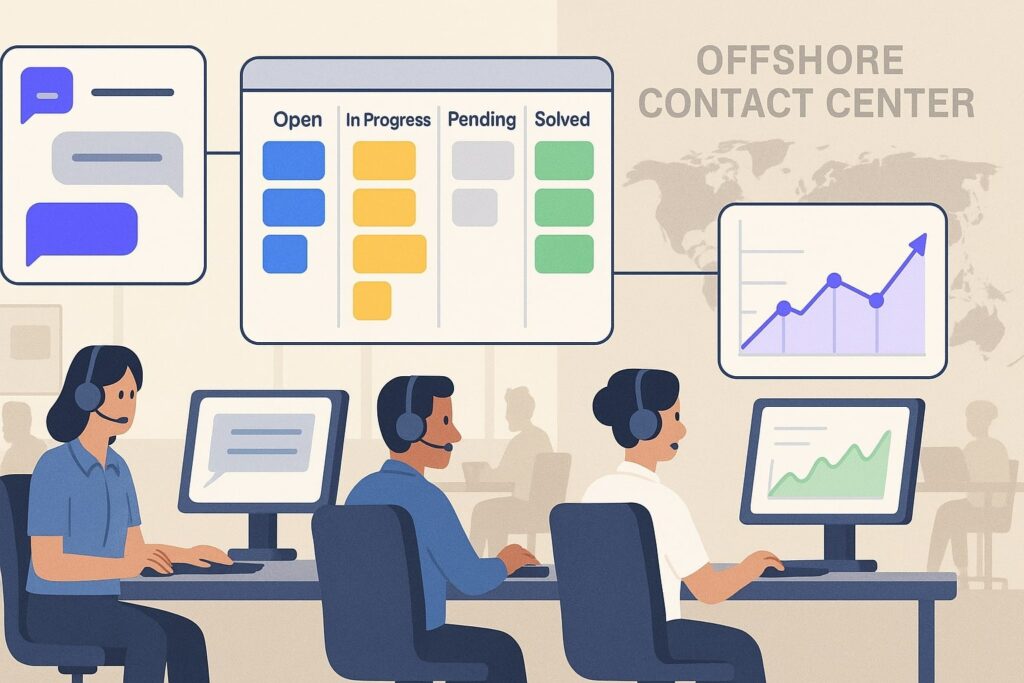
You improve productivity in offshore BPO teams by focusing on process efficiency, smart staffing, and supportive performance management. Productivity is not just about doing work faster; it is about doing the right work in the right way.
Begin by mapping end-to-end processes and identifying 3–5 common bottlenecks, such as long verification steps, repeated data entry, or unclear approvals. Use lean methods to remove waste, standardize best steps, and automate routine actions. Even small changes, like pre-populated forms or better knowledge-article search, can save seconds per interaction that accumulate across thousands of cases.
Next, align staffing levels with demand patterns through workforce management practices. Analyze hourly and daily volume trends and adjust schedules, break patterns, and skill groups accordingly. Well-tuned schedules reduce idle time during slow periods and minimize long queues during peaks.
A simple comparison can clarify the shift from traditional to modern productivity practices:
| Aspect | Traditional BPO Productivity | Modern Offshore BPO Productivity |
| Focus | Hours worked | Outcomes per hour (resolved tickets, sales, etc.) |
| Measurement | Basic handle time and occupancy | Balanced metrics: quality, speed, satisfaction |
| Tooling | Manual spreadsheets | Real-time dashboards and workforce tools |
| Improvement Approach | Occasional initiatives | Continuous small experiments and refinements |
Finally, support agents with the right environment. Provide good headsets, ergonomic setups, stable connectivity, and easy access to supervisors. A comfortable, well-supported agent handles interactions more efficiently and with better attitude.
Technology and Tools for Managing Offshore BPO Operations
Technology and tools for managing offshore BPO operations provide the backbone that keeps global teams synchronized, measured, and efficient. In 2026, high-performing BPO organizations rely on integrated stacks rather than isolated systems.
Core tool categories include:
-
Contact handling platforms
These handle voice, chat, email, and social messages in a single interface.
Omnichannel routing ensures customers reach the right agent with the right skills, regardless of location. -
Customer relationship and case management systems
These store customer history, tickets, and past interactions in one place.
Agents can see context immediately, reducing time spent asking repeated questions. -
Workforce management and scheduling tools
These forecast volumes, plan shifts, and handle intraday adjustments.
Accurate forecasts help offshore centers match staffing to demand and protect SLAs. -
Quality monitoring and speech or text analytics
These record interactions and analyze them for compliance, sentiment, and keywords.
Supervisors can quickly spot coaching opportunities and emerging issues. -
Knowledge bases and agent-assist tools
These provide step-by-step guides, FAQs, and dynamic prompts during live interactions.
Knowledge tools reduce training time and ensure agents follow the latest procedures.
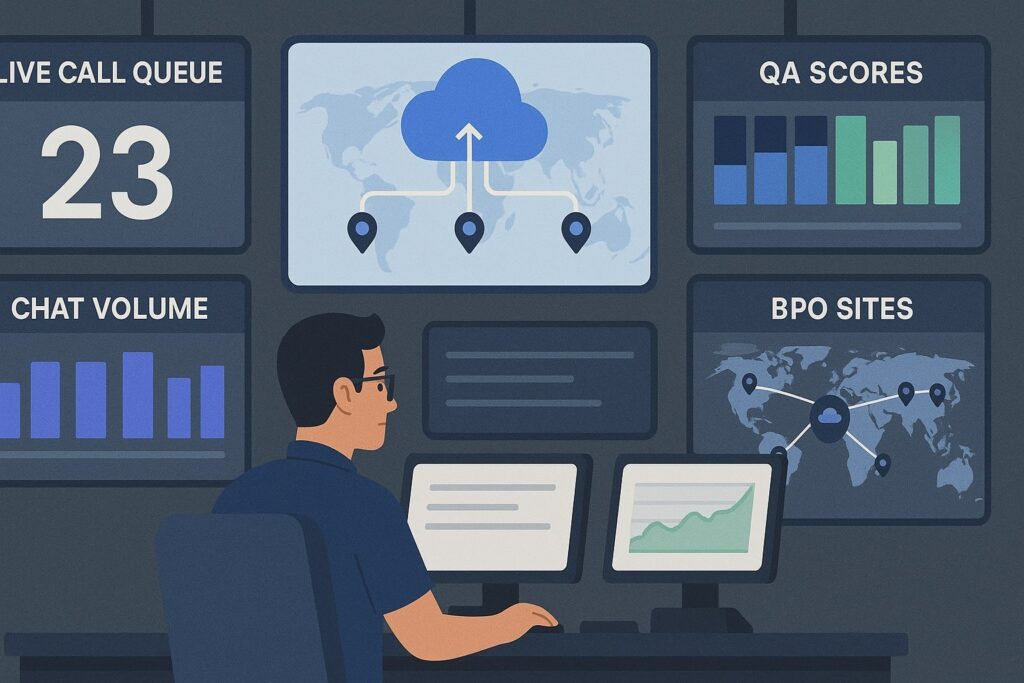
When choosing tools, prioritize integration, usability, and reporting. A smaller, well-integrated stack is better than a large set of disconnected platforms. Always involve frontline agents and supervisors in tool evaluations, since they use the systems daily and can spot practical issues early.
For a broader perspective, you can read Hiring offshore teams.
Tips for Training and Process Standardization for Offshore BPO Teams
Tips for training and process standardization for offshore BPO teams focus on building skills quickly and ensuring every agent follows the same proven steps. Strong training and standardization protect quality even as teams grow.
Building a Modern Training Framework
A modern training framework for offshore BPO teams typically includes 5 parts: hiring profiles, classroom training, simulations, nesting, and continuous learning. Start by defining clear hiring criteria that match client processes, such as language level, typing speed, or domain knowledge.
Deliver training in a blended format, combining instructor-led sessions, e-learning modules, role plays, and system walk-throughs. Use real call recordings, actual ticket examples, and realistic scenarios so new hires experience common edge cases before going live. After initial training, move agents into a “nesting” phase where they take live interactions with extra support from floor-walkers.
Standardizing Processes and Documentation
Process standardization means capturing the best way to do work and making it easy to follow. Create standard operating procedures (SOPs) for each type of interaction, including pre-call checks, verification, issue resolution, and closing.
To keep SOPs practical:
- Use clear headings, numbered steps, and screenshots rather than dense text.
- Review and update SOPs every quarter or whenever clients change policies.
- Tie QA scorecards directly to SOP steps, so agents see how following the process affects their scores.
Regular refresher training sessions reinforce critical topics like security, compliance, and soft skills. Microlearning modules of 5–10 minutes help reinforce knowledge without long breaks from production.
Time Zone Management Approaches for Offshore BPO Teams
Time zone management approaches for offshore BPO teams determine how you offer round-the-clock coverage without burning out staff. Thoughtful time zone planning protects both service levels and employee wellbeing.
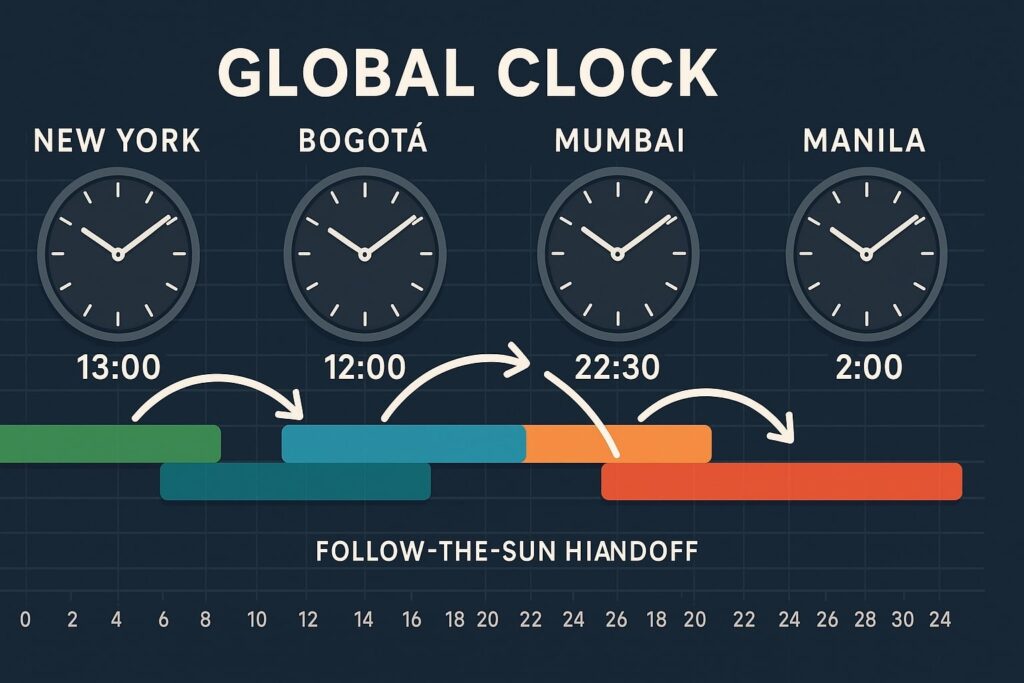
One common approach is the follow-the-sun model, where different sites handle different time bands. For example, a center in Manila may handle daytime hours for Asia-Pacific, while a center in Bogotá covers Americas evenings. Clear handover notes and shared systems ensure customers experience a seamless service, even as teams change.
Another approach is the hub-and-spoke model, where a primary site manages most volume while secondary sites handle peaks, weekends, or specialized queues. This model works well when one location has a very strong talent pool and infrastructure but needs backup coverage for resilience.
Practical tips for better time zone management include:
- Create shift patterns that rotate fairly and respect regional labor laws.
- Use shared calendars and clear meeting norms so people know which hours are protected and which are collaborative.
- Automate handover reports at the end of each shift, summarizing open tickets, critical incidents, and pending approvals.
When possible, avoid scheduling frequent meetings outside regular working hours for the same group. If occasional late or early meetings are necessary, offer time-off adjustments or flexible arrangements to keep teams motivated.
FAQs About Effective Strategies for Offshore BPO Teams
1. How do I decide which processes to move offshore?
Start with stable, well-documented processes that have high volume and clear metrics, such as customer support, billing queries, or basic technical troubleshooting. Move complex or high-risk processes only after building trust and maturity with the offshore partner.
2. How long does it take to stabilize a new offshore BPO team?
Most organizations see stable performance within 3–6 months if they invest in strong training, clear SOPs, and daily governance. Complex, regulated processes may take closer to 9–12 months to reach full maturity.
3. How can I keep offshore teams engaged and reduce attrition?
Offer competitive compensation, growth pathways, recognition programs, and opportunities to handle more complex work over time. Regular feedback, career conversations, and visible appreciation from client stakeholders also play a big role.
4. What metrics should I track to know if strategies are working?
Track a balanced set of metrics, including customer satisfaction, first-contact resolution, quality scores, productivity indicators, and employee engagement. Review these at least monthly and tie corrective actions to specific owners.
5. How do I ensure data security in offshore BPO operations?
Combine strong technical controls—like secure networks, access management, and device policies—with strict process controls, such as clean-desk rules and restricted printing. Reinforce security awareness through regular training and targeted audits.
6. Can offshore BPO teams handle higher-value work, not just basic tasks?
Yes, offshore teams now manage complex functions like fraud detection, financial operations, and advanced technical support. The key is to invest in deeper training, domain specialists, and closer collaboration with onshore subject-matter experts.
By applying these strategies with discipline and empathy, offshore BPO teams in 2026 become trusted partners that protect margins, delight customers, and support long-term business growth.
