


Typical onboarding timelines for offshore teams range from 2 weeks for basic integration to 8–12 weeks for full productivity on complex product surfaces. The timeline depends on access setup, clarity of ownership, documentation maturity, and how well offshore teams are integrated into the same delivery system as onshore teams. Offshore onboarding moves fastest when the organization treats onboarding like a product workflow with defined inputs, milestones, and measurable outcomes.
Onboarding timelines matter because offshore hiring only creates value after teams can ship reliably with low rework. Many offshore programs underperform not because the engineers lack skill, but because onboarding is unstructured, access provisioning is slow, and expectations are unclear. A clear onboarding timeline prevents confusion, protects sprint plans, and reduces the hidden cost of ramp time.
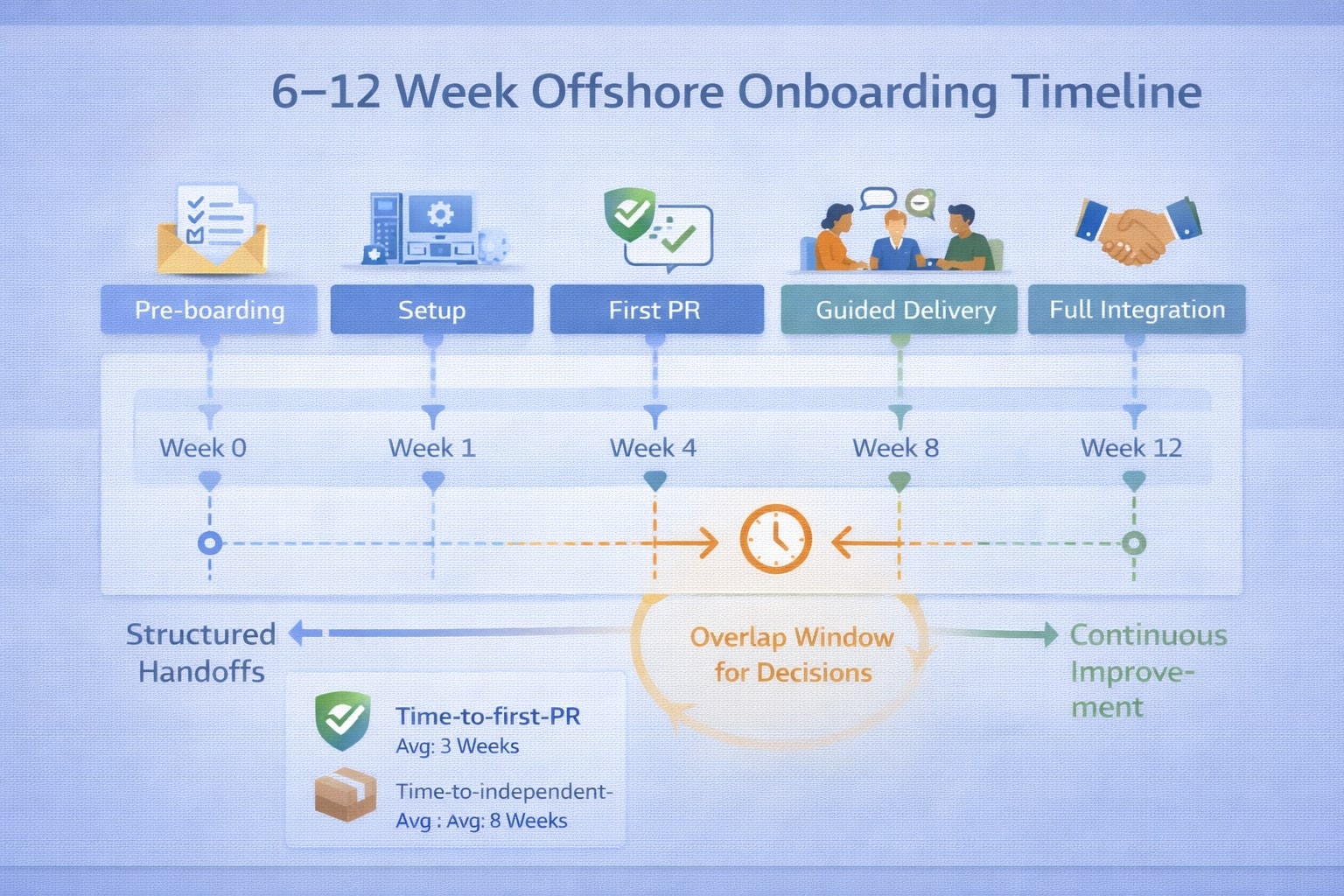
Typical onboarding timelines vary depending on role complexity, so it helps to build a structured plan around training offshore teams to accelerate ramp-up.
Why Do Typical Onboarding Timelines Matter for Offshore Teams?
Typical onboarding timelines matter because they set realistic expectations for productivity, quality, and delivery predictability. Offshore work is sensitive to decision latency and missing context, so ramp time can expand quickly when onboarding is left informal. A defined timeline protects the roadmap by planning for ramp-up instead of assuming immediate output.
Timelines Prevent “Day One Productivity” Assumptions
Timelines prevent unrealistic assumptions that new offshore engineers will contribute at full capacity immediately. Even strong engineers need time to learn the codebase, architecture, and release process. A realistic timeline prevents mislabeling ramp as underperformance.
Timelines Reduce Hidden Ramp Costs
Ramp costs are real because early work takes longer and requires more review. A structured timeline reduces repeated clarifications and avoids rework caused by missing context. Hidden ramp costs shrink when onboarding is consistent and measurable.
Timelines Align Stakeholders Across Locations
Stakeholder alignment improves when there is a shared view of what “week 1,” “week 4,” and “week 8” should look like. Alignment reduces pressure to skip quality steps. Offshore onboarding becomes smoother when expectations are explicit.
Timelines Improve Retention by Reducing Early Friction
Early friction reduces retention because new team members feel blocked and ineffective. A defined onboarding timeline removes avoidable blockers like missing access and unclear ownership. Better early experience improves stability and long-term output. In addition to formal onboarding checklists, it’s important to integrate offshore development teams into your workflows so new hires can contribute effectively as soon as possible.
What Are the Standard Onboarding Stages for Offshore Teams?
Standard onboarding stages for offshore teams follow a predictable sequence: pre-boarding setup, orientation and access, guided contribution, ownership ramp, and full delivery integration. Each stage has distinct goals and deliverables. The stages remain similar across companies, but the speed depends on operational maturity.
Stage 0: Pre-Boarding Preparation
Pre-boarding prepares tools, access, and context before the offshore team starts. The goal is to remove non-engineering delays. This stage often determines whether onboarding starts cleanly or starts with frustration.
Stage 1: Orientation and Environment Setup
Orientation and setup focus on access provisioning, development environment readiness, and process orientation. The goal is to ensure engineers can run the system locally, navigate repositories, and understand how work flows. Setup delays are a common cause of slow onboarding.
Stage 2: Guided First Contributions
Guided contributions build confidence and establish quality norms. The goal is to ship small, low-risk changes while learning review and release workflows. Strong teams use “starter tasks” that teach the system rather than random tickets.
Stage 3: Ownership Ramp and Independent Delivery
Ownership ramp begins when engineers can take a work item end-to-end with limited supervision. The goal is independent execution with predictable cycle time. Ownership ramp is where the offshore team transitions from “helping” to “owning.”
Stage 4: Full Integration Into Delivery Rhythm
Full integration occurs when offshore engineers participate smoothly in planning, estimation, reviews, and incident response. The goal is to operate as part of the core team. This stage includes consistent sprint performance and stable quality.
How Long Does It Take to Fully Onboard Offshore Teams?
Fully onboarding offshore teams typically takes 6–12 weeks for complex product work and 2–6 weeks for more modular or execution-heavy scopes. “Fully onboarded” means the offshore team can ship independently with stable quality and predictable delivery cadence. Time-to-full onboarding is driven by how quickly teams gain context, access, and ownership.
Typical Timeline for Modular Work: 2–6 Weeks
Modular work on well-defined systems onboards faster. Engineers can contribute within the first 1–2 weeks and reach independent execution by weeks 3–6. This timeline assumes stable requirements and a clean CI/review process.
Typical Timeline for Core Product Ownership: 6–12 Weeks
Core product ownership takes longer because it requires deeper domain understanding and a stronger mental model of the system. Engineers need time to understand edge cases, performance constraints, and release risk. Full integration usually appears around weeks 8–12 when delivery becomes predictable.
Typical Timeline for High-Compliance or High-Security Environments: 8–16 Weeks
Highly regulated environments often onboard slower due to access approvals, security training, and strict release processes. The bottleneck is frequently governance rather than engineering capability. The timeline improves when access workflows are templated and pre-approved for offshore roles.
“First Value” Arrives Earlier Than “Full Onboarding”
First value often arrives within 1–3 weeks when engineers ship small improvements, bug fixes, or test coverage. Full onboarding is reached later when engineers own a surface end-to-end. Separating these milestones prevents confusion about progress. For companies establishing formal entities to employ offshore staff, using local resident director services ensures compliance and statutory onboarding requirements are handled smoothly.
What Factors Influence Onboarding Timelines for Offshore Teams?
Onboarding timelines are influenced by access readiness, documentation quality, clarity of ownership, time-zone overlap, engineering maturity, and the complexity of the product surface. Most timeline delays are operational rather than technical. The fastest programs remove operational friction before the team starts.
Access Provisioning and Security Approvals
Access is the most common early bottleneck. Tooling access, repository permissions, VPN configuration, and production read access often require multiple approvals. Onboarding accelerates when access is provisioned before day one.
Documentation and System Clarity
Documentation accelerates onboarding because it reduces repeated explanations. Runbooks, architecture notes, and “how we ship” guides reduce dependency on a few onshore team members. Poor documentation stretches onboarding timelines significantly.
Ownership Clarity and Work Definition
Ownership clarity accelerates onboarding because teams know what they are responsible for. Clear acceptance criteria reduces rework and reduces delays from clarifications. Ambiguous work expands the time needed to become independent.
Time-Zone Overlap and Decision Availability
Overlap affects onboarding speed because early onboarding requires higher interaction. A predictable overlap window helps answer questions quickly. The need for overlap decreases as the offshore team becomes more autonomous.
Codebase Complexity and Tooling Maturity
Complex codebases require more time for context building. Tooling maturity reduces onboarding effort by making setup and testing repeatable. Mature CI systems and local dev tooling shorten ramp significantly.
Efficient onboarding sets the foundation for long-term team success, not just quick ramp-up. When companies hire dedicated offshore teams, they benefit from consistent onboarding playbooks and less frequent role churn. This stability makes it easier to forecast timelines and achieve early contributions from new members.
How Do Training and Documentation Impact Offshore Team Onboarding?
Training and documentation impact onboarding by reducing dependency on live explanations and by standardizing how engineers learn the system. Strong documentation turns onboarding into a repeatable process rather than a one-time effort. Training accelerates ramp when it is focused on real workflows rather than generic sessions.
Documentation Reduces “Wait Time” for Answers
Documentation reduces wait time because offshore engineers can unblock themselves during non-overlap hours. This prevents work from stalling overnight. Documentation also reduces repeated questions that consume senior engineering time.
Training Builds Shared Standards Early
Training builds shared standards by clarifying how the organization defines quality, testing, review discipline, and release readiness. Shared standards reduce rework. Shared standards also reduce friction during code review.
Process Guides Improve Collaboration Speed
Process guides explain how planning, estimation, incident response, and escalation work. Understanding the process prevents misunderstandings that look like performance issues. Process clarity improves collaboration across time zones.
A Strong “Onboarding Kit” Creates Repeatability
An onboarding kit typically includes environment setup steps, architecture overview, codebase map, runbooks, and sample pull requests. Repeatability improves onboarding speed for every future hire. This also reduces variability across offshore cohorts.
What Are the Best Practices to Reduce Onboarding Timelines for Offshore Teams?
Best practices reduce onboarding timelines by removing operational blockers, clarifying ownership, and creating a structured ramp plan with measurable milestones. The goal is to shorten time-to-independent delivery without cutting quality. Faster onboarding comes from fewer delays, not from fewer standards.
Pre-Provision Access and Equipment Before Day One
Pre-provisioning prevents the most common early delays. Accounts, permissions, devices, and credentials should be ready before start. This converts week-one time into productive learning and shipping.
Use a 30-60-90 Ramp Plan With Clear Deliverables
A ramp plan works because it clarifies what success looks like at each stage. Early deliverables can include a first PR, a small feature, and ownership of a module. Clear deliverables also reduce anxiety and confusion.
Assign a Single Onboarding Owner and a Buddy System
A single owner prevents onboarding from becoming everyone’s responsibility and no one’s responsibility. A buddy supports day-to-day questions and accelerates context building. This reduces delays caused by unclear escalation paths.
Start With “Learning Tasks” That Teach the System
Learning tasks are chosen to expose engineers to build, test, review, and release workflows. These tasks build system understanding faster than random backlog work. Learning tasks also reinforce quality expectations early.
Establish One Source of Truth for Work and Decisions
A single backlog and a simple decision log prevent confusion. Offshore teams onboard faster when chat instructions do not conflict with backlog priorities. Clear sources of truth reduce rework and missed expectations.
The One Bullet List of Timeline-Reducing Practices
- Access provisioned before day one with a standard checklist
- Onboarding kit with setup, architecture map, and runbooks
- 30-60-90 ramp plan with explicit milestones
- Dedicated onboarding owner plus a buddy system
- Starter tasks designed to teach the system and release process
- Predictable overlap window for early decisions and unblockers
How to Measure Successful Onboarding Outcomes for Offshore Teams?
Successful onboarding outcomes are measured through delivery readiness, quality stability, and independence. Measurement should focus on objective signals rather than subjective impressions. Good metrics confirm that the team is integrated into the delivery system and can operate predictably.
Time to First Meaningful Contribution
Time to first contribution measures how quickly onboarding begins producing value. A meaningful contribution includes a merged PR with review feedback incorporated. This metric detects access and setup bottlenecks quickly.
Time to Independent Work Item Completion
Independent completion measures when engineers can take work end-to-end with minimal support. This indicates true onboarding progress. It also correlates strongly with long-term delivery stability.
Cycle Time and Blocked Time Trends
Cycle time measures how long work takes to move from start to shipped. Blocked time reveals where the workflow is slowing down. Improving trends indicate onboarding maturity.
Quality Signals: Defect Escape and Rework Ratio
Defect escape and rework ratio show whether onboarding is producing reliable delivery. High rework often indicates unclear requirements or weak standards. Stable quality indicates strong integration.
Participation in Core Delivery Rituals
Participation shows whether offshore engineers are fully integrated. Smooth participation includes planning, estimation, code reviews, and incident response routines. Integration is complete when offshore participation is normal and consistent.
Onboarding timelines for offshore teams in 2026 are designed to ensure seamless integration, strong collaboration, and early contribution to project success while addressing cultural differences, time zone differences, and communication challenges. Most companies working with an offshore development team or offshore partner follow a phased onboarding program that typically spans 2 to 6 weeks, depending on project complexity, business objectives, and the level of specialization required.
Week 1: Foundations and Alignment
During the initial phase, project managers, the in house team, and offshore team members align on business goals, project timelines, communication processes, and clear expectations. Onboarding materials, communication strategy, project management tools, and task management frameworks are introduced so both remote teams and the existing team stay on the same page.
This stage also focuses on cultural differences, company culture, and language barriers through cross cultural training, ensuring mutual understanding and smoother team integration.
Weeks 2–4: Integration, Training, and Contribution
Next, offshore developers, offshore staff, and skilled professionals begin technical assessment, hands-on training, and participation in critical tasks using asynchronous communication, video calls, and collaboration tools.
Continuous performance monitoring, progress tracking, and ongoing development responsibilities gradually increase as team members adapt to business practices, working hours, and project management workflows. Data security policies, protecting data, and regular security audits are reinforced during this stage, particularly when managing remote teams across popular offshore destinations supported by outsourcing partners.
Weeks 4–6: Full Contribution and Continuous Improvement
By this stage, dedicated teams are well integrated into continuous development cycles, contribute meaningfully to complex projects, and help enhance operational efficiency while reducing development costs and operational costs.
With dedicated resources, niche expertise, and access to global talent pools, offshore development efforts support faster time to market, substantial cost savings, and business growth without long term hiring commitments associated with local hiring. Continuous improvement practices, continuous performance monitoring, and communication refinements ensure sustained business success as offshore talent becomes an integral part of the internal team.
India continues to be a popular choice for offshore hiring because of its large, skilled workforce and predictable onboarding rhythms. Many organizations choose to hire offshore dedicated software development teams in india to streamline onboarding while maintaining high productivity.
FAQs About Onboarding Timelines for Offshore Teams
What is a realistic onboarding timeline for offshore developers?
A realistic timeline is 2–6 weeks for modular work and 6–12 weeks for full ownership of complex product surfaces. The timeline depends on access, documentation, and ownership clarity. Most teams deliver first value within 1–3 weeks.
Why does offshore onboarding sometimes take longer than local onboarding?
Offshore onboarding can take longer because informal alignment is weaker and decision access is limited by time zones. Missing documentation and slow access approvals amplify the delay. Structured onboarding reduces these factors significantly.
What is the most common reason offshore onboarding gets delayed?
The most common reason is slow access provisioning. Missing credentials, permissions, and environment readiness can waste the first 1–2 weeks. Pre-provisioning and checklists reduce this delay.
How can a company shorten onboarding timelines without cutting quality?
Timelines shorten when onboarding becomes repeatable and operational friction is removed. Pre-provision access, provide an onboarding kit, and use a ramp plan with milestones. Quality stays protected when CI gates and review standards remain consistent.
How can onboarding success be measured objectively?
Objective measures include time to first meaningful contribution, time to independent work completion, cycle time trends, blocked time trends, defect escape rate, and rework ratio. These signals show whether the team is becoming independent and reliable. Subjective impressions should follow metrics, not replace them.
When should offshore teams be expected to own modules end-to-end?
Module ownership is often realistic by weeks 6–12 for core product areas. For modular scopes, ownership can arrive earlier, often by weeks 3–6. Ownership readiness depends on context depth, not just time spent.