


Integrating offshore development teams requires designing a single operating system for ownership, workflows, communication, quality, and culture across locations. Offshore integration succeeds when teams are treated as first-class owners with clear boundaries, full context, and consistent standards. Offshore integration fails when teams are used as add-on capacity without decision rights, which increases rework and slows delivery.
Strong integration converts distributed capacity into predictable execution. It reduces decision latency, improves quality consistency, and makes scaling smoother as headcount grows. Integration also protects long-term ROI by lowering coordination overhead and improving retention through fairness and visibility.
Integrating offshore developers works best when teams are set up for long-term collaboration rather than short-term execution. When companies hire dedicated offshore teams, integration becomes smoother because roles, ownership, and communication channels are already clearly defined. This allows offshore developers to operate as an extension of the core team.
Why Is It Important to Integrate Offshore Teams Into Your Development Process?
Integrating offshore teams into a development process is important because it turns cross-border capacity into reliable delivery with consistent quality. Offshore work naturally introduces time-zone constraints, approval delays, and context gaps if processes are not designed intentionally. Integration reduces those risks by aligning ownership, standards, and decision-making into one shared system.
Integration Protects Delivery Predictability Across Time Zones
Integration protects delivery predictability because offshore teams cannot depend on constant real-time alignment. A shared process ensures that work can move forward with clear acceptance criteria and defined review gates. This reduces idle time and prevents last-minute changes that break sprint plans.
Integration Reduces Rework by Improving Context and Clarity
Integration reduces rework because most defects and delays come from unclear requirements rather than weak engineering. Offshore teams deliver best when they understand the user goal, edge cases, and success criteria upfront. Better clarity lowers bug rates and reduces repeated clarification loops.
Integration Maintains Security and Compliance Consistency
Integration maintains security because offshore access must match the same governance expectations as onshore access. A single security and change-control system reduces variance across teams and supports audit readiness. Consistency prevents accidental exceptions that create long-term risk.
Integration Improves Retention Through Fair Ownership and Visibility
Integration improves retention because offshore teams disengage when work feels like ticket execution. Fair ownership, consistent feedback, and visibility into impact create stronger commitment. Retention improves ROI because stable teams compound domain knowledge and reduce onboarding cost.
Successful integration starts with strong leadership practices, which is why these tips for managing offshore development teams are essential for aligning workflows and expectations.
How to Integrate Offshore Development Teams Successfully?
Offshore development teams integrate successfully when ownership boundaries are stable, decision rights are clear, and workflows support asynchronous execution. Integration success is operational, not cosmetic. The strongest integrations define how work enters the system, how it is clarified, how it is reviewed, and how it is released.
Start With Stable Ownership Boundaries
Stable ownership works because teams build momentum when they own a module or service for multiple release cycles. Ownership should include end-to-end responsibility for quality, reliability, and improvements within that surface. Stable ownership reduces coordination overhead and increases accountability.
Choose an Engagement Model That Fits the Required Control
The engagement model matters because it influences availability expectations, compliance ownership, and the ability to invest in long-term capability. Direct employment, EOR employment, and contractor models create different constraints. The model should match the product’s risk profile and long-term scaling plan.
Standardize Requirements and Decision Recording
Standardized requirements reduce confusion because distributed teams rely more on written clarity. A short design note, explicit acceptance criteria, and a decision log prevent repeated questions. Standardization also improves onboarding because new engineers can search for context.
Enforce a Single Quality System Across Locations
A single quality system ensures that code shipped by offshore teams meets the same standards as code shipped by onshore teams. Review rules, CI gates, test coverage expectations, and release checks should be consistent. Consistency reduces defect escape and stabilizes velocity.
Assign an Integration Owner With Cross-Functional Authority
An integration owner is necessary because integration spans engineering, product, security, and operations. This owner resolves systemic blockers, protects overlap windows, and ensures standards are adopted. The owner is measured by delivery stability and reduced rework, not by meeting volume.
A common integration principle used in high-performing distributed orgs is: “Ownership without context becomes ticket execution.” This quote reflects a practical pattern seen in offshore programs that prioritize integration as a system.
Process alignment becomes much easier when teams follow best practices for running agile with offshore teams, especially across distributed engineering units.
What Integration Steps Help Offshore Teams Work Seamlessly?
Integration steps help offshore teams work seamlessly when they reduce ambiguity, prevent dependency gridlock, and establish predictable handoffs. A phased approach prevents the overbuilding process and allows the organization to learn what frictions are real. The steps below reflect a sequence that tends to stabilize execution quickly.
Use a Phased Rollout With a Single Pod First
A phased rollout works because the first pod exposes gaps in onboarding, documentation, and decision speed. A small pilot limits impact while standards are still being tuned. Expansion should follow after two stable release cycles.
Build One Shared Integration Plan With Clear Checkpoints
A shared plan aligns stakeholders because integration affects multiple teams. Checkpoints should include measurable outcomes like cycle time, rework ratio, and defect escape rate. A clear plan also reduces confusion about what “integrated” means.
Step-by-Step Integration Sequence
- Confirm the engagement model, IP terms, and access requirements for the offshore team.
- Define the module boundaries the offshore pod will own end-to-end.
- Create a shared definition of ready and definition of done for that ownership area.
- Standardize ticket templates with acceptance criteria, edge cases, and measurable outcomes.
- Establish overlap windows and a decision cadence for reviews and approvals.
- Implement consistent CI gates, review rules, and a release checklist across teams.
- Run a two-sprint pilot and track cycle time, rework ratio, and incident frequency.
- Create an escalation path with response-time expectations for blockers.
- Expand scope gradually while keeping ownership stable for two release cycles.
- Review integration health monthly and change process only when metrics support it.
Create a Repeatable Onboarding Track for Every New Hire
Repeatable onboarding matters because offshore models are built to scale. A structured onboarding track reduces ramp time and avoids knowledge being trapped in a few individuals. Onboarding should include architecture maps, runbooks, and a first-week milestone.
How to Integrate Communication and Collaboration With Offshore Teams?
Communication and collaboration integrate well when they are designed for partial overlap and high-quality asynchronous work. The goal is predictable decisions and fewer misunderstandings, not more meetings. Offshore collaboration improves when written context is consistent and escalation paths are time-bound.
Design Collaboration Around Decision Latency
Decision latency matters because it determines how long work sits idle. Overlap windows should be reserved for decisions, reviews, and blocker resolution. Everything else should move through structured asynchronous updates.
Use Structured Asynchronous Updates to Reduce Meetings
Structured updates reduce meetings because they make progress visible without constant syncs. A daily update format typically includes progress, next step, and blockers with owners. A consistent format reduces back-and-forth across time zones.
Run Meetings With Inputs-First Discipline
Inputs-first meetings work because overlap time is limited and expensive. A short pre-read clarifies the decision required and the options being evaluated. A written decision record prevents repeated debate.
Make Escalation Paths Explicit and Time-Bound
Escalation paths prevent stalls when blockers appear outside overlap windows. A time-bound path defines who must respond and by when. This protects sprint commitments and reduces frustration.
A practical communication principle often used in distributed teams is: “The backlog holds tasks, the decision log holds truth.” This framing supports clarity across time zones.
What Tools Support Integration Between Onshore and Offshore Teams?
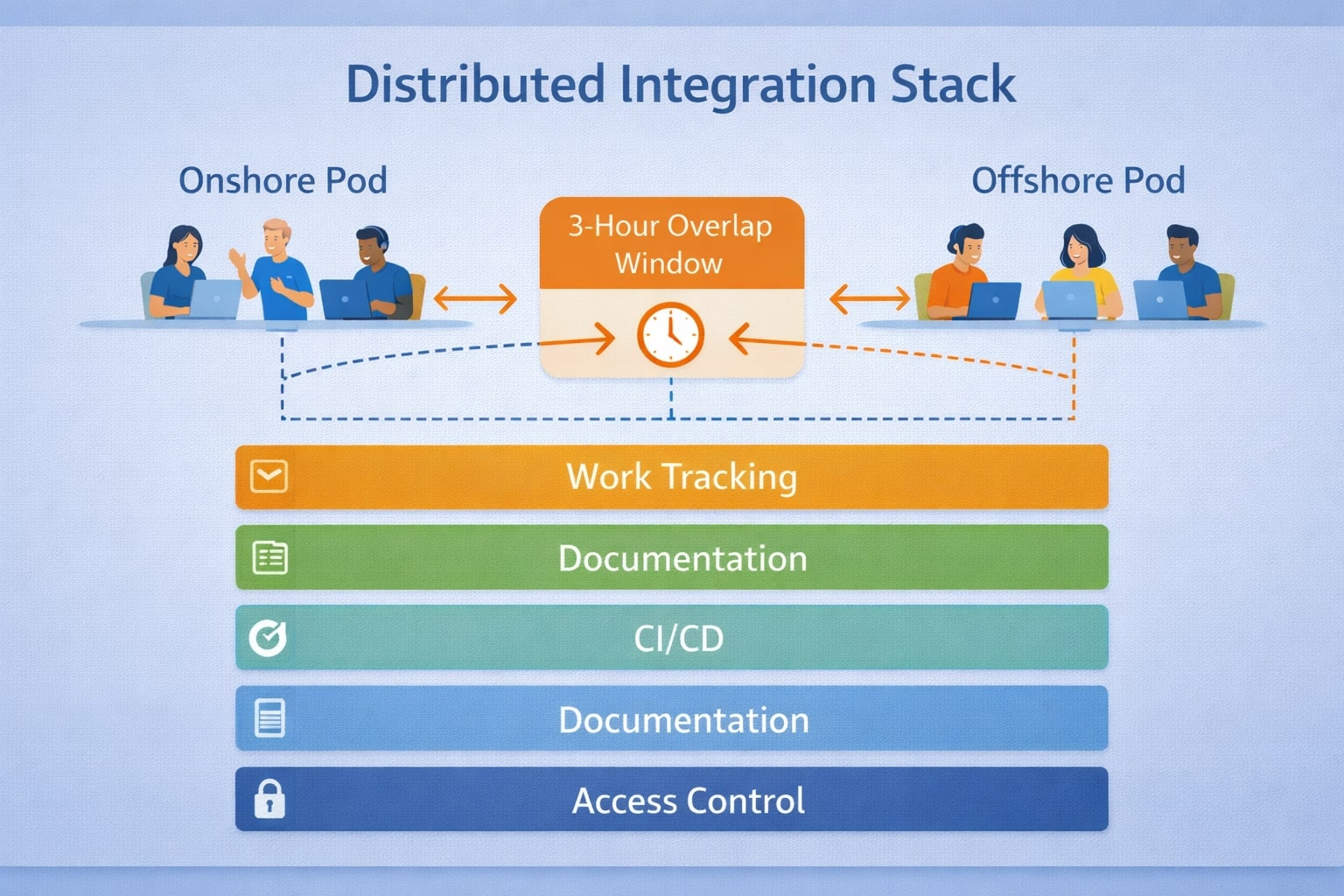
Tools support integration when they reduce context loss, automate quality enforcement, and make work status visible without constant meetings. Tooling should reinforce the operating system rather than replace it. Tooling also influences security controls and audit readiness.
Use One Source of Truth for Work and Priority
One source of truth matters because multiple trackers create conflicting priorities. A single backlog with clear acceptance criteria reduces duplicate work and improves planning. Ownership tags and decision links should live in the same system.
Standardize CI, Code Review, and Release Tooling
Standardized engineering tooling reduces variance because it enforces consistent quality gates. Automated tests, required reviews, and merge rules reduce defect escape. Standardization also improves onboarding because workflows are predictable.
Use Documentation Tools That Make Decisions Searchable
Searchable documentation supports integration because distributed teams must retrieve context quickly. Architecture notes, API contracts, runbooks, and decision logs reduce repetitive clarification. Searchability is more important than perfect formatting.
Tool Categories and What They Prevent
|
Tool Category |
Integration Benefit |
What It Prevents |
Example Outcome |
|
Work tracking |
Priority and clarity |
Duplicate work |
Stable sprint commitments |
|
Docs and decision logs |
Context transfer |
Repeated questions |
Faster onboarding |
|
CI/CD and automation |
Quality enforcement |
Manual variance |
Lower defect escape |
|
Incident tooling |
Reliability learning |
Hidden outages |
Shared runbooks |
|
Access management |
Security consistency |
Overbroad access |
Cleaner audits |
|
Async communication |
Continuity |
Meeting overload |
Faster handoffs |
Beyond tools and processes, integration depends heavily on people, making best practices for cultural alignment in offshore teams a critical success factor.
How to Integrate Offshore Teams Into Your Company Culture?
Integrating offshore teams into company culture requires consistent access to context, fairness in ownership, and equal visibility into impact. Culture integration is operational because it is shaped by information flow, recognition systems, and growth frameworks.
Give Offshore Teams Direct Access to Product Context
Product context improves culture because it signals trust and ownership. Offshore engineers deliver better outcomes when they understand customer pain and business goals. Context can be shared through product demos, roadmap narratives, and release retrospectives.
Apply One Growth and Performance Framework Across Locations
A single growth framework improves fairness because expectations do not change by geography. Role leveling, promotion criteria, and feedback cadence should be consistent. This reduces attrition and improves long-term team stability.
Normalize Recognition Through Shared Rituals
Recognition matters because offshore impact can be invisible if rituals are location-biased. A shared demo cadence and release note ritual makes outcomes visible. Recognition should focus on measurable impact and engineering craft.
Build Lightweight Rituals That Do Not Increase Meeting Load
Lightweight rituals work because excessive meetings reduce productivity. Monthly reviews, structured retrospectives, and written shout-outs can build inclusion. Rituals should support connection without forcing social time.
A common culture principle in distributed organizations is: “Inclusion is mostly about information flow.” This framing matches day-to-day execution realities.
What Integration Practices Improve Productivity in Offshore Teams?
Integration practices improve productivity when they reduce rework, increase autonomy, and keep decision loops short. Productivity gains come from system design rather than longer working hours. Offshore productivity rises when teams own stable modules and can ship independently with strong quality gates.
Reduce Dependencies by Designing Smaller Ownership Surfaces
Smaller ownership surfaces improve productivity because fewer dependencies reduce coordination points. Teams ship faster when they can release independently. Clean interfaces also reduce integration bugs.
Use Outcome Metrics Instead of Activity Metrics
Outcome metrics improve productivity because they align work with value. Metrics like cycle time, defect escape rate, and rework ratio reveal whether the system is functioning. Activity metrics increase noise and encourage busywork.
Treat Rework as a Measurable Signal
Rework is a useful signal because it reveals unclear requirements and weak quality gates. A rework threshold can trigger root-cause review when exceeded. This approach protects productivity by preventing rework from becoming normal.
Productivity Practices That Hold Up in Distributed Pods
- Stable ownership of a module for at least two release cycles
- Clear definition of done with test coverage expectations
- Small PRs with predictable reviewers and required approvals
- Decision logs for scope changes and architecture choices
- Asynchronous daily updates with blockers and owners
Align Working Agreements to Real Overlap Hours
Working agreements matter because overlap time is limited. Agreements should define response times, what requires synchronous discussion, and what can be handled asynchronously. When agreements match reality, productivity rises without extra meetings.
Integrating an offshore development team effectively requires the right balance of strategy, communication, and culture. Tech companies and US companies increasingly rely on offshore developers and offshore software development teams to access global talent, specialized skills, and senior developers who help scale efficiently and maintain round the clock productivity. Working with experienced offshore development companies or a proven offshore development partner allows tech leaders to build dedicated teams that complement the in house team, reduce management overhead, save office space, and drive significant cost savings while meeting changing market demands.
Successful integration starts with clear project requirements, defined project scope, and strong project management supported by reliable project management tools and collaboration tools like Microsoft Teams. Project managers must establish consistent communication processes, encourage collaboration, celebrate successes, and maintain team building to strengthen team dynamics across remote teams and offshore employees. Addressing cultural differences, language barriers, and time zone differences is critical to ensure smooth offshore collaboration, effective communication, and positive team members’ experience, especially when integrating new team members.
Offshore development companies in Eastern Europe and other regions provide offshore software developers and skilled professionals with strong technical skills, proven track records, and adherence to global security standards and data security expectations. With continuous development, ongoing support, and the ability to track progress closely, offshore dev teams enable business growth, cost effectiveness, and competitive edge. When offshore team management is structured well, offshore group members, in house staff, and local talent remain aligned with project timelines, project goals, and business needs—ensuring successful collaboration and long-term software development success.
For technology-focused companies, India offers a strong ecosystem for offshore development. Many organizations choose to hire offshore dedicated software development teams in india to ensure smoother integration, cost efficiency, and access to experienced engineers.
FAQs About Integrating Offshore Development Teams
1.How long does it take to integrate an offshore development team?
Integration typically stabilizes in 4–8 weeks for a single pod with clear ownership and strong onboarding. Larger programs can take a full quarter because workflows and standards must align across multiple teams. Stability is reached when cycle time and rework become predictable.
2.What is the most common reason offshore integration fails?
The most common reason is unclear ownership paired with weak requirements. Teams get stuck in repeated clarification loops, which increases rework and delays releases. The failure is operational rather than technical.
3.Should offshore teams be given end-to-end ownership?
End-to-end ownership is often the strongest structure when boundaries are stable and interfaces are clear. Ownership increases accountability and reduces handoffs. Shared ownership across locations usually increases coordination cost.
4.How much overlap time is usually needed?
Effective collaboration is often possible with 2–4 hours of overlap when asynchronous practices are strong. Overlap should be reserved for decisions and blocker resolution. More overlap helps during discovery-heavy phases.
What is the best way to reduce blockers and delays?
The best way is to reduce decision latency through a predictable cadence and a clear escalation path. Written acceptance criteria and decision logs reduce repeated questions. Strong CI gates and release checklists reduce last-minute delays.
5.How does culture integration affect delivery outcomes?
Culture integration affects delivery because it improves trust, retention, and ownership behavior. Offshore teams that have equal access to context and recognition make better decisions and ship with higher accountability. Over time, this reduces churn and strengthens delivery continuity.