


Project management offshore teams fail most often due to unclear ownership, weak communication systems, and onboarding gaps that compound as the team scales. These mistakes are rarely about talent quality. They are usually about how work is defined, how decisions are made, and how delivery is governed across locations. Avoiding the most common setup and scaling mistakes creates predictable delivery, stable quality, and lower management overhead.
|
Mistake Area |
Common Mistake |
What Goes Wrong |
Impact on Delivery |
|
Ownership & Scope |
No clear scope boundaries |
Offshore teams “help” without ownership |
Weak accountability and scattered execution |
|
Decision Design |
Undefined decision rights |
Teams wait for approvals and clarifications |
Delays, missed timelines, frustration |
|
Requirements |
Vague requirements and no definition of done |
Ambiguity leads to rework |
Quality drift and higher costs |
|
Governance |
Reactive governance |
Issues reviewed only after failure |
Escalation cycles instead of improvement |
|
Tooling |
Multiple work-tracking systems |
Fragmented priorities and reporting |
Lost time and coordination overhead |
|
Role Clarity |
Unclear PM, Tech Lead, QA roles |
Decisions stall in handoff loops |
Late-stage surprises |
|
Escalation |
No escalation rules |
Risks raised too late |
Deadline misses and firefighting |
|
Communication |
Overreliance on meetings |
Context lost across time zones |
Slow feedback and misalignment |
|
Onboarding |
Poor onboarding structure |
Teams lack context and confidence |
Dependency, rework, higher attrition |
|
Scaling |
Adding headcount without redesign |
More people, same weak process |
Slower delivery instead of faster |
|
Leadership |
Centralized control |
One PM or lead becomes bottleneck |
Uneven progress and overload |
|
Metrics |
Vanity metrics |
Activity looks healthy, outcomes aren’t |
Hidden quality and predictability issues |
Offshore project management works best when the offshore team operates inside the same delivery system as the onshore team. That system includes shared planning rhythms, clear responsibilities, measurable standards, and a disciplined approach to risk and escalation. When offshore teams are treated as a separate execution layer, coordination load rises and delivery reliability declines.
Why Do Companies Make Mistakes When Managing Offshore Project Teams?
Companies make mistakes when managing offshore project teams because they underestimate how much structure distributed delivery requires. Local teams can compensate for ambiguity through frequent informal alignment. Offshore teams rely more on written clarity, stable workflows, and explicit ownership. When these are missing, small issues become systemic.
Offshore Is Often Treated as a Staffing Shortcut
Offshore programs are sometimes launched to reduce cost or hire faster without redesigning delivery workflows. This creates a mismatch between expectations and operating reality. Staffing alone does not create delivery predictability.
Decision Access Is Not Designed Upfront
Distributed teams need defined decision rights and escalation paths. Without this design, offshore teams wait for approvals and requirements clarifications. Waiting time accumulates into missed timelines and frustrated stakeholders.
Requirements and “Done” Are Under-Specified
Ambiguous requirements are manageable in colocated teams because clarifications happen quickly. Offshore teams experience longer feedback loops, so ambiguity creates rework. Rework is one of the most expensive offshore failure modes.
Governance Is Often Reactive Instead of Routine
Governance becomes reactive when performance is reviewed only after misses. Reactive governance creates escalation cycles instead of continuous improvement. Routine governance creates stable, predictable delivery behavior.
What Are the Most Common Setup Mistakes in Project Management Offshore Teams?
The most common setup mistakes are unclear scope, missing ownership definitions, weak tooling consistency, and lack of measurable delivery standards. Setup mistakes are especially costly because they shape how the offshore team behaves for months. Correcting them later requires relearning habits and rebuilding trust.
Mistake 1: Starting Without a Clear Scope Boundary
Scope boundary mistakes occur when the offshore team is asked to “help with delivery” without clear ownership. This creates scattered work and weak accountability. Strong setup defines what the offshore team owns, what it supports, and how ownership evolves.
Mistake 2: Using Multiple Systems for Work Tracking
Multiple systems create fragmented priorities and unreliable reporting. Offshore teams lose time reconciling tasks across tools. One source of truth improves planning accuracy and reduces coordination load.
Mistake 3: Missing Role Clarity Between PM, Tech Lead, and QA
Role clarity prevents work from getting stuck in decision loops. Offshore teams need to know who approves scope changes, who validates technical direction, and who owns release readiness. Confusion here leads to late-stage surprises.
Mistake 4: No Definition of Done and Quality Gates
Without quality gates, delivery becomes inconsistent and review load increases. Offshore teams can ship high-quality work, but quality must be system-enforced. A shared definition of done is a baseline requirement.
Mistake 5: No Escalation Rules for Risks and Blockers
Escalation failures happen when teams are unsure when to raise risks. Risks are often raised too late. A simple escalation policy improves transparency and protects deadlines.
One Bullet List of Setup Mistakes That Repeat Most Often
- Vague scope and shared ownership without clear boundaries
- Separate “offshore backlog” instead of a single prioritized backlog
- Undefined decision rights and unclear escalation paths
- No shared definition of done, testing expectations, or release gates
- Tool inconsistency across locations leading to fragmented visibility
- Overreliance on meetings instead of written clarity and logs
How to Avoid Communication Breakdowns With Offshore Project Teams?
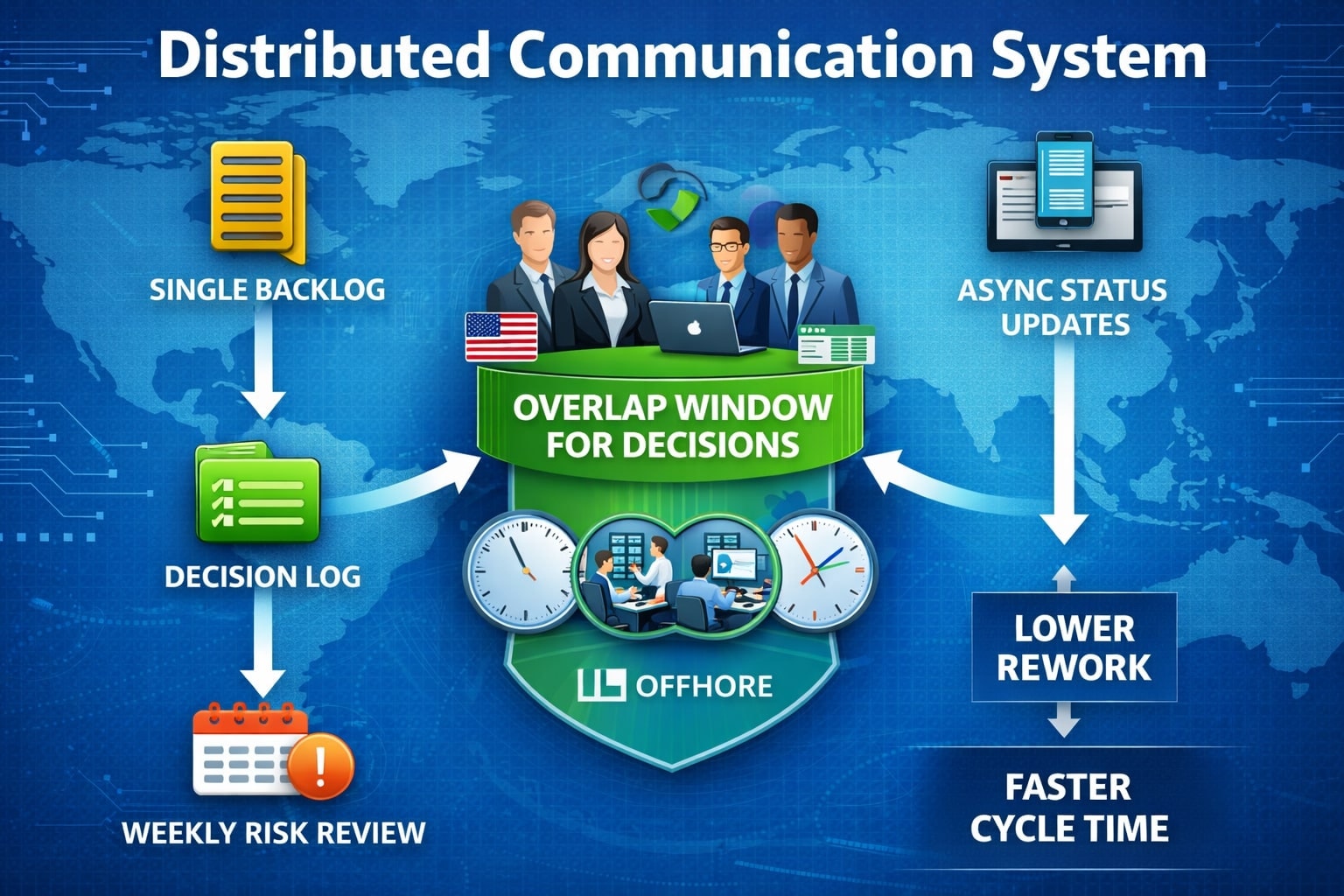
Communication breakdowns are avoided by making information explicit, designing predictable collaboration rhythms, and using written artifacts that reduce dependency on real-time alignment. Offshore communication fails when decisions and context live only in meetings or chat threads. Offshore communication succeeds when it is structured, consistent, and outcome-focused.
Use Written Requirements With Explicit Acceptance Criteria
Written requirements reduce ambiguity and reduce rework. Acceptance criteria should describe expected behavior, edge cases, and non-goals. Clarity is more valuable than length.
Protect Overlap Time for Decisions, Not Status
Overlap time should be used for fast decisions, unblockers, and clarification. Status can be handled asynchronously. Decision-first overlap reduces waiting time and improves throughput.
Standardize Update Formats for Daily and Weekly Reporting
A standard update format reduces noise and improves visibility. Strong updates highlight outcomes, blockers, and risks rather than listing activity. Consistent updates reduce the need for repeated status meetings.
Maintain a Simple Decision Log
A decision log prevents repeated discussions and conflicting directions. It also helps new team members ramp faster. Decisions should include owner, date, and what changed.
What Mistakes Happen When Project Responsibilities Aren’t Clear?
When responsibilities are not clear, the most common mistakes are duplicated work, missed work, delayed approvals, and unresolved ownership during incidents and escalations. Responsibility ambiguity creates hidden time loss because work stalls while teams wait for someone else to decide. Responsibility clarity is a core requirement for offshore reliability.
Mistake: Work Is Done Twice or Not Done at All
Teams may assume someone else is handling testing, documentation, or deployment readiness. The gap is discovered late, usually near release. This triggers rush fixes and quality risk.
Mistake: Approval Bottlenecks Appear Without an Owner
Approvals slow down when there is no clear decision maker. Offshore teams often wait for onshore approvals, which increases cycle time. Decision rights should be explicit to avoid this bottleneck.
Mistake: Ownership Is Blurred During Production Issues
During incidents, unclear ownership leads to delayed response and unclear escalation. Response delays damage trust quickly. Offshore programs need clear incident roles and runbooks.
Mistake: “PM Owns Everything” Becomes the Default
When responsibilities are unclear, PMs often become the default owner for decisions, coordination, and escalation. This creates overload and reduces decision quality. Clear role design protects both PM effectiveness and delivery speed.
Great project managers use structured workflows and also follow tips for managing offshore teams to maintain alignment across locations.
How Does Poor Onboarding Create Long-Term Issues for Offshore Teams?
Poor onboarding creates long-term issues by embedding incorrect assumptions, slowing context acquisition, and reducing early confidence and ownership. Onboarding problems are expensive because early habits shape delivery behavior. Offshore onboarding must be designed, not improvised.
Poor Onboarding Creates Persistent Dependency
Teams remain dependent on a few onshore experts for basic decisions. Dependency increases waiting time and reduces independent execution. Dependency is often mistaken for “team weakness,” even when the root issue is missing onboarding structure.
Poor Onboarding Increases Rework Through Misunderstood Context
Misunderstood system constraints and domain rules cause rework. Rework compounds across sprints. Strong onboarding reduces misinterpretation by providing clear references and examples.
Poor Onboarding Reduces Quality Discipline
Teams may not learn expected testing depth, review norms, or release readiness standards. Quality then becomes inconsistent. Strong onboarding teaches the quality system early through guided tasks.
Poor Onboarding Increases Attrition Risk
Engineers who feel blocked and ineffective early are more likely to disengage. Attrition increases knowledge loss and increases onboarding load for replacements. A strong onboarding system protects retention and continuity.
Project management becomes more predictable when teams are stable and familiar with your processes and tools. When organizations hire dedicated offshore teams, offshore contributors are better positioned to understand milestones, dependencies, and quality expectations. This long-term commitment makes it easier to avoid misalignment and delays in cross-border projects.
What Scaling Mistakes Affect Project Management Offshore Teams?
Scaling mistakes affect offshore project management when headcount grows faster than process maturity. Scaling increases coordination complexity, so weak systems fail harder at larger size. The goal is to scale the delivery system first, then scale the team.
Scaling Mistake: Adding Headcount Without Changing the Operating Model
More people increases communication paths and review load. Without changes to ownership and process, delivery slows instead of speeding up. Scaling requires redesigning ownership boundaries and delivery lanes.
Scaling Mistake: Keeping Everything Centralized With One PM or One Lead
Centralized control becomes a bottleneck as scope grows. Offshore teams need distributed leadership and clear sub-ownership. Without this, decisions queue up and progress becomes uneven.
Scaling Mistake: No Standard Work for Repeated Activities
Repeated work such as release preparation, QA sign-off, and incident response should be standardized. Without standard work, each cycle is reinvented. Reinvention creates inconsistency and fatigue.
Scaling Mistake: Inconsistent Hiring Bar and Role Definitions
Scaling often lowers the hiring bar due to urgency. This increases performance variance and increases management overhead. Clear role definitions and structured evaluation protect quality at scale.
Scaling Mistake: Metrics Become Vanity Metrics
Vanity metrics such as “tickets closed” or “stories completed” can hide rework and quality drift. Better metrics reflect outcomes: cycle time trend, defect escape, rework ratio, and predictability. Outcome metrics support the right behaviors.
For teams running iterative work, combining strong project frameworks with best practices for running agile with offshore teams ensures smoother sprints and better delivery predictability.
How to Prevent Deadline Issues During Scaling?
Deadline issues are prevented by reducing uncertainty early, controlling work-in-progress, designing for dependencies, and enforcing predictable execution rituals. Offshore deadline issues often happen because scope changes late and risks are not surfaced early. Deadline protection depends on risk discipline and flow discipline.
Use Clear Milestones and Delivery Checkpoints
Milestones reduce surprise by making progress visible. Checkpoints should validate assumptions early. Early validation prevents late-stage rework.
Limit Work-in-Progress and Reduce Partial Work
High WIP creates partial work across multiple threads. Partial work increases context switching and reduces throughput. WIP limits increase completion rate and improve predictability.
Manage Dependencies Through Explicit Interfaces
Dependencies cause deadline risk because they create waiting time. Interfaces should be defined early, such as API contracts and integration expectations. Clear interfaces allow parallel work with less coordination.
Treat Risks as Trackable Items With Owners
Risks must have owners, due dates, and mitigation steps. Risk tracking prevents late escalations. Risk discipline is especially important in offshore execution because feedback loops are longer.
One Table of Deadline Risk Drivers and Controls
|
Deadline Risk Driver |
What It Looks Like |
Preventive Control |
|
Scope creep mid-cycle |
Requirements expand after work starts |
Scope freeze window + change control |
|
Dependency delays |
Teams wait for approvals or integration |
Clear interfaces + defined decision rights |
|
High WIP |
Many tasks started, few finished |
WIP limits + lane-based planning |
|
Late risk escalation |
Risks raised near deadlines |
Risk log + weekly risk review |
|
Weak release discipline |
Release issues appear late |
Release checklist + quality gates |
|
Poor estimation |
Commitments miss repeatedly |
Historical data + calibration reviews |
Setting up and scaling offshore teams has tremendous potential, but poor project management can quickly undermine project success. One major mistake companies make is failing to establish clear communication channels early. Offshore team members, onshore and offshore teams, and remote teams need structured collaboration tools, reliable project management software, and defined communication protocols to avoid confusion and communication barriers. Without effective communication strategies, cultural differences, language barriers, and multiple time zones can weaken team cohesion and slow offshore projects.
Another common mistake in offshore team management is neglecting cultural awareness and team building. Many offshore teams struggle when businesses ignore cultural sensitivity training, language training, and virtual team building activities like virtual coffee breaks or online team building activities. These activities boost morale, strengthen relationships, and build a strong team culture that supports continuous development and successful offshore team management. Failure to onboard offshore team members properly or not clarifying project scope, project goals, and project timelines can also lead to misalignment and poor project outcomes.
Companies also often underestimate legal and compliance considerations, security protocols, and the need to track progress effectively using project management tools and task management frameworks. Ignoring overlapping working hours or not appointing a capable offshore team lead or project manager can disrupt round the clock productivity and weaken overall software development capabilities.
To avoid these mistakes, businesses should identify overlapping working hours, encourage team members, maintain clear communication, use reliable communication tools like Microsoft Teams, and nurture a high performing offshore team. India has emerged as a preferred destination for robust offshore engineering and project delivery due to its vibrant tech talent pool. Many companies choose to hire offshore dedicated software development teams in india to build consistent delivery teams that are familiar with global project management norms.
FAQs About Mistakes in Managing Offshore Project Teams
1.What is the biggest mistake companies make with offshore project management?
The biggest mistake is unclear ownership paired with vague requirements. Offshore execution depends on clarity because feedback loops are slower. Clear scope boundaries and a shared definition of done reduce this risk.
2.Are communication issues with offshore teams mostly about language?
Communication issues are usually about process, not language. Missing context, vague acceptance criteria, and unclear priorities create most breakdowns. Structured written artifacts reduce these problems.
3.How should responsibilities be defined for offshore project teams?
Responsibilities should be defined using explicit ownership boundaries, decision rights, and escalation paths. A simple RACI-style mapping can help, but the key is operational clarity. Clear ownership reduces waiting time and rework.
4.How long does it take to fix an offshore setup that started poorly?
Fixing a poor setup often takes multiple cycles because habits must change and trust must rebuild. Improvements appear faster when scope and workflow are simplified first. Consistent governance accelerates stabilization.
5.What metrics best show whether offshore project management is working?
The best metrics include sprint predictability, cycle time trends, defect escape rate, rework ratio, and escalation frequency. These metrics reflect delivery health. Activity metrics can hide underlying issues.
6.What is the fastest way to prevent deadline misses when scaling offshore teams?
The fastest way is to reduce uncertainty early through clearer requirements, control WIP, and enforce a risk review cadence. Deadline misses usually start as untracked risks and unmanaged dependencies. Early structure prevents late chaos.