


Offshore staff augmentation benefits Agile teams by adding flexible capacity without redesigning the entire delivery organization. It allows teams to fill skill gaps quickly, scale sprint capacity during demand spikes, and control costs while keeping the core Agile system intact. The strongest results appear when augmented engineers operate inside the same Agile rituals, quality gates, and ownership rules as internal teams.
Offshore augmentation is often misunderstood as “more hands for more output.” The real benefit is predictability under change: faster staffing when priorities shift, better coverage when teams are stretched, and lower opportunity cost when hiring pipelines are slow. These benefits compound when onboarding is structured, work is sliced well, and the augmented team is treated as part of the product delivery system.
Why Do Agile Teams Use Offshore Staff Augmentation?
Agile teams use offshore staff augmentation because sprint demand and skill requirements change faster than traditional local hiring can keep up. Augmentation provides a controlled way to add capacity for a specific time window, role type, or delivery milestone. It is often used to protect roadmap commitments without inflating permanent headcount.
Agile Delivery Creates Variable Capacity Needs
Agile delivery creates variable capacity needs because priorities shift, incidents occur, and deadlines compress. A stable team may not be enough during a major release or migration. Augmentation adds capacity without forcing the organization to hire permanently for a short-term spike.
Local Hiring Cycles Can Be Too Slow for Sprint Timelines
Local hiring cycles can be slow due to competition, long notice periods, or limited supply in specific stacks. Agile teams lose momentum when roles stay unfilled. Offshore staff augmentation reduces time-to-fill by widening the talent pool.
Agile staff augmentation only works when new developers are embedded properly, making it critical to integrate offshore development teams into existing sprint workflows.
Augmentation Supports Specialized Skill Gaps Without Long Commitments
Specialized skill gaps are common in areas like DevOps, data engineering, QA automation, mobile engineering, and security. Augmentation allows teams to bring in expertise for a defined scope. This prevents over-hiring for skills that are only needed temporarily.
To make staff augmentation effective in fast-moving environments, teams should follow the best practices for offshore agile teams that focus on alignment, velocity, and accountability.
Augmentation Helps Teams Maintain Velocity During Change
Velocity often drops during migrations, re-architecture, and platform work. Augmentation can help the team maintain feature delivery while foundational work progresses. This reduces the risk of a “freeze period” where the roadmap stalls.
What Are the Key Benefits of Offshore Staff Augmentation for Agile Teams?
The key benefits are flexibility, faster scaling, cost efficiency, improved delivery speed, access to specialized talent, and better support for growth phases. These benefits are strongest when augmented staff integrate into the team’s Agile operating system. The benefits weaken when augmented engineers operate as an external task queue.
Faster Capacity Adds Without Rebuilding the Org
Faster adds matter because Agile teams often need help within 2–4 weeks, not 2–4 months. Offshore augmentation provides quick access to engineers when delivery timelines are tight. This reduces opportunity cost from delayed releases.
Flexible Staffing for Short-Term Peaks and Long-Term Programs
Flexibility matters because some needs are temporary while others are program-based. A team might need three extra engineers for a 10-week migration. Another team might need a long-term extension of capacity for a multi-quarter roadmap.
Cost Efficiency Through Controlled Headcount Growth
Cost efficiency improves when staff can be added without increasing fixed costs beyond the project window. Offshore models can reduce fully loaded cost in many markets. Cost efficiency becomes real when quality and velocity remain stable.
Improved Delivery Speed Through Parallel Execution
Delivery speed improves when augmented staff take ownership of parallel workstreams. Parallel execution requires clear interfaces and stable modules. Without clear ownership, augmentation can increase coordination overhead and slow delivery.
Better Risk Management During Critical Releases
Risk is reduced when teams can staff up for security hardening, testing, observability, or incident readiness before major launches. Augmented specialists can reduce defect escape and improve release confidence. This is often more valuable than raw feature output.
How Does Offshore Staff Augmentation Improve Agile Team Flexibility?
Offshore staff augmentation improves flexibility by allowing Agile teams to adjust sprint capacity, add specialization, and rebalance workloads without restructuring core roles. It creates a “capacity buffer” that can be deployed where bottlenecks are highest. Flexibility is operational, not just staffing.
Augmentation Supports Rapid Role Swaps When Priorities Change
Priorities can shift from feature delivery to reliability, security, or performance work. Augmentation allows teams to bring in the required skill without abandoning planned work. This prevents disruption when leadership changes priorities mid-quarter.
Augmentation Enables Temporary Pod Expansion
Pod expansion works when augmented staff are attached to a stable team and given clear ownership. This can increase throughput without increasing meeting load significantly. The flexibility comes from scaling pods rather than adding disconnected individuals.
Augmentation Helps Reduce Burnout During High-Pressure Cycles
Burnout risk rises during launches and migrations. Adding temporary capacity can reduce overtime and protect the team’s sustainability. This improves retention and reduces long-term hiring cost.
Flexibility Improves When Onboarding Is Repeatable
Repeatable onboarding improves flexibility because new engineers can contribute faster. A standard onboarding track reduces dependence on a few internal people for knowledge transfer. This allows augmentation to work even during busy periods.
What Cost Advantages Come From Offshore Staff Augmentation in Agile Teams?
Cost advantages come from lower fully loaded labor costs in many markets, reduced opportunity cost from faster staffing, and controlled headcount commitments tied to specific delivery goals. The true cost advantage is measured as cost per shipped outcome. Cost advantage disappears when rework and supervision rise.
Lower Fully Loaded Cost Can Reduce Sprint Cost
Lower fully loaded cost can reduce the cost of adding incremental sprint capacity. This includes salary, benefits, and local employment overhead. The savings are strongest when skill level is matched correctly and quality gates are consistent.
Faster Staffing Reduces Opportunity Cost
Opportunity cost matters because delayed hiring can delay features, revenue milestones, and reliability improvements. Offshore augmentation can reduce time-to-fill for hard-to-hire roles. Faster staffing converts into cost advantage when it prevents delivery delays.
Controlled Commitment Reduces Fixed Cost Risk
Controlled commitment matters because it keeps headcount aligned with demand. Teams can scale down after a milestone without layoffs. This reduces financial risk during uncertain planning cycles.
Cost Advantage Must Include Coordination and Quality Factors
Coordination and quality costs matter because they can erase salary savings. Clear acceptance criteria, strong reviews, and CI gates reduce rework and protect savings. Augmentation becomes expensive when work is unclear and repeatedly re-done.
How Can Offshore Staff Augmentation Speed Up Agile Delivery?
Offshore staff augmentation speeds up delivery by increasing parallel execution, reducing bottlenecks in critical paths, and improving throughput when work is sliced into independent increments. Speed comes from better flow, not from adding more tickets. Augmentation improves speed when augmented staff own defined surfaces end-to-end.
Parallel Workstreams Increase Sprint Throughput
Parallel workstreams increase throughput because multiple features or improvements can be built simultaneously. This requires clear module boundaries and stable interfaces. Parallel execution is one of the most reliable ways augmentation improves delivery speed.
Specialists Remove Bottlenecks That Slow the Whole Sprint
Bottlenecks can include slow QA automation, weak DevOps capacity, or insufficient frontend bandwidth. Specialists increase speed by removing constraints on the team. Removing a single constraint can improve sprint outcomes more than adding generalists.
Review and Release Flow Improves With Defined Responsibilities
Speed increases when code review and release steps are predictable. Augmented staff can take responsibility for testing, observability, or CI improvements. This improves delivery flow by reducing “done but not shipped” work.
Speed Improvements Depend on Intake Discipline
Intake discipline matters because offshore work slows down when requirements are unclear. Definition of ready, acceptance criteria, and edge cases reduce delays. Strong intake makes augmented capacity productive quickly.
What Talent and Skill Benefits Does Offshore Staff Augmentation Offer Agile Teams?
Offshore staff augmentation offers access to broader talent pools, faster availability of specialized skills, and improved ability to build balanced teams. The skill benefit is strongest when hiring is selective and evaluation standards are consistent. Talent benefits fade when skill mapping is weak and roles are mismatched.
Access to Specialized Skills on Short Notice
Specialized skills can be sourced faster offshore in many markets. This is valuable for short-term needs such as cloud migrations, data pipeline upgrades, QA automation, and performance tuning. Rapid access to expertise reduces project risk.
Broader Hiring Pools Improve Role Fit
Broader pools improve role fit because teams can hire for the exact need rather than settling for availability. Better fit reduces ramp time and improves quality. Role fit is especially important for senior and specialized roles.
Ability to Add Senior Anchors to Raise Standards
Senior anchors raise standards by improving design decisions and reducing rework. Augmentation can bring in senior engineers for stabilization periods. Strong senior guidance often improves outcomes beyond their individual contribution.
Skill Benefits Compound With Stable Ownership
Skill benefits compound when augmented staff stay long enough to gain domain knowledge. A stable ownership surface allows engineers to learn the system and ship faster over time. Skill advantage is maximized when staff are not rotated too frequently.
Staff augmentation can be a great starting point, but agility improves when teams gain continuity. When companies hire dedicated offshore teams, agile ceremonies become more predictable and team ownership increases over time. This stability helps agile teams move faster without sacrificing quality.
How Does Offshore Staff Augmentation Support Agile Scalability and Growth?
Offshore staff augmentation supports scalability and growth by allowing teams to scale capacity in line with roadmap demand, expand into new workstreams, and maintain predictable delivery without permanent headcount inflation. It also helps teams build repeatable onboarding and delivery systems. These systems make long-term scaling easier.
Augmentation Helps Scale Without Delaying Roadmaps
Roadmaps stall when hiring cannot keep up with demand. Augmentation reduces that risk by providing capacity quickly. This is valuable during growth phases when demand rises faster than hiring systems can respond.
Augmentation Supports Multi-Team Expansion With Pod-Based Scaling
Pod-based scaling works because it creates clear ownership. Augmented engineers can form or expand pods around modules. This supports growth while keeping coordination manageable.
Augmentation Encourages Standardization in Process and Tooling
Standardization improves scalability because onboarding and workflows become repeatable. Offshore augmentation often pushes teams to clarify definitions, templates, and review rules. These improvements usually benefit the whole organization.
Scalability Improves When Retention and Knowledge Transfer Are Managed
Retention improves scalability because the cost of churn is high in distributed models. Knowledge transfer is strongest when documentation and decision logs are consistent. A stable augmented team often performs better than a constantly rotating one.
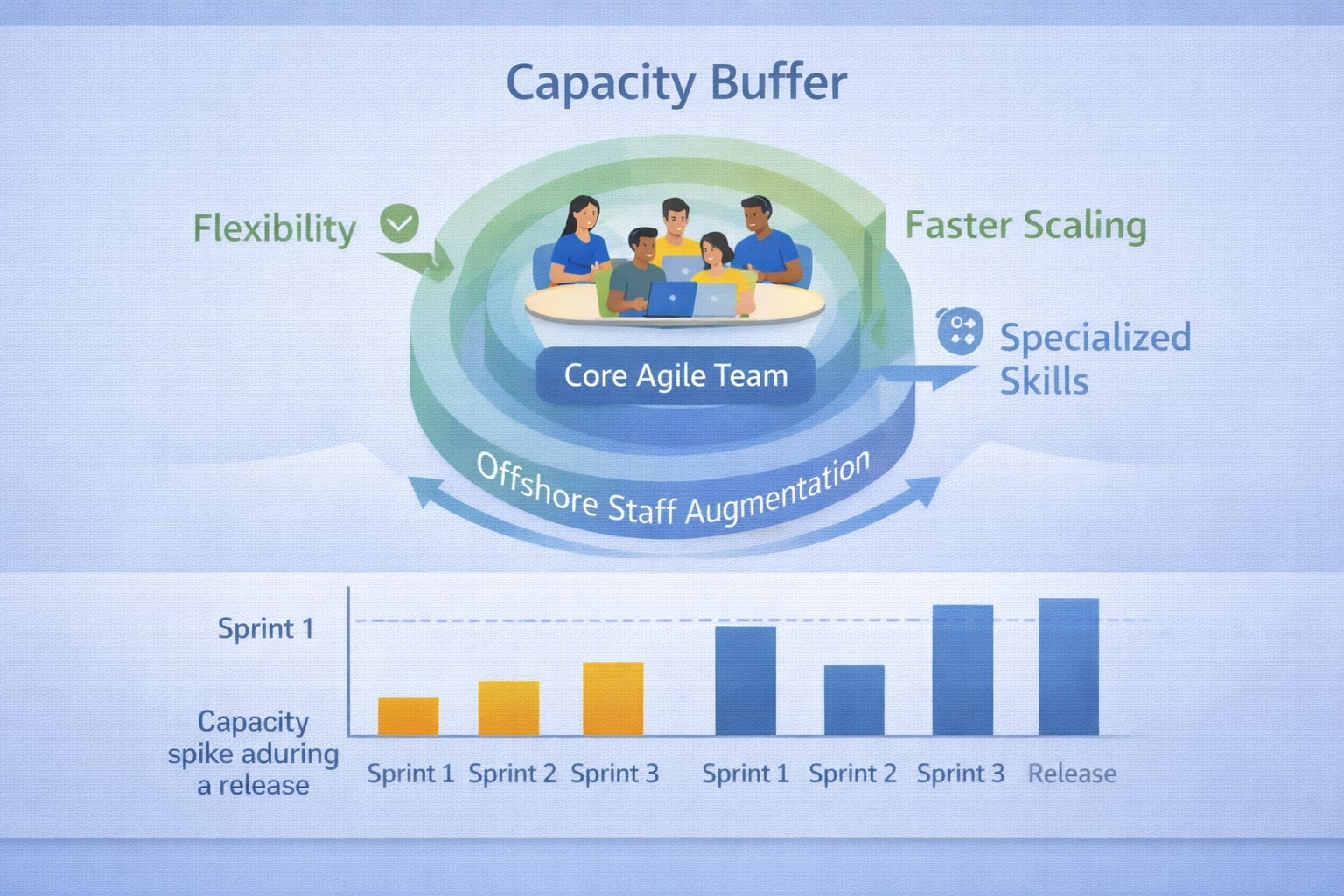
Offshore staff augmentation for agile teams offers a powerful way to accelerate project completion, manage project demands, and access a vast global talent pool without the long-term commitments of traditional hiring. Through offshore staff augmentation services, companies can quickly add offshore professionals, offshore developers, and highly specialized skills to their existing team, supporting both short term projects and large-scale software development initiatives. This flexible offshore staff augmentation model enables rapid team expansion, niche expertise, and agile adaptability while maintaining alignment with project requirements, business objectives, and development processes.
Partnering with an experienced offshore staff augmentation company or offshore staffing services provider gives organizations access to skilled professionals, dedicated team members, and offshore IT staff augmentation talent with proven track records. North American companies and global businesses benefit from offshore staffing partners who offer cultural compatibility, data security, and reliable project management support. With strong project management tools, regular performance reviews, and structured collaboration, augmented staff integrate smoothly with the in house team, helping agile teams maintain project success and remain competitive.
Cost effectiveness is another key advantage. Offshore staff augmentation helps reduce office space needs, lower labor costs, minimize hidden costs, and deliver significant cost savings compared to full-time hiring. India has become a preferred destination for agile staff augmentation due to its deep engineering talent. Many product companies choose to hire offshore dedicated software development teams in india to scale agile squads quickly while keeping costs and delivery under control.
FAQs About Offshore Staff Augmentation for Agile Teams
1.Is offshore staff augmentation the same as outsourcing?
Offshore staff augmentation is not the same as outsourcing. Augmentation places engineers inside the client’s team structure, rituals, and tooling, while outsourcing often shifts ownership to an external vendor. Augmentation works best when the client retains product ownership and delivery standards.
2.When is offshore staff augmentation most effective for Agile teams?
It is most effective during capacity spikes, migrations, major launches, and when specialized skills are needed quickly. It also works well when hiring pipelines are slow and roadmap deadlines are fixed. Effectiveness rises when work can be owned end-to-end.
3.What is the biggest risk with offshore staff augmentation?
The biggest risk is treating augmented staff as ticket executors without context. This increases rework and reduces accountability. Clear ownership and strong onboarding reduce this risk.
4.How can Agile teams integrate augmented staff quickly?
Integration is faster with a structured onboarding plan, clear definitions of ready and done, and stable module ownership. Overlap windows should be used for decisions, not status. Small, well-specified work items accelerate ramp.
5.Does offshore augmentation reduce costs even after coordination overhead?
It can reduce costs when quality and velocity remain stable. Coordination overhead can erase savings when work is unclear or approvals are slow. A cost-per-outcome view is the most reliable way to evaluate savings.
6.How long should augmented staff stay to create real value?
Real value is usually created when engineers stay long enough to gain domain knowledge and ship multiple increments. Short engagements can work for narrowly scoped specialist tasks. Longer engagements work better for ownership-based module delivery.