


Offshore Agile teams perform best when Agile practices are adapted for distributed execution rather than copied from co-located teams. The goal is predictable delivery, low rework, and fast decisions under partial time overlap. Agile becomes especially valuable offshore because it creates structure around ambiguity, prioritization, and feedback loops, which are otherwise expensive across time zones.
The most effective offshore Agile setup treats Agile as an operating system: clear ownership, tight backlogs, disciplined ceremonies, strong asynchronous communication, and consistent quality gates.
Agile offshore teams perform best when they’re built for continuity and long-term ownership. When companies hire dedicated offshore teams, agile rituals become more effective because team members stay aligned across sprints. This stability allows agile practices to scale without constant process resets.
Why Do Offshore Agile Teams Need Strong Agile Practices?
Offshore Agile teams need strong Agile practices because distributed delivery magnifies ambiguity, dependency friction, and waiting time for decisions. Agile provides a structured cadence for prioritization, planning, review, and learning that keeps work moving even when real-time overlap is limited. Strong Agile practices reduce rework by clarifying scope and acceptance criteria before implementation.
Offshore Delivery Amplifies the Cost of Unclear Work
Unclear work becomes expensive offshore because questions can take hours to resolve instead of minutes. Strong Agile practices force clarity through grooming, definition of ready, and acceptance criteria. This reduces idle time and prevents mid-sprint rework.
Agile Cadence Protects Predictability Across Time Zones
Predictability matters offshore because coordination windows are limited and backlog churn is disruptive. Sprint rituals create a reliable schedule for decisions and stakeholder inputs. Predictability also supports better estimation and improves release planning over multiple cycles.
Strong Practices Reduce Dependency Gridlock
Dependency gridlock happens when offshore teams depend on approvals or inputs that are not available during overlap windows. Agile practices reduce gridlock through better slicing, clearer ownership, and pre-planned decision points. The result is fewer blocked tickets and more consistent throughput.
Agile Creates a Shared Language Across Locations
A shared Agile language reduces confusion because teams align on what “ready,” “done,” and “accepted” mean. This reduces quality variance across locations and improves onboarding speed. Consistency matters more than the specific Agile flavor used.
To strengthen sprint planning, reviews, and retrospectives, teams should also apply the best practices for running agile with offshore teams that focus on distributed collaboration.
What Practices Work Best for Offshore Agile Teams?
The best practices for offshore Agile teams focus on clarity, ownership, and decision speed under partial overlap. The most effective practices are those that reduce back-and-forth and ensure that work can move forward asynchronously. Offshore Agile works best when teams operate as stable pods with end-to-end ownership.
Keep Ownership Stable at the Pod Level
Stable ownership works because offshore pods build domain knowledge and improve velocity over time. Ownership should be defined by a module, service, or product area that can be shipped independently. Stable ownership also reduces cross-team handoffs.
Enforce Definition of Ready and Definition of Done
Definition of ready prevents unclear items from entering a sprint. Definition of done prevents “almost finished” work from creating hidden rework later. Both definitions must include quality requirements such as test coverage and review rules.
Slice Work Into Small, Testable Increments
Small increments work offshore because they reduce risk and simplify review. Large stories increase dependency on clarification and increase the chance of misalignment. Smaller slices also improve cycle time and make sprint progress more visible.
Agile frameworks work best when engineering units are fully aligned, making it essential to integrate offshore development teams into existing product workflows.
Use a Written Decision Log for Scope and Tradeoffs
Decision logs reduce repeated debates and prevent scope drift. This is critical offshore because decisions often happen in limited overlap windows. A written decision record preserves clarity across sprints and across new team members.
Standardize Quality Gates Across All Teams
Standardized quality gates reduce defect escape and make delivery predictable. CI checks, review rules, and release criteria should be the same for onshore and offshore teams. Consistency improves trust and reduces stakeholder friction.
A practical offshore Agile principle used in distributed programs is: “If a story cannot be understood without a meeting, it is not ready.” This principle reflects an execution reality for partial overlap teams.
How to Implement Communication Practices for Offshore Agile Teams?
Communication practices for offshore Agile teams should be designed to reduce decision latency and preserve context. Offshore communication is strongest when most coordination is asynchronous and the overlap window is used for high-value decisions. The goal is fewer misunderstandings, not more messages.
Use Structured Asynchronous Standups
Structured asynchronous standups work because they reduce meeting dependency and preserve focus. A short update format should include progress, next step, and blockers with owners. This creates daily visibility without forcing meetings across time zones.
Protect a Fixed Overlap Window for Decisions
A fixed overlap window works because it creates reliability for reviews, approvals, and design discussions. The overlap window should be used for decisions that unblock multiple tasks. Routine status updates should remain asynchronous.
Require Written Context Before Meetings
Written context before meetings reduces wasted overlap time. A short pre-read should state the decision required, options, and risks. This reduces debates and increases the quality of decisions.
Set Response-Time Expectations for Blockers
Response-time expectations prevent tickets from stalling. A blocker policy should define who is responsible for responding and the maximum response time. This turns blockers into managed events rather than daily frustration.
Use One Communication Channel for Each Work Type
Channel discipline reduces noise. Delivery updates, incident handling, and planning discussions should not mix randomly. Clear separation improves searchability and reduces missed information.
Strong agile execution depends on leadership, and these tips for managing offshore development teams help maintain velocity and accountability across time zones.
What Collaboration Practices Improve Offshore Agile Teams?
Collaboration practices improve offshore Agile teams when they reduce handoffs, improve review speed, and keep work aligned without constant real-time meetings. Offshore collaboration works best with predictable rituals and clear interface boundaries. The strongest collaboration style offshore is structured and lightweight.
Pair Collaboration Through Scheduled Review Windows
Scheduled review windows improve collaboration because they prevent PRs from waiting for hours. A predictable review block during overlap hours increases throughput. This also reduces the pressure for constant ad hoc pings.
Use Design Spikes and Lightweight RFCs for Complex Work
Lightweight RFCs reduce risk because they align teams before major implementation begins. Offshore teams benefit from short design notes that define boundaries and tradeoffs. This reduces rework and makes implementation faster.
Treat Code Review as a Quality and Alignment Ritual
Code review is a collaboration ritual because it spreads standards and context. Review rules should encourage smaller PRs and clear acceptance criteria. Strong review practice improves maintainability and reduces defect escape.
Run Cross-Team Demos to Build Shared Understanding
Demos build shared understanding because stakeholders see outcomes, not only tickets. A demo cadence also improves motivation by making impact visible. Demos should be short and focused on user value.
The One Bullet List of Collaboration Practices That Matter Most
- Small PRs with predictable reviewers and review-time expectations
- Lightweight design notes for any work that changes interfaces
- Shared definition of done that includes test and release requirements
- Demo cadence that shows shipped outcomes, not only progress updates
- Shared incident and postmortem process across onshore and offshore teams
- Escalation path for blockers that is time-bound and enforced
How to Apply Sprint Planning Practices in Offshore Agile Teams?
Sprint planning practices for offshore Agile teams should emphasize clarity, dependency management, and alignment on outcomes. Planning should avoid pulling unclear work into the sprint because offshore teams pay a higher cost when scope is ambiguous. A strong planning system also protects sprint stability by limiting mid-sprint churn.
Plan Around Outcomes, Not Task Lists
Outcome-based planning improves alignment because it clarifies what success looks like. Outcomes can be feature behavior, reliability improvements, or measurable performance changes. Outcome focus also supports better sprint review discussions.
Pre-Groom the Backlog Before Planning
Pre-grooming matters because planning meetings should not be used to discover requirements. Grooming should ensure acceptance criteria and edge cases are ready. Items that fail definition of ready should not enter the sprint.
Keep Sprint Scope Stable With Controlled Intake
Controlled intake matters because mid-sprint additions disrupt flow. A policy should define when urgent work can enter and what gets removed to compensate. This keeps velocity predictable and prevents burnout.
Use Dependency Mapping During Planning
Dependency mapping reduces surprises. Any work that depends on another team should have a clear owner and due date for the dependency. Offshore teams perform better when dependencies are addressed before coding begins.
Planning Should Align on Capacity and Review Bandwidth
Review bandwidth matters because PR bottlenecks can stall delivery. Planning should include review capacity and QA capacity as real constraints. This reduces “done but not merged” and “done but not released” situations.
What Practices Enhance Productivity in Offshore Agile Teams?
Productivity practices enhance offshore Agile teams when they reduce rework, reduce waiting time, and improve the ratio of shipped outcomes to effort. Productivity rises when offshore teams can ship independently and when quality is maintained through automation. Productivity drops when teams depend on frequent approvals and unclear definitions.
Reduce Rework Through Better Acceptance Criteria
Rework reduction improves productivity because it converts effort into durable output. Acceptance criteria should include edge cases and non-functional requirements when relevant. Better criteria prevent backtracking after reviews.
Improve Cycle Time With Smaller Work and Faster Reviews
Cycle time improves when work is sliced smaller and review processes are predictable. Faster reviews reduce idle time and keep sprints moving. Smaller work also improves testing speed and release confidence.
Standardize Tooling and Automation Across Pods
Standardized tooling improves productivity because workflows become repeatable. CI/CD automation reduces manual errors and shortens release steps. Standardization also improves onboarding speed for new hires.
Track Productivity With a Small Set of Outcome Metrics
A small set of metrics keeps focus. Cycle time, rework ratio, defect escape rate, and blocked time provide a clean view of delivery health. Metrics should be reviewed monthly to avoid overreacting to weekly noise.
A Simple Productivity Table for Offshore Agile Pods
|
Productivity Lever |
What It Improves |
What It Reduces |
Primary Signal |
|
Smaller stories |
Flow and predictability |
Spillover |
Cycle time drops |
|
Definition of ready |
Clarity |
Blocked work |
Fewer clarifications |
|
Review windows |
Throughput |
PR waiting |
Merge time drops |
|
CI gates |
Quality |
Regression bugs |
Defect escape drops |
|
Decision log |
Alignment |
Scope churn |
Less rework |
|
Stable ownership |
Autonomy |
Handoffs |
Fewer dependencies |
How to Build Leadership and Team Alignment Practices for Offshore Agile Teams?
Leadership and alignment practices are necessary offshore because culture and accountability must be built intentionally across distance. Offshore Agile teams perform best when leaders protect clarity, enforce standards, and create fair visibility into impact. Alignment is built through predictable rituals and consistent decision-making.
Assign a Strong Product Owner or Product Partner Model
A strong product partner model reduces confusion because the backlog stays consistent and priorities remain clear. Offshore teams struggle when priorities change without explanation. A stable product owner relationship improves context and reduces churn.
Establish Clear Decision Rights and Escalation Ownership
Decision rights matter because unclear authority increases waiting time. Teams should know who decides on scope, tradeoffs, and priority changes. Clear decision rights reduce friction and improve sprint stability.
Build Trust Through Consistent Standards and Fair Recognition
Trust improves when standards apply equally across locations. Fair recognition improves retention and encourages ownership behavior. Leaders should highlight outcomes and reliability improvements, not only high-visibility features.
Use Retrospectives to Fix System Issues, Not Individuals
Retrospectives should focus on system improvements. Offshore teams often face systemic blockers such as unclear intake and slow approvals. Retros should produce actions with owners and deadlines.
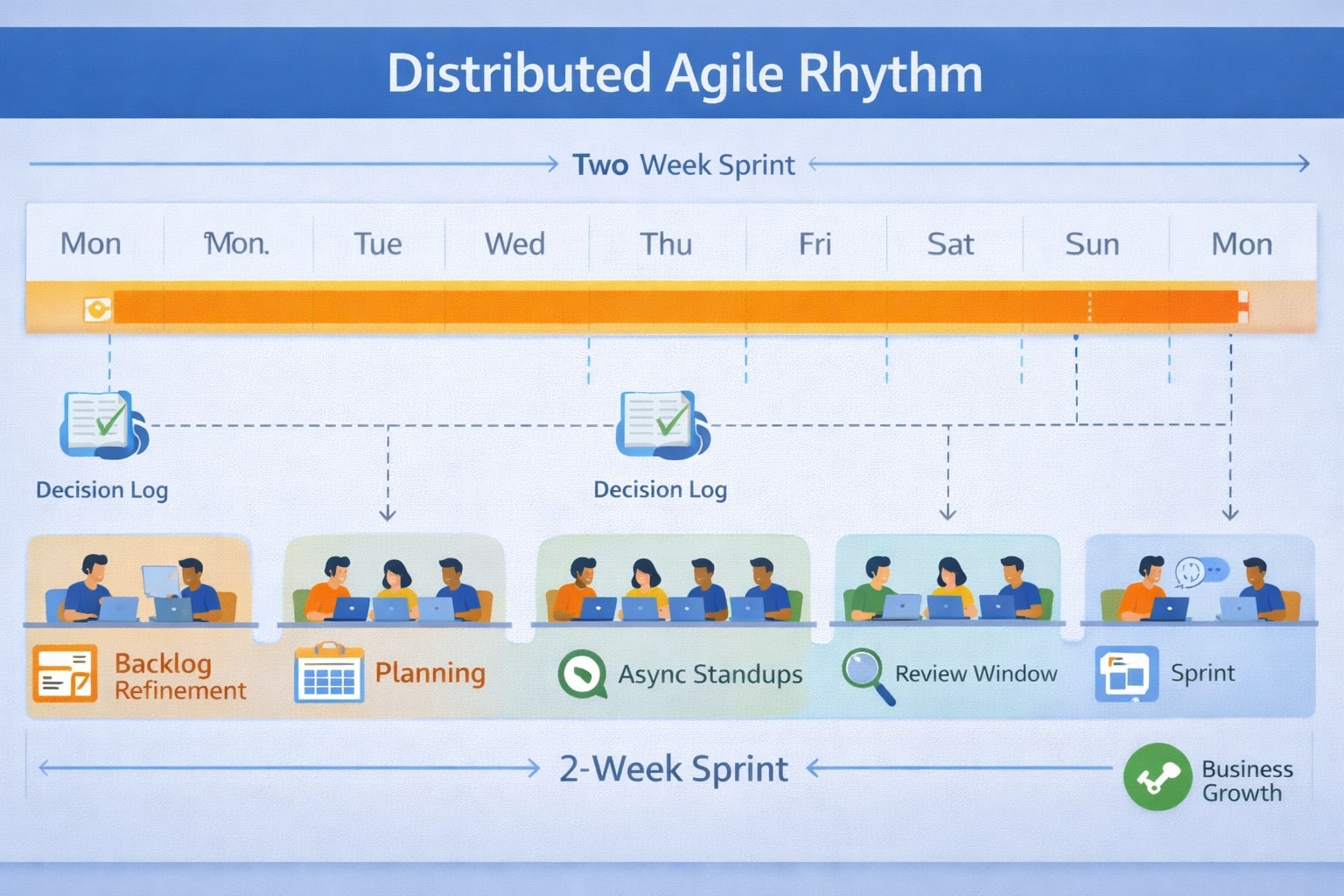
Offshore agile teams play a critical role in global software development, combining agile methodologies with the flexibility of distributed teams to deliver high-quality working software. Building a strong agile offshore development team starts with adopting agile practices, agile principles, and iterative development that keep offshore team members, the local team, and remote teams aligned throughout the development process. Clear communication channels, collaboration tools, and project management tools ensure offshore development teams, project managers, and team leads stay on the same page while managing offshore teams across multiple time zones.
To build truly successful offshore agile teams, companies must focus on team cohesion, mutual understanding, and cultural differences that often influence distributed development teams. Structured sprint planning, well-defined user stories, and continuous improvement help agile offshore software development teams track progress effectively and maintain team performance. Agile methods such as Scrum support offshore projects and agile work environments where communication barriers and language barriers are minimized through deliberate offshore team management, strong leadership, and cultural awareness.
A dedicated development team that understands agile expertise, task management, and quality control can leverage the global talent pool to handle complex development projects. Offshore agile development models enable global teams to deliver project success with robust offshore software development while ensuring offshore teams thrive through agile work, best practices, and structured agile processes that keep the entire team connected, productive, and consistently delivering value on every particular project.
India has become a global hub for agile software delivery thanks to its experienced talent pool. Many product companies hire offshore dedicated software development teams in india to run agile programs efficiently while maintaining speed, quality, and cost control.
FAQs About Best Practices for Offshore Agile Teams
1.Do offshore Agile teams need daily standups?
Offshore Agile teams do not always need live daily standups. Structured asynchronous standups often work better because they reduce meeting load and preserve focus. A live standup can be used during overlap hours when the work is highly interdependent.
2.What is the most important Agile practice for offshore teams?
The most important practice is a strong definition of ready and clear acceptance criteria. Offshore teams pay a high cost for ambiguity because clarifications take longer. Strong readiness prevents blocked work and reduces rework.
3.How should sprint planning differ for offshore teams?
Sprint planning should be stricter about clarity and dependencies. Items that are unclear should not enter the sprint. Planning should also account for review bandwidth and overlap windows to avoid hidden bottlenecks.
4.How can offshore Agile teams reduce rework?
Rework is reduced by better grooming, clearer acceptance criteria, lightweight design notes for complex changes, and consistent CI gates. Stable ownership also reduces rework because teams build domain knowledge. Rework should be tracked as a signal and reviewed monthly.
5.What is the best way to handle time-zone challenges in Agile?
Time-zone challenges are handled by protecting overlap windows for decisions and moving routine updates to asynchronous channels. Decision logs preserve context across days. Escalation paths with response-time expectations prevent stalls.
6.How can leadership keep offshore Agile teams aligned?
Leadership keeps teams aligned by maintaining a stable backlog, setting clear decision rights, enforcing consistent standards, and running retrospectives that produce system fixes. Alignment improves when outcomes are visible and recognition is fair.