


The key reasons to setup global capability centers (GCCs) are cost efficiency, access to high-quality talent, innovation, scalability, and durable competitive advantage. A well-run GCC becomes a strategic extension of the enterprise that owns core capabilities instead of outsourcing them. This guide explains the main business advantages of GCCs and shows how they create long-term value across cost, talent, digital transformation, and governance.
Global Capability Centers have evolved from transactional back-office units into integrated innovation hubs for product development, analytics, finance, and customer operations. Companies now rely on GCCs to deliver digital programs, manage risk, and support regional expansion in at least three continents. The sections below unpack each reason in detail so you can evaluate whether a GCC fits your own growth strategy.
Power your offshore development center strategy with Flexiple’s vetted experts. Hire global capability center teams with seamless onboarding, top-tier quality, and the reliability your business deserves.
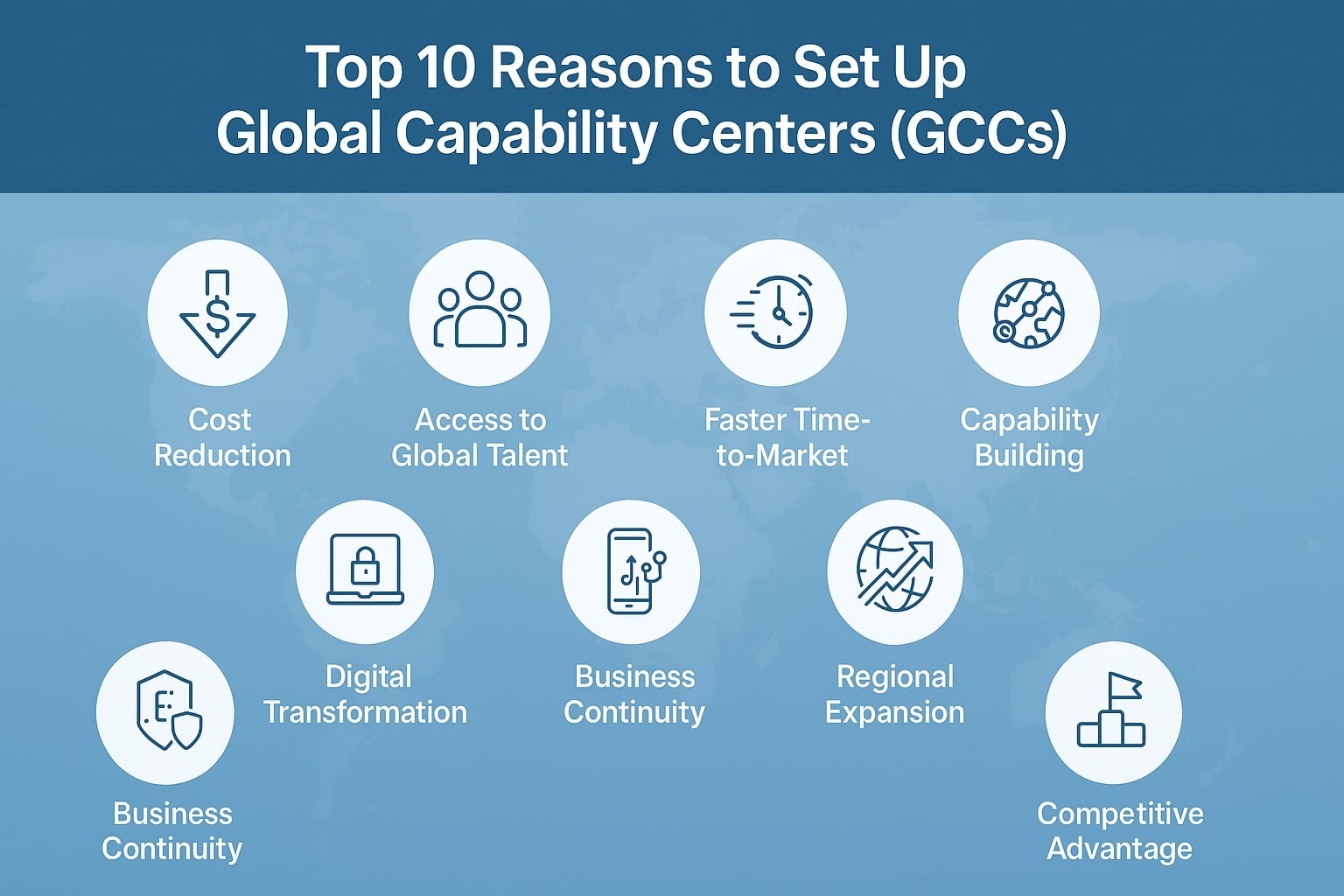
Top 10 Reasons to Set Up Global Capability Centers (GCCs)
If you’re exploring whether a GCC is the right strategic move for your organization, here are the top 10 reasons that clearly outline the significant value, impact, and long-term advantages they offer.
1. Reduces Overall Operating Costs
A well-designed GCC reduces overall operational costs while maintaining high quality and performance. Instead of depending on expensive onshore teams or high-margin vendors, companies can operate their own centers in cost-competitive global markets.
Labor arbitrage is one of the most immediate and visible savings. Roles based in established GCC hubs often cost significantly less than equivalent onshore roles—yet they still attract highly skilled professionals.
By creating the right mix of onshore and offshore teams, organizations can reduce blended costs without compromising capability or throughput.
Global Capability Centers help enterprises consolidate fragmented business operations. Instead of relying on multiple vendors performing similar tasks, the GCC acts as a unified operations platform.
This consolidation reduces vendor margins, simplifies management layers, eliminates duplicated overheads, and creates more control over execution quality.
Cost savings are not limited to lower salaries. GCCs strengthen productivity through standardized processes, shared tools, automation, and repeatable playbooks that help to drive innovation .
Over 2–3 years, these efficiency gains often surpass the initial savings from labor arbitrage, resulting in significantly improved operational performance and reduced rework.
2. Accesses High-Quality Global Talent
A GCC provides direct access to a diverse talent pool that might be scarce, expensive, or unavailable in the home country. Modern hubs specialize in engineering, product development, analytics, finance, cybersecurity, design, and operational excellence.
Certain high-value skills—like AI engineering, cybersecurity, DevOps, and ERP configuration—tend to cluster in global talent hotspots. Establishing a GCC in one of these locations gives organizations immediate access to niche expertise that supports strategic growth . This makes it easier to run complex, multi-year programs that require specialized roles working together consistently instead of competing for limited onshore talent.
GCCs make it possible to assemble entire cross-functional teams in one place, enhancing global operations . Product managers, designers, developers, analysts, and QA engineers can work side by side, owning end-to-end journeys. This structure reduces handoffs, speeds up alignment, encourages experimentation, and results in faster time-to-market.
A visible and well-run GCC enhances your global employer reputation among multinational corporations . Talent in major hubs views GCC roles as long-term career opportunities—not temporary outsourcing. This strengthens hiring pipelines, reduces attrition, and boosts internal mobility. Over time, strong employer branding lowers recruitment costs and attracts higher-caliber candidates.
3. Maintains Full Control Over IP, Quality, and Security
A GCC maintains full control over intellectual property, quality, cloud computing and security because the center operates as an extension of your own organization. Instead of relying on vendors for sensitive work, you keep strategic knowledge, systems, and processes within the enterprise.
Teams inside the GCC are full employees with the same confidentiality obligations as onshore staff, which also includes working with ai models . This ensures that source code, data models, process designs, and customer intelligence all remain within your secured repositories. Retaining ownership of these assets reduces IP leakage risks and gives you long-term continuity in product and platform development.
Since the GCC is internal, you can apply consistent quality frameworks globally that include diverse perspectives . The same coding standards, QA processes, testing requirements, review checklists, and documentation practices apply everywhere. This consistency raises overall quality, reduces rework, and eliminates the gap that often appears between internal teams and vendor-run teams.
Your internal security team can extend enterprise-grade controls directly to the GCC, facilitating business growth . You maintain uniform access rights, data residency policies, authentication systems, and incident management procedures across all locations. This integrated approach strengthens compliance, simplifies audits, and reduces the risk of operational or security breaches.
4. Accelerates Digital Transformation
GCCs accelerate digital transformation by concentrating digital skills, tools, and ways of working in one place. They become the engine room for delivering new platforms, products, and experiences.
Enterprises often position GCCs as dedicated digital hubs for diverse markets . These hubs host product engineering, UX, data science, and automation teams focused on building next-generation platforms. Concentrating digital talent in one center makes it easier to share reusable components and best practices.
GCC teams can adopt agile and DevOps ways of working from day one. Scrum teams, release trains, and site reliability engineering can be standardized across 5–10 product lines. This modern delivery model improves release frequency, reduces defects, and shortens feedback cycles.
Data and analytics capabilities thrive in GCC environments. You can centralize data engineering, analytics, and AI skills to support use cases for multiple business units. Over time, the GCC becomes the hub for automation, AI experimentation, and enterprise data platforms.
5. Strengthens Business Continuity and Risk Diversification
GCCs strengthen business continuity and risk diversification by adding another resilient operating location. They reduce dependency on a single geography or vendor.
Replicating key capabilities in a different region protects against local disruptions. If one geography faces natural disasters, political unrest, or infrastructure failures, the GCC can maintain core services. This geographic spread supports 24/7 resilience for critical platforms.
GCCs often own backup responsibilities for critical processes. Runbooks, failover environments, and shared knowledge ensure at least one alternate team can step in when needed. This redundancy reduces single points of failure around specific people, vendors, or sites.
Because GCCs are strategic, they usually follow formal business continuity planning. Regular drills, documented playbooks, and clear escalation paths prepare teams for real incidents. These practices raise the overall resilience of the enterprise, not just the center.
6. Speeds Up Time-to-Market
A well-integrated GCC speeds up time-to-market for new products and features. It provides additional capacity and better time-zone coverage to move work forward continuously.
Distributed teams can hand off work between onshore and GCC locations. For development, testing, or operations, this creates near 24/7 progress on key initiatives. As a result, release cycles shorten and critical fixes reach customers faster.
Many enterprises struggle with bottlenecks in testing, integration, or specialist reviews. GCCs can host dedicated teams that unblock these stages for at least 3–4 major programs at once. This support reduces queue times and keeps product pipelines flowing smoothly.
When GCC teams are tied directly to product roadmaps, they become co-owners, not just executors, showcasing a proven track record . Shared backlogs, sprint rituals, and planning sessions keep everyone aligned on priorities. This alignment cuts rework and ensures that every sprint moves the product closer to market.
7. Builds Strategic Organizational Capabilities
GCCs build strategic organizational capabilities that compound over time. They help companies develop deep expertise that supports the business for 5–10 years, not just the current project.
Teams working consistently on similar domains build strong expertise. Whether it is payments, logistics, risk, or healthcare, the GCC becomes a center of excellence for those journeys. This expertise is difficult for competitors to replicate quickly.
GCCs often own the build and evolution of internal platforms and tools. Examples include pricing engines, risk models, customer data platforms, and automation frameworks. Owning these assets internally gives you flexibility to adapt, extend, or monetize them over time.
GCCs are fertile grounds for leadership development by attracting diverse talent . Managers learn to work across cultures, time zones, and product lines, which prepares them for global roles. Over the long term, this leadership bench becomes one of the most valuable outcomes of the center.
8. Enhances Cultural Alignment and Governance
A GCC enhances cultural alignment and governance compared with fragmented vendor models. Because teams are part of the same company, they share values, expectations, and codes of conduct.
From onboarding onwards, GCC employees experience the same values as onshore teams. Company rituals, communications, and leadership behaviors are replicated locally. This alignment drives consistent customer experience and decision-making across locations.
Internal centers follow the same policies and control frameworks as the rest of the enterprise. HR policies, risk standards, and compliance checks remain under your direct oversight. This consistency reduces friction and confusion for employees who work across regions.
Shared performance frameworks ensure transparency. OKRs, KPIs, and scorecards link GCC outcomes directly to business goals. Because accountability is clear, it becomes easier to recognize high performers and address gaps quickly.
9. Enables Regional Expansion Opportunities
A GCC enables regional expansion opportunities by acting as a hub for specific markets. It provides market insight, language skills, and operational support close to customers.
Teams based in-region understand customer behavior, regulation, and competition better. They gather insights from local partners, suppliers, and customers that might be harder to access from headquarters. These insights inform product localization, pricing, and service design for at least 2–3 key markets.
When launching products in a region, the GCC can host pilot teams. They handle local configuration, testing, onboarding, and customer support for early launches. Once adoption grows, the center can scale capability quickly without waiting for new onshore hires.
GCCs often house shared services that support regional sales and marketing. This may include campaign operations, pre-sales support, solution consulting, or customer success teams. Having these capabilities in time-zone and language proximity improves customer engagement.
10. Creates Sustainable Competitive Advantage
Over time, GCCs create sustainable competitive advantage rather than just short-term cost savings. They help you build a system of capabilities that competitors cannot easily copy.
Enterprises with mature GCCs often run 3–5 critical functions more effectively than peers. Examples include faster product releases, better risk analytics, or superior customer support. These differentiated capabilities translate directly into market share and loyalty.
GCC teams can run structured continuous improvement programs. Suggestions, automation ideas, and new service concepts are tested and scaled quickly inside the center. This culture of improvement compounds value year after year.
A visible, successful GCC draws strong talent and partners. Universities, startups, and local vendors seek collaboration with a recognized global brand. This ecosystem effect amplifies your ability to innovate, recruit, and experiment.
How Do GCCs Support Innovation and Digital Transformation?
GCCs support innovation and digital transformation by concentrating skills, tools, and experimentation capacity in one place. They act as digital factories that collaborate closely with business teams.
Creating Innovation Pods and Product Squads
Innovation pods within GCCs focus on specific themes such as AI, automation, or customer experience. These squads prototype ideas, run experiments, and refine concepts before scaling them across the enterprise. The model blends exploration with delivery so innovation is not isolated from day-to-day work.
Co-Creation with Business Units and Customers
GCC teams co-create solutions with business units instead of building in isolation. Workshops, discovery sprints, and customer interviews ensure digital solutions solve real problems. This co-creation increases adoption and reduces wasted investment in unused features.
Rapid Experimentation, Testing, and Scaling
Because GCCs pool engineering, data, and design skills, they can run rapid experiments. Teams test at least 3–5 ideas per quarter, gather data, and funnel the most promising ones into full delivery. This structured pipeline turns innovation into a repeatable process rather than a one-off project.
Once the rationale is clear, following how to set up offshore global capability centers ensures a smoother buildout process.
How Do GCCs Provide Scalability for Global Enterprises?
GCCs provide scalability by offering flexible capacity, standardized platforms, and modular services. They allow enterprises to grow operations without linearly increasing onshore headcount.
Flexible Capacity Models and Phased Ramp-Up
Enterprises can ramp GCC headcount up or down in phases. New teams can be added for additional product lines, regions, or functions with predictable cost and timelines. This flexibility is especially useful when launching new ventures or entering new markets.
Standardized Global Platforms and Shared Services
GCCs often host shared platforms used across 3–10 business units. Once a standard CRM, ERP, data platform, or automation tool is built, the center can onboard new teams quickly. This shared-services model delivers economies of scale and simplifies support.
Supporting New Business Models and Acquisitions
When companies enter new business models or complete acquisitions, the GCC can absorb additional work. It can take over integration projects, ongoing operations, and technology harmonization. This capability shortens the time needed to realize synergies and value.
How Do GCCs Strengthen Governance Across Business Functions?
GCCs strengthen governance across business functions by centralizing oversight and standardizing controls. They provide a single point of accountability for specific processes and platforms.
Centralized Oversight for Critical Processes
When processes are centralized in the GCC, leadership gets clearer visibility. Dashboards, SLAs, and operational reviews show how functions perform across countries and brands. This visibility makes it easier to intervene early when issues appear.
Unified Data, Reporting, and Performance Metrics
GCCs often own data and reporting for cross-functional processes. They standardize definitions, metrics, and reports so that all stakeholders see the same numbers. Unified reporting improves decision-making and reduces disputes about data accuracy.
Shared Risk, Compliance, and Audit Frameworks
Risk and compliance teams can work directly with GCC leadership to enforce standards. Controls are implemented once and applied consistently across multiple markets. As a result, audits become easier and findings reduce over time.
Location strategy is crucial, making the best cities in India to set up global capability centres a key consideration.
What Long-Term Business Value Does a Global Capability Center Create for an Organization?
Over the long term, a Global Capability Center creates financial, strategic, and cultural value for an organization. Its impact goes beyond immediate cost savings.
Compounding Financial Returns Over the GCC Lifecycle
Initial setup costs are recovered over 3–5 years through lower run-rate and higher productivity. After breakeven, every incremental year delivers strong net savings and additional efficiencies. These compounding benefits free up capital for expansion, acquisitions, or innovation investments.
Stronger Employer Brand, Engagement, and Retention
GCCs help build a reputation as a global employer that invests in people. They offer employees international exposure, diverse work, and clear career growth. This environment increases engagement and reduces attrition, which further protects capability.
Strategic Optionality and Future Readiness
A mature GCC gives companies more options for the future. They can pivot into new markets, build new products, or reconfigure operations faster because the necessary skills already exist in-house. This strategic optionality is a key reason many leaders view GCCs as long-term engines of growth and resilience. The core reasons to set up global capability centers are strongly supported by the measurable benefits of global capability centers.
FAQs About Reasons to Set Up Global Capability Centers
1. Is a GCC only about cost savings?
A GCC is not only about cost savings. Cost efficiency is important, but long-term value also comes from talent access, digital capabilities, and better control over core work. Most successful centers evolve into strategic innovation and capability hubs within 3–7 years.
2. Which organizations benefit the most from GCCs?
Enterprises with multi-country operations and ongoing digital programs benefit the most. Industries like technology, financial services, retail, healthcare, and manufacturing often see strong results. Companies with at least a few hundred roles in repeatable functions usually have the scale required to justify a center.
3. How do GCCs differ from pure outsourcing?
Outsourcing involves paying a vendor to deliver services under a contract. In a GCC, employees work directly for your company, follow your culture, and build internal IP. You retain more control and can shape the center around long-term strategic goals rather than short-term contracts.
4. What risks should be considered before setting up a GCC?
Key risks include underestimating setup effort, weak leadership, and lack of alignment between locations. Choosing the wrong city, ignoring culture, or pushing work without clear scope can hurt performance. Mitigation requires strong sponsorship, realistic plans, and disciplined governance from the start.
5. How quickly can business advantages be realized?
Initial benefits such as access to talent and lower run costs appear within the first 12–18 months. Deeper advantages like innovation, capability building, and competitive differentiation strengthen over 3–5 years. Viewing the GCC as a long-term investment rather than a quick fix is critical to realizing its full potential.