


You set up offshore global capability centres by following a clear roadmap from strategy and location selection to legal setup, hiring, and scaling operations. Offshore GCCs let companies build dedicated teams that handle core work such as engineering, finance, analytics, and customer operations in global talent hubs. This guide walks through why firms build GCCs, the essential requirements, the step-by-step setup process, and how to run these centers successfully over the long term.
Offshore GCCs have moved from “cost-saving back offices” to strategic hubs that drive innovation for digital, data, and product innovation. Done well, they improve speed, resilience, and capability while still delivering strong cost advantages. This article helps you design your GCC with a structured approach so you avoid common pitfalls and unlock long-term value.
Bring your GCC vision to reality. With Flexiple, you can hire global capability center talent that’s fully vetted, easy to onboard, and guaranteed to deliver exceptional quality.
Why Companies Set Up Offshore GCCs
Companies set up offshore GCCs to gain strategic control over critical business functions while optimizing cost and access to talent. A well-designed GCC becomes an integrated extension of the headquarters rather than a transactional vendor.
Strategic Control and Ownership of Capabilities
Strategic control is a primary reason companies choose GCCs over pure outsourcing to improve operational efficiency . With a GCC, you own the talent, processes, tools, and intellectual property rather than relying on a third party. This ownership lets you align priorities directly with business strategy, change direction quickly, and safeguard sensitive IP.
Cost Optimization With Long-Term Value
Cost optimization and cost efficiency are another major driver for setting up offshore GCCs. GCCs in talent-rich, lower-cost markets reduce total run-rate while keeping work inside the company. Over 3–5 years, firms usually see better value than outsourcing because savings combine with stronger process maturity, reusable assets, and reduced vendor margins.
Access to Deep, Scalable Talent Pools
GCCs give companies access to large, specialized talent pools of skilled professionals in global hubs. Markets such as India, Poland, and Mexico have strong ecosystems for engineering, analytics, finance, and customer operations. This scale allows you to build multi-disciplinary teams, grow niche skills, and support 24/7 operations with rotational shifts.
Faster Digital and Innovation Outcomes
Offshore GCCs help speed up digital and innovation programs. When cross-functional digital teams sit together in the GCC, they can own end-to-end journeys instead of handling only narrow tasks. This setup improves release velocity, experimentation, and collaboration with product and business teams.
Risk Diversification and Business Resilience
Risk diversification is an important but often overlooked reason. A GCC in another geography reduces dependency on a single region for critical business operations. This multi-location model increases resilience against local disruptions, regulatory changes, and geopolitical risk.
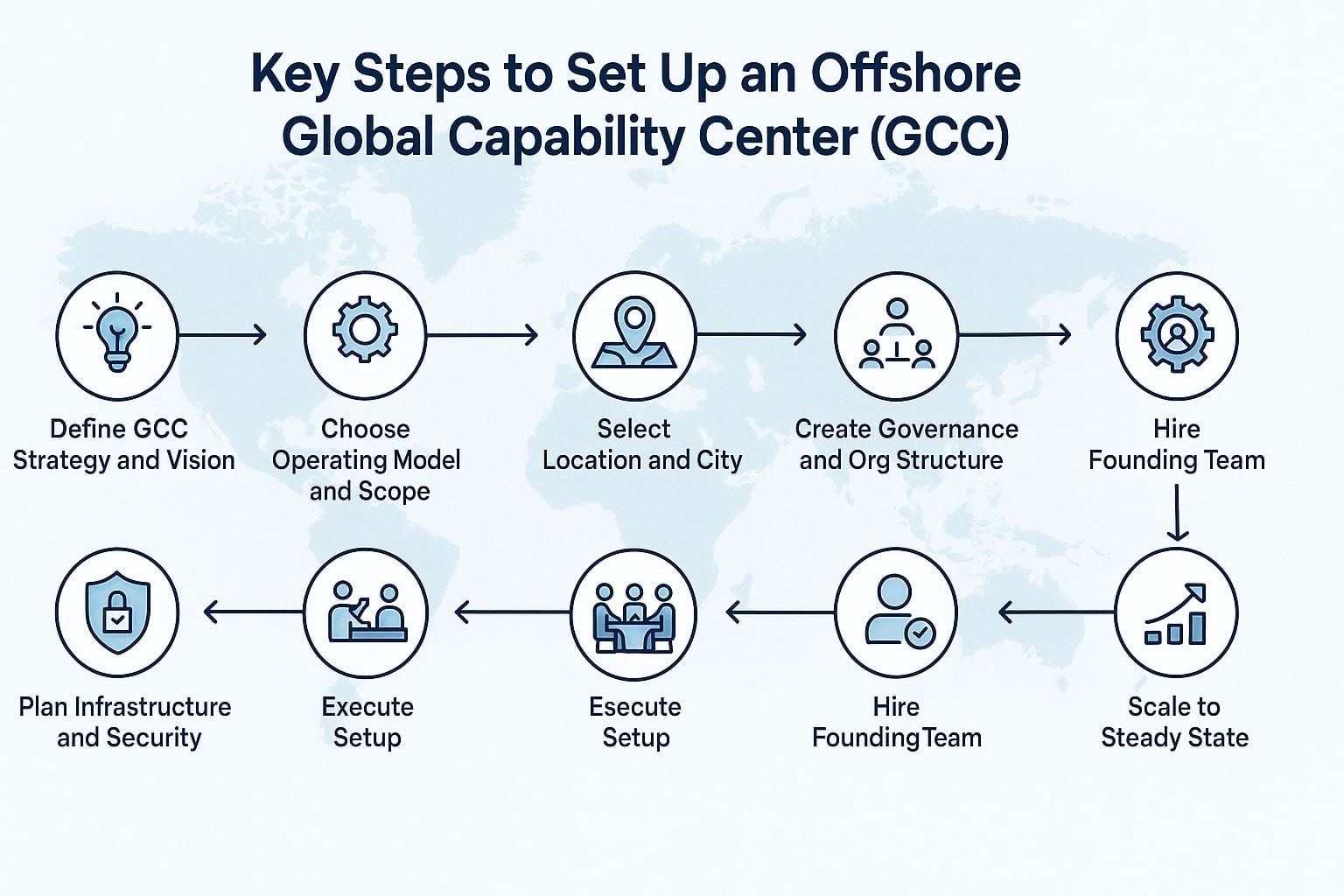
Key Steps to Set Up an Offshore Global Capability Center
Key steps to set up an offshore GCC start with strategy and end with scaling the center to steady state. Each step builds on the previous one and should be handled in a structured, program-managed way.
Define GCC Strategy and Vision
Defining GCC strategy gives clarity on why the center exists and what success looks like. You should articulate the primary objectives: cost, innovation, speed, risk diversification, or a mix of these. Translate this vision into a 3-year roadmap covering functions, headcount, and expected value.
Choose the Operating Model and Scope
Choosing the operating model determines how the GCC integrates with the parent organization. Decide whether the center will be a pure captive, a build-operate-transfer (BOT) with a partner, or a hybrid model. Define the initial scope of work, service lines, and which processes or products will be owned from day one.
Select Location and City
Selecting the location drives your access to talent, cost structure, and regulatory environment. Evaluate short-listed countries and cities on talent depth, cost levels, infrastructure, language, and stability. Engage local advisors, industry bodies, and existing GCC peers to validate your assumptions before deciding.
Create Governance, Org Structure, and Leadership Model
Creating robust governance ensures the GCC is accountable and aligned with headquarters. Design the reporting lines, leadership roles, decision rights, and escalation paths between the GCC and global teams. Appoint a strong site head and functional leaders who can operate in a global matrix without daily supervision.
Plan Infrastructure, Technology, and Security
Planning infrastructure early prevents delays and compliance issues. Define requirements for office space, connectivity, collaboration tools, development environments, and security controls. Work closely with IT, security, and facilities teams to meet corporate standards and local regulations.
Execute Setup, Hire the Founding Team, and Scale
Execution converts the design into a working center.
- Incorporate the legal entity and open banking, payroll, and statutory accounts.
- Finalize office space, network, and core systems.
- Hire a founding leadership team and first wave of critical roles.
- Transition prioritized processes or products using clear playbooks.
- Stabilize operations, capture lessons, and then scale headcount and scope in phases.
Treat the first 12–18 months as a build-and-stabilize phase rather than expecting full value from day one.
Essential Requirements for Establishing an Offshore GCC
Essential requirements for establishing an offshore GCC cover sponsorship, governance, infrastructure, support services and change management. Meeting these requirements early reduces risk and accelerates time to value.
Strong Executive Sponsorship and Business Case
Strong executive sponsorship is non-negotiable for GCC success. You need senior leaders who actively champion the center, remove roadblocks, and defend the long-term vision when short-term challenges arise. A clear business case with quantified benefits, investments, and timelines helps secure this commitment.
Clear Scope of Work and Service Catalogue
Clear scope prevents confusion and scope creep. Document which activities will move to the GCC, which stay onshore, and how responsibilities split between teams. Create a service catalogue with defined KPIs, SLAs, and interfaces so everyone understands what the GCC owns.
Fit-for-Purpose Operating Model and Governance
A fit-for-purpose operating model ties structure, governance, and processes together. Agree on how decisions are made, which metrics matter, and how disputes are handled. Set up steering committees, operating reviews, and joint planning forums involving both GCC and onshore leaders.
Robust Infrastructure, Security, and Tools
Robust infrastructure and security protect your business and customers. Apply corporate security standards on access control, data protection, development environments, and vendor onboarding. Ensure the GCC has the same collaboration tools, code repositories, and knowledge systems as onshore teams to avoid fragmentation.
Effective Change Management and Internal Alignment
Effective change management keeps stakeholders supportive throughout the journey. Communicate early with employees whose work will move, managers who will work with the GCC, and local HR teams. Provide clear timelines, FAQs, and training so people see the center as a partner rather than a threat.
Best Locations for Setting Up Offshore GCCs
Best locations for setting up offshore GCCs combine deep talent, competitive costs, stable regulations, and good infrastructure. Different regions suit different types of work and time-zone needs.
India and South Asia
India and South Asia remain leading destinations for global capability centers. Cities such as Bengaluru, Hyderabad, Pune, and Chennai offer large engineering, analytics, finance, and customer service talent pools. The ecosystem includes mature vendors, strong telecom infrastructure, and deep experience running GCCs across industries.
Central and Eastern Europe
Central and Eastern Europe are strong choices for nearshore hubs serving Europe and the UK. Countries like Poland, Romania, and Hungary offer high-quality engineering and finance professionals with strong language capabilities. Time-zone overlap with Western Europe makes these centers ideal for collaborative, real-time work.
Latin America
Latin America works well for companies headquartered in North America. Locations such as Mexico, Colombia, and Costa Rica offer proximity, cultural affinity, and overlapping time zones. These hubs are attractive for customer experience, product engineering, and analytics teams that need daily interaction with US stakeholders.
Southeast Asia and Emerging Hubs
Southeast Asia and other emerging hubs provide diversification and specialized skills. The Philippines is strong in customer operations and shared services, while Vietnam and Malaysia are growing in engineering and R&D. Some firms also explore Africa and the Middle East for niche skills and regional coverage.
Many organizations benchmark their plan against insights from global capability centers in India.
Sample Comparison of GCC Regions
|
Region |
Typical Strengths |
Common Functions |
Key Considerations |
|
India & South Asia |
Scale, cost, multi-skill talent |
Tech, analytics, finance, CX |
Competition for top talent, regulations |
|
Central & Eastern Europe |
Language skills, proximity to Western Europe |
Tech, finance, risk, design |
Higher costs than Asia, smaller scale |
|
Latin America |
Time-zone alignment with US |
CX, engineering, analytics, marketing |
Talent depth varies by city |
|
Southeast Asia |
CX strength, emerging tech hubs |
Customer support, shared services, tech |
Maturity varies, regulatory differences |
Cost Factors Involved in Setting Up an Offshore GCC
Cost factors in setting up an offshore GCC include one-time investments, recurring operating costs, and hidden or transition costs. Understanding each bucket helps you build a realistic financial model.
One-Time Setup and Transition Costs
One-time setup costs are incurred while creating the center. These include entity incorporation, legal and advisory fees, office fit-out, initial technology setup, and relocation for key leaders. Transition costs cover knowledge transfer, temporary dual-running of processes, and potential productivity dips during the first phases.
Ongoing People and Operations Costs
Ongoing costs form the majority of GCC spend. They include salaries, benefits, office rent, utilities, licenses, connectivity, and local vendors such as recruitment partners. Factor in annual increments, promotions, and investments in learning and development to avoid underestimating long-term costs.
Hidden and Overlooked Costs
Hidden costs can erode the business case if ignored. Examples include travel between headquarters and the GCC, additional compliance or audit work, and higher management bandwidth in the early years. You should also consider costs of attrition, re-hiring, and time lost when key roles turn over.
Optimizing Total Cost of Ownership
Optimizing total cost of ownership is more important than chasing the lowest hourly rate. Design roles, spans, and skills so teams are productive, not just cheap. Automate repetitive work, standardize platforms across locations, and keep the GCC focused on high-value activities rather than every possible task.
Understanding the reasons to set up global capability centers and skilled talent strengthens your setup strategy.
Talent Requirements for Establishing a GCC
Talent requirements for a GCC cover leadership, functional experts, and enabling teams such as HR and finance. Hiring the right first 50–100 people shapes culture and performance for years.
Site Leadership and Founding Team
Site leadership sets the tone for the entire center. You need a site head who understands both the local market and the parent organization’s culture. Pair this person with founding leaders in key functions who can recruit, mentor, and build scalable teams.
Core Functional and Technical Roles
Core roles depend on the functions you place in the GCC. For engineering-led centers, this includes software engineers, QA, DevOps, architects, and product managers. For shared services, you may focus on finance, HR operations, procurement, or legal support teams with clear process expertise.
HR, Talent Acquisition, and Learning Teams
Strong HR and talent acquisition capabilities are essential from day one. Recruiters with local market knowledge ensure you reach the right candidate pools and move fast on offers. Learning and development teams help build skills, run onboarding programs, and create clear career paths within the center.
Culture Building, Engagement, and Retention
Culture and engagement make the GCC a long-term success rather than a revolving door. Invest in transparent communication, inclusive leadership, and recognition programs that connect employees to the global mission. Provide visible growth paths, rotational opportunities, and exposure to global leaders to keep high performers engaged.
A successful launch depends on applying the best practices in global capability centers from the beginning.
Legal Compliance Required for Setting Up a GCC
Legal compliance for a GCC covers company formation, employment, tax, data privacy, and industry-specific regulations. Ignoring these areas creates serious risk for the parent company.
Entity Registration and Corporate Structure
Entity registration is the first legal step in a new location. You must choose the right corporate structure, such as a private limited company, branch office, or subsidiary, depending on local rules and your tax strategy. Work with local counsel to secure necessary approvals, registrations, and licenses.
Employment and Labor Law Compliance
Employment law defines how you hire, manage, and exit employees. You need compliant employment contracts, policies on working hours and leave, and processes for handling grievances and terminations. Understand rules related to unions, benefits, and mandatory social contributions to avoid disputes or penalties.
Data Privacy, IP Protection, and Cybersecurity
Data privacy and IP protection are critical when sensitive customer or product data flows through the GCC. Align the center with global standards such as GDPR equivalents where applicable and your own internal security policies. Implement clear rules on data access, code ownership, use of open-source components, and third-party vendors.
Taxation, Transfer Pricing, and Incentives
Tax and transfer pricing rules govern how profits and costs are shared between the GCC and the parent entity. Design intercompany agreements that meet local laws and OECD guidelines while reflecting the actual functions and risks in each location. Explore government incentives or special economic zones where available, but ensure compliance with their conditions over the long term.
Contracts, Policies, and Documentation
Well-drafted contracts and policies reduce ambiguity. Standardize templates for vendor contracts, NDAs, IP assignments, and employee handbooks. Maintain accurate documentation of governance structures, approvals, and board decisions to simplify audits and regulatory reviews.
Best Practices for Successfully Running an Offshore GCC
Best practices for running an offshore GCC focus on integration, outcomes, capability building, and continuous improvement. These practices turn the center into a long-term strategic asset.
Treat the GCC as a Strategic Extension, Not Only a Cost Center
Treating the GCC as a strategic extension shifts mindsets on both sides. Onshore leaders involve GCC teams in product roadmaps, strategy discussions, and customer conversations rather than giving them only execution tasks. This trust improves ownership, innovation, and retention of top talent.
Build Strong Integration Between GCC and Headquarters
Strong integration avoids “us versus them” behavior. Use shared objectives, joint planning, and cross-location leadership forums to keep everyone aligned. Encourage regular travel, virtual town halls, and temporary assignments in both directions to build relationships.
Measure Outcomes and Business Impact
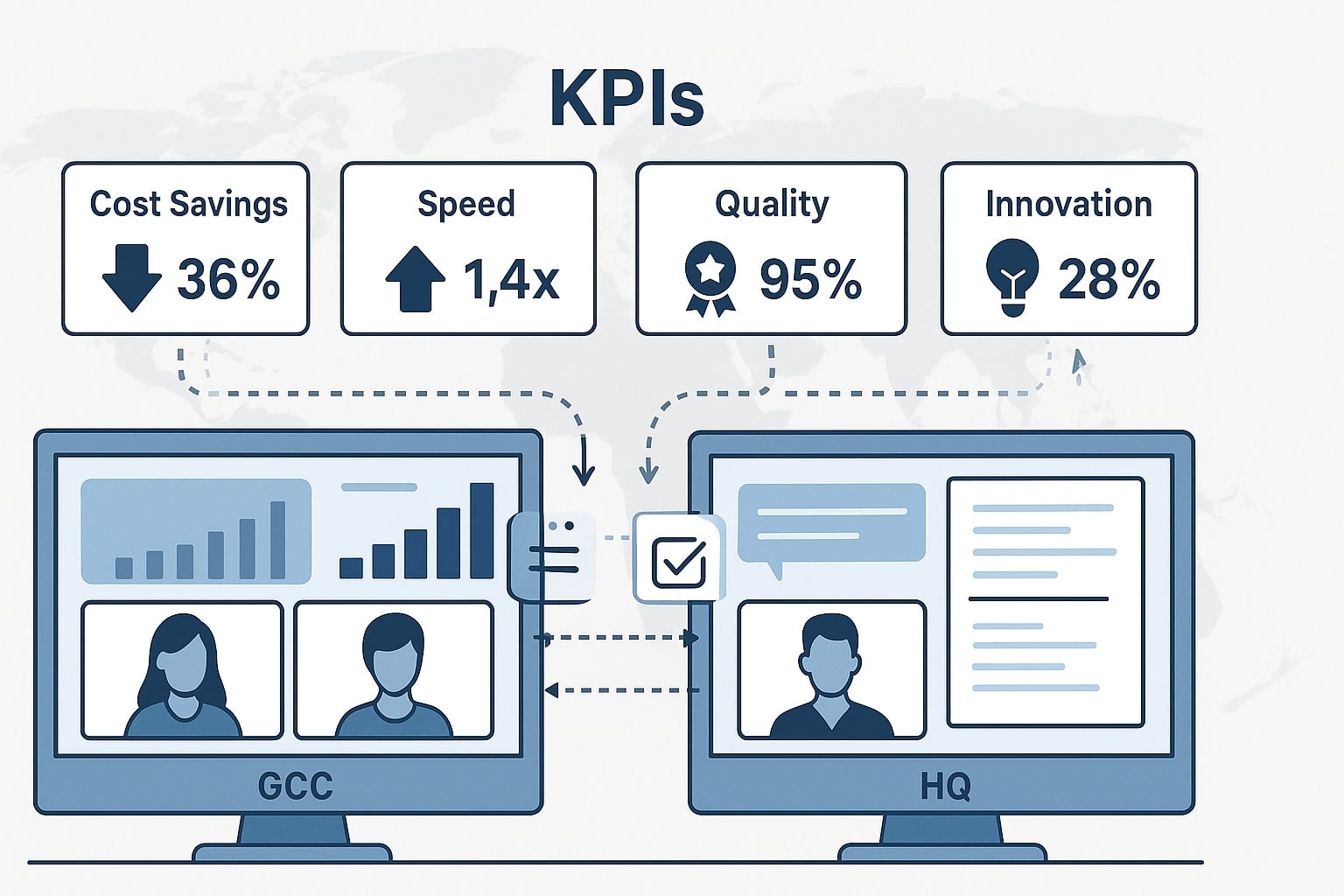
Outcome-based metrics show the GCC’s real value. Track not only cost savings but also release velocity, incident reduction, customer satisfaction, and quality improvements. Link GCC performance dashboards to global business metrics so leaders see the center as a driver of results, not just a line item.
Invest in Capability Building and Career Paths
Capability building keeps the GCC relevant as business needs evolve. Create structured learning paths for technical, functional, and leadership skills.
Provide dual career tracks for specialists and managers so you can grow both deep experts and strong people leaders.
Drive Continuous Improvement and Innovation
Continuous improvement ensures the center does not stagnate. Encourage teams to identify process gaps, automation opportunities, and new services they can own. Recognize and scale successful experiments so the GCC becomes a source of new ideas, not just execution capacity.
Common Challenges in Establishing a GCC
Common challenges in establishing a GCC include misaligned expectations, talent issues, cultural gaps, and regulatory surprises. Knowing these early helps you design mitigation plans.
Misaligned Expectations Between GCC and Headquarters
Misaligned expectations create frustration on both sides. Headquarters may expect instant cost savings and full productivity, while the GCC is still in build mode. Regular communication, a shared roadmap, and realistic milestones help keep everyone aligned on progress.
Talent Attraction and Retention Constraints
Talent challenges often surface once initial hiring is done. Competition for skilled workers, unclear career growth, or weak branding can increase attrition. Investing in employer branding, campus programs, and strong people managers reduces these risks.
Cultural and Collaboration Gaps
Cultural gaps affect communication and decision-making. Differences in communication style, hierarchy, and risk appetite can slow down work or create misunderstandings. Training both GCC and onshore teams in cross-cultural collaboration and clear documentation practices helps bridge these gaps.
Scope Creep and Fragmented Processes
Scope creep happens when work moves in an ad-hoc way without proper planning. The GCC then handles disconnected tasks with inconsistent tools and standards, leading to inefficiency. Guardrails in the service catalogue and a strong intake process ensure new work fits the operating model.
Regulatory, Compliance, or Policy Surprises
Regulatory surprises can disrupt plans or add unplanned costs. Changes in tax rules, employment law, or data restrictions can affect how the center operates. Staying close to local advisors, industry associations, and internal legal teams helps you anticipate and respond to such changes.
FAQs About Setting Up Offshore Global Capability Centers
1. How long does it take to set up an offshore GCC?
It typically takes 12–24 months to set up an offshore GCC from idea to stable operations. The first 3–6 months cover strategy, location selection, and entity formation. The next 9–18 months involve hiring, process transition, and maturity building until the center reaches steady-state performance.
2. What is the minimum scale for a viable GCC?
A viable GCC usually needs at least 50–100 full-time employees within the first two years. Below this size, fixed costs and management overhead can dilute the business case. Larger firms often plan to reach several hundred employees over a 3–5 year horizon to maximize value.
3. Should we start with one function or multiple functions?
Most organizations start with one or two anchor functions rather than many at once. Beginning with a focused scope allows you to hone governance, hiring, and transition playbooks before broad expansion. Once the model proves itself, you can add more functions and business units in a structured way.
4. How is a GCC different from outsourcing or a BPO arrangement?
A GCC is different from outsourcing, unlike outsourcing, because the company owns and manages the center directly. Employees work for your entity, follow your culture, and focus on long-term capability building, not short-term contracts. This model offers deeper integration and stronger IP control, while outsourcing remains useful for flexible or non-core work.
5. When might a company decide not to set up a GCC?
A company might decide not to set up a GCC when scale, complexity, or investment appetite are limited. If you need only a small, short-term team or lack bandwidth to build a new organization, managed service or outsourcing models may be better. You should also reconsider if leadership is not aligned on the long-term commitment required to make a GCC succeed.