


The best practices in Global Capability Centers (GCCs) are structured ways of running operations, people, technology, governance, and performance so the center delivers consistent global value to the parent organization . A mature GCC uses disciplined processes, clear roles, and data-driven decisions to support the parent enterprise across functions and time zones. This guide explains proven guidelines across operations, talent, technology, governance, performance, communication, and leadership so a GCC can move from “support unit” to strategic partner.
Offshore and nearshore GCCs now shape product roadmaps, digital transformation, analytics, and customer experience, focusing on operational efficiency . To succeed at this expanded mandate, centers must balance efficiency with innovation, and autonomy with alignment. The sections below give practical, repeatable practices that leadership teams can apply at any stage of GCC maturity.
Build a high-quality execution engine and hire a GCC team with flexiple vetted experts seamless onboarding guaranteed quality.
What Are the Operational Best Practices for GCCs?
Operational best practices for GCCs are the methods that keep services reliable, predictable, and scalable. They ensure the center can grow without losing quality or control.
|
Best Practice |
Description |
|
Standardized Processes & Playbooks |
Document workflows, ownership, inputs/outputs, and escalation paths to ensure consistency. |
|
Outcome-Focused Service Levels |
Use business-driven metrics like defect reduction, throughput, and first-contact resolution. |
|
Risk, Compliance & Continuity Planning |
Run risk assessments, define controls, and test BCP for outages or disruptions. |
|
Lean Operations & Continuous Improvement |
Remove waste using RCA, Kaizen, and value-stream mapping to improve efficiency. |
|
Capacity Planning & Demand Management |
Forecast staffing and workloads using historical data and intake planning. |
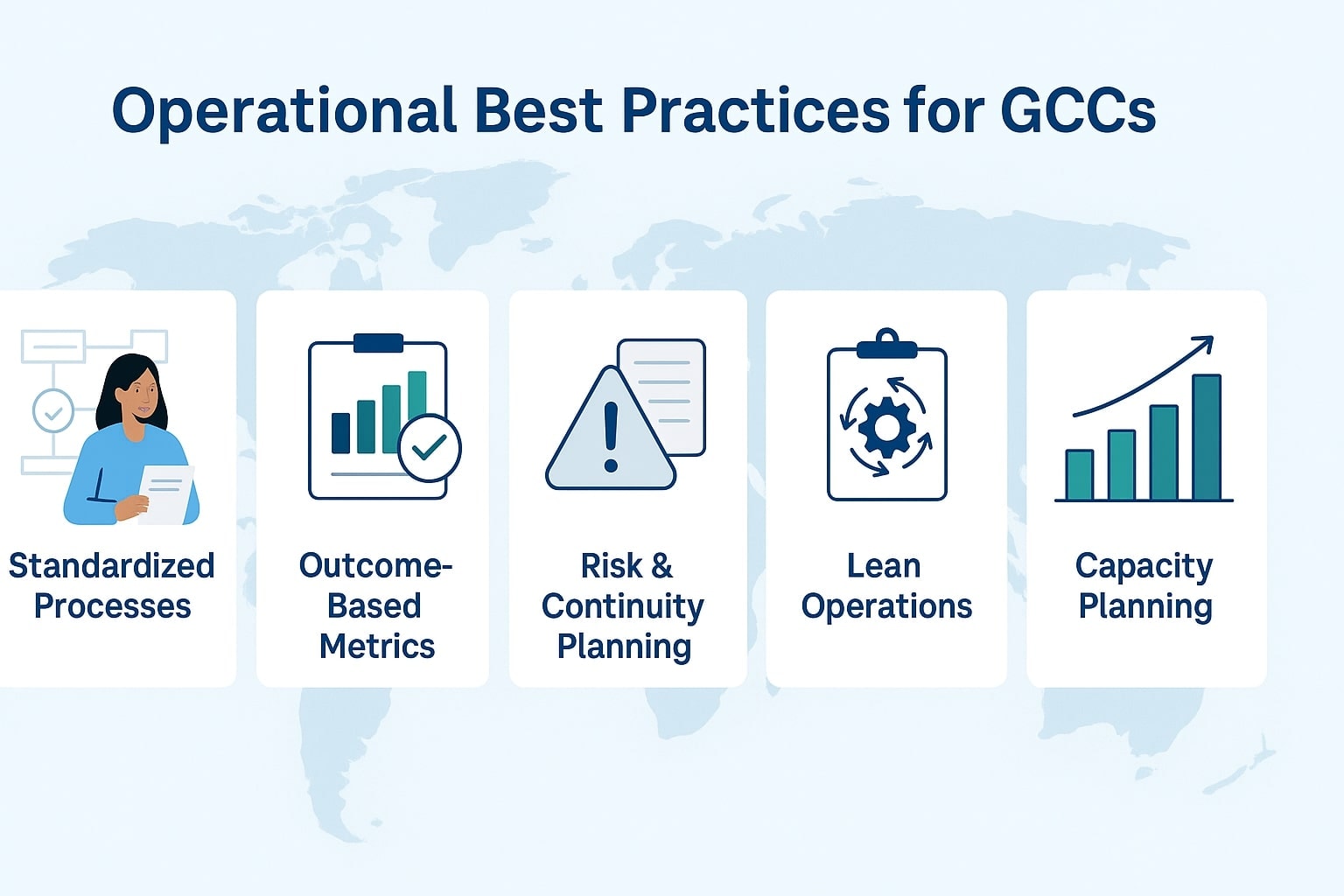
Standardized Processes and Playbooks
Standardized processes are the backbone of operational excellence. The GCC should document end-to-end workflows, ownership, inputs, outputs, and escalation paths in clear playbooks. For example, a standardized incident-management playbook lets technology and operations teams react the same way every time, regardless of who is on shift.
Outcome-Focused Service Levels and Metrics
Outcome-focused service levels help the GCC avoid box-ticking behavior. In addition to traditional SLAs like response time, incorporate metrics such as defect reduction, first-contact resolution, or business throughput. A finance GCC might track accuracy of reconciliations and time-to-close the books, not just the number of tickets processed.
Robust Risk, Compliance, and Continuity Planning
Robust risk and continuity planning protect enterprise operations. The GCC should run periodic risk assessments, define controls, and test business continuity plans for scenarios like network failures or regional disruptions. Tabletop exercises and recovery drills make sure that critical services can continue or restart within defined timelines.
Lean Operations and Continuous Improvement Culture
Lean operations reduce waste and variation. Encourage teams to map value streams, identify non-value steps, and use simple tools such as root-cause analysis or Kaizen events. For instance, a customer support GCC can remove redundant approvals, automate status updates, and cut average handling time while improving satisfaction.
Capacity Planning and Demand Management
Capacity planning ensures the right staffing at the right time. The GCC should use historical data and business forecasts to plan headcount, shift rosters, and cross-training needs. Demand-management routines, such as quarterly intake planning with business units, prevent last-minute fire-fighting and burnout.
Best Practices for Managing and Developing Talent in GCCs
GCCs should manage and develop talent through structured hiring, capability building, engagement, and career paths. People's practices determine whether the center remains stable and high-performing or faces constant churn.
|
Best Practice |
Description |
|
Strategic Workforce Planning |
Define role families, competency levels, and skills needed for the next 2–3 years. |
|
Structured Hiring & Onboarding |
Use standardized interviews and robust onboarding to ensure quality and faster productivity. |
|
Continuous Learning & Upskilling |
Design learning paths with online courses, training, and real-world project experience. |
|
Performance Management & Feedback |
Use balanced scorecards and frequent check-ins to drive accountability and development. |
|
Engagement, Inclusion & Retention |
Support employees with career paths, mentoring, recognition, and inclusive engagement programs. |
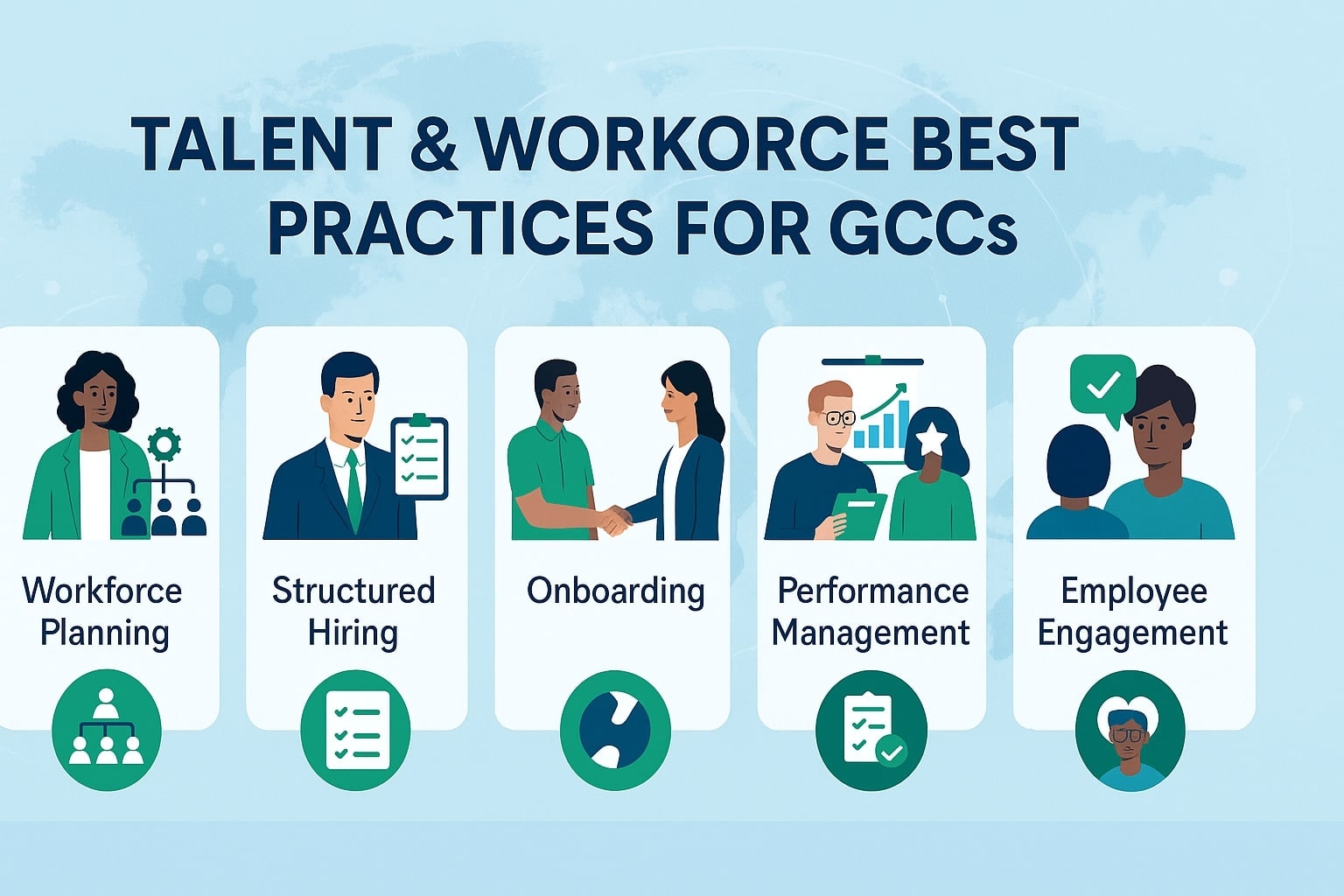
Strategic Workforce Planning and Role Clarity
Strategic workforce planning aligns talent with the GCC mandate. Leadership should define role families, competency levels, and future skills needed for the next 2–3 years. Clear job descriptions and expectations help employees understand how they contribute to global objectives.
Structured Hiring and Onboarding Programs
Structured hiring produces consistent, high-quality talent. Use standardized interview guides, assessment rubrics, and case studies aligned with each role. Comprehensive onboarding that covers tools, processes, and cultural norms helps new hires become productive within the first 60–90 days.
Continuous Learning and Upskilling
Continuous learning keeps GCC talent relevant as technology and business needs evolve. Create learning paths that combine online courses, instructor-led training, and on-the-job projects. For example, analytics professionals might follow a path that covers data storytelling, new platforms, and domain knowledge such as retail or banking.
Performance Management and Feedback Culture
Performance management in GCCs should be transparent and developmental. Use balanced scorecards for employees that combine results, behaviors, and collaboration. Regular check-ins, not just annual reviews, encourage feedback, course correction, and recognition of achievements.
Engagement, Inclusion, and Retention Strategies
Engagement and inclusion protect the center from costly attrition. Run regular engagement surveys, listening circles, and focus groups to understand employee needs. Offer visible career paths, internal mobility, mentoring, and recognition programs that celebrate both individual and team success.
Technology and Innovation Practices in GCCs
Technology and innovation practices in GCCs focus on modern platforms, secure environments, and experimentation driven by technological advancements . GCCs that master these areas become engines of digital transformation for the parent company.
|
Best Practice |
Description |
|
Unified Technology Stack |
Align all tools and platforms with global enterprise standards for consistency. |
|
Secure Engineering & Data Environments |
Implement RBAC, secure coding, vulnerability scans, and sandbox testing environments. |
|
Innovation Frameworks |
Provide structured idea-to-prototype cycles, innovation sprints, and experimentation budgets. |
|
Automation, AI & Analytics Adoption |
Deploy bots, workflow automation, dashboards, and AI models to improve productivity and insights. |
|
Knowledge Management & Reusable Assets |
Store playbooks, reference architectures, and reusable code to reduce rework and speed delivery. |
Unified Technology Stack and Tooling
A unified technology stack reduces friction and fragmentation. Align the GCC’s development, analytics, and collaboration tools with enterprise standards to enable seamless work across locations. For example, using the same CI/CD pipelines and code repositories lets product teams contribute to shared codebases without rework.
Secure, Compliant Engineering and Data Environments
Secure engineering and data environments protect customer and enterprise information. Implement role-based access control, data classification, and secure development practices such as code reviews and vulnerability scanning. Sandboxed environments for experimentation prevent test data from leaking into production systems.
Innovation Frameworks and Experimentation
Innovation does not happen by accident; it needs structure, which is vital for gcc success . Create lightweight frameworks for teams to propose ideas, secure limited funding, run experiments, and measure results. A GCC might run quarterly “innovation sprints” where cross-functional teams prototype solutions for operational pain points or customer journeys.
Automation, AI, and Analytics Adoption
Automation, AI, and analytics amplify the impact of GCC teams. Identify repetitive tasks that can be handled by scripts, bots, or workflow tools, and redeploy people to higher-value work. Analytics teams can build dashboards that highlight process bottlenecks, capacity trends, or customer behavior patterns for decision-makers.
Knowledge Management and Reusable Assets
Knowledge management prevents reinvention and speeds delivery. Store playbooks, design patterns, reference architectures, and reusable code components in organized repositories. When a new project starts, teams can assemble solutions from proven assets instead of starting from a blank slate.
Best Practices for Governance and Compliance in GCCs
Governance and compliance standards for GCCs define how decisions are made, monitored, and controlled. Strong governance keeps the center aligned with enterprise strategy while managing risk, ensuring cultural alignment .
|
Best Practice |
Description |
|
Clear Governance & Decision Rights |
Define steering committees, reporting lines, and decision authority between GCC & HQ. |
|
Policies, Controls & Audit Readiness |
Maintain documented security, vendor, and compliance policies with audit-ready evidence. |
|
Regulatory & Local Compliance |
Track local labor, tax, and data laws; run compliance reviews and trainings. |
|
Vendor & Third-Party Governance |
Use due diligence, SLAs, and data protection clauses when engaging external partners. |
Clear Governance Structures and Decision Rights
Clear governance structures prevent confusion and duplication. Define steering committees, operating councils, and working groups that include both GCC and headquarters leaders. Document who decides strategy, who owns budgets, and who is accountable for operational outcomes.
Policies, Controls, and Audit Readiness
Policies and controls translate high-level governance into daily behavior. The GCC should maintain documented policies for information security, vendor management, remote work, and acceptable use of systems. Audit readiness means records, approvals, and evidence of compliance are organized and easy to access when needed.
Regulatory and Local Compliance Management
Regulatory compliance ensures the GCC operates within local and cross-border laws. Dedicated compliance officers or legal partners should track changes in employment law, tax rules, and data regulations. Regular compliance reviews and training sessions help employees understand their responsibilities.
Vendor, Partner, and Third-Party Governance
Third-party governance is critical when vendors support GCC operations. Use standardized contracts, due diligence checklists, and performance reviews for partners such as staffing firms or technology vendors. Embed clauses on data protection, service levels, and exit terms so the GCC can pivot without disruption if a vendor underperforms.
Integrating the best practices in global capability centers ensures consistent value across the benefits of global capability centers.
How Can GCCs Measure and Optimize Performance?
GCCs can measure and optimize performance by using clear metrics, transparent reporting, and continuous improvement loops. Without robust measurement, even strong operations may not be recognized or improved.
|
Best Practice |
Description |
|
Balanced Scorecards & KPIs |
Track metrics for cost, quality, speed, risk, and employee health. |
|
Real-Time Dashboards |
Provide transparent visibility into SLAs, backlog, capacity, risks, and incidents. |
|
Root-Cause Analysis |
Conduct structured RCA to fix underlying issues and prevent recurrence. |
|
Benchmarking & Continuous Improvement |
Compare against industry/internal benchmarks and run improvement programs regularly. |
Balanced Scorecards and KPI Frameworks
Balanced scorecards give a rounded view of GCC performance. Track indicators across cost, quality, speed, risk, and employee health instead of focusing on a single metric. A technology GCC could monitor deployment frequency, incident severity, customer satisfaction, and unit cost per feature.
Real-Time Dashboards and Transparent Reporting
Real-time dashboards make performance visible to all stakeholders. Use business intelligence tools to visualize SLAs, backlog, capacity, and risk indicators at team and leadership levels. Transparent reporting builds trust with headquarters and enables faster decisions when trends change.
Root-Cause Analysis and Problem-Solving Routines
Root-cause analysis prevents recurring issues. When a service breach occurs, teams should conduct structured reviews that identify process, technology, and behavior factors. Action plans with owners and timelines ensure the GCC fixes underlying causes, not just symptoms.
Benchmarking and Continuous Improvement Programs
Benchmarking helps the GCC understand where it stands. Compare metrics with internal peers, industry data, or external benchmarks where available. Formal continuous improvement programs, such as suggestion schemes or Lean projects, help teams close identified gaps.
Communication and Collaboration Best Practices
Communication and collaboration best practices keep global teams aligned and productive. Because GCCs work across time zones and cultures, intentional collaboration design is essential.
|
Best Practice |
Description |
|
Structured Meeting Cadence |
Use stand-ups, weekly ops reviews, and monthly strategic check-ins for alignment. |
|
Clear Documentation |
Maintain single sources of truth for requirements, processes, and designs. |
|
Cross-Cultural Awareness |
Train teams on communication norms, cultural differences, and inclusive practices. |
|
Collaboration Tools & Remote-First Practices |
Use shared digital tools and async communication norms to support distributed teams. |
Structured Cadence of Meetings and Reviews
A structured cadence of meetings creates rhythm and predictability. Combine daily stand-ups, weekly operations reviews, and monthly strategic check-ins between GCC and headquarters teams. Shared agendas, notes, and follow-ups ensure time is used for decisions rather than updates alone.
Clear Documentation and Single Sources of Truth
Clear documentation reduces dependency on individual memory. Use shared spaces for requirements, architecture diagrams, process maps, and FAQs. A single source of truth for each domain prevents conflicting versions of plans or metrics.
Cross-Cultural Awareness and Inclusion
Cross-cultural awareness helps prevent friction and aids in cultural integration . Provide training on communication styles, decision-making norms, and holidays across locations. Inclusive practices, such as rotating meeting times and inviting diverse voices, strengthen collaboration and psychological safety.
Collaboration Tools and Remote-First Practices
Modern collaboration tools are essential for distributed GCC teams. Adopt shared chat, video, whiteboarding, and project management platforms with agreed norms on usage. Remote-first practices—like documenting decisions in channels and recording key meetings—support both office and remote staff.
These principles form the foundation of how to set up offshore global capability centers successfully.
Strategic Leadership Principles for Managing GCCs
Strategic leadership principles guide how GCC heads and senior managers shape the center. Leadership mindsets often determine whether the GCC is seen as tactical or truly strategic.
|
Best Practice |
Description |
|
Vision, Purpose & Long-Term Roadmap |
Define how the GCC supports innovation, customer value, and global growth. |
|
Empowerment & Accountability |
Give GCC leaders autonomy within clear boundaries and expect transparent outcomes. |
|
Stakeholder Management |
Build strong partnerships with business units through regular engagement and shared charters. |
|
Leadership Development & Succession |
Grow internal leaders and ensure continuity for critical roles with succession plans. |
Vision, Purpose, and Long-Term Roadmap
A clear vision and purpose anchor the GCC’s role in the enterprise. Leaders should articulate how the center contributes to customer value, innovation, and competitiveness. A multi-year roadmap, refreshed annually, gives employees confidence that the GCC will continue to grow and evolve.
Empowerment, Autonomy, and Accountability
Empowerment balances autonomy with accountability. Headquarters should give GCC leaders room to make local decisions on hiring, operations, and innovation within clear boundaries. In return, GCC leaders own outcomes and transparently report performance against agreed goals.
Stakeholder Management and Internal Partnerships
Stakeholder management keeps relationships healthy with business units and functional leaders, which is key for employee engagement . Site heads should regularly meet global stakeholders, understand their priorities, and identify how the GCC can support them. Co-created charters or partnership agreements clarify expectations and ways of working.
Leadership Development and Succession Planning
Leadership development protects the center from dependency on a few individuals. Invest in programs that build people managers, technical leaders, and future site heads from within the GCC. Succession plans for critical roles ensure continuity when leaders move on or take new assignments.
Industry-specific models like the leading global capability centers for real estate offer practical benchmarks.
FAQs About Best Practices in Global Capability Centers
1. How often should GCCs review and update their best practices?
GCCs should review key practices at least once a year and after major organizational or technology changes. Operational processes may need quarterly refreshes, while governance frameworks can be reviewed annually. Regular retrospectives and feedback from stakeholders reveal areas that need adjustment sooner.
2. What is the first best practice a new GCC should focus on?
A new GCC should first focus on process clarity and governance. Documenting scope, decision rights, and core workflows prevents confusion as teams grow. Once this foundation is in place, the center can invest more heavily in automation, innovation, and advanced metrics.
3. How can a mature GCC identify gaps in its current practices?
A mature GCC can identify gaps through benchmarking, audits, and stakeholder interviews. Comparing metrics and practices with other centers or industry data highlights areas where performance lags. Independent assessments by internal audit or external advisors also provide an objective view of maturity.
4. Do best practices differ between technology GCCs and shared services GCCs?
Core principles are similar, but emphasis varies. Technology GCCs focus more on engineering practices, DevOps, and product collaboration, while shared services GCCs emphasize standardization, transactional accuracy, and process automation. Both types still rely on strong governance, talent development, and performance measurement.
5. How should GCCs communicate their best practices to the wider enterprise?
GCCs should communicate best practices through playbooks, internal portals, and regular knowledge-sharing sessions. Case studies that show business impact make these practices more compelling for global teams. By positioning the GCC as a source of proven methods, the center strengthens its reputation as a strategic partner.