


The benefits of Global Capability Centers (GCCs) include cost efficiency, access to skilled talent, faster innovation, stronger governance, and scalable growth. GCCs function as dedicated, in-house innovation hubs that own critical work for global organizations rather than acting as external vendors. When designed well, they become long-term strategic assets that strengthen competitiveness across operations, technology, and customer experience.
GCCs have evolved from back-office support units into centers of operational excellence for digital, analytics, and product development. They help organizations simplify global operations, standardize processes, and reduce risk while staying close to customers and markets. This article explains the key advantages of GCCs across seven core dimensions and answers common questions leaders ask before investing.
You can drive innovation and these benefits further when you build a GCC team with flexiple vetted experts seamless onboarding guaranteed quality.
Key Benefits of Global Capability Centers
Key benefits of Global Capability Centers span operations, cost, talent, innovation, governance, scalability, and strategic impact. Together, these advantages make GCCs one of the most powerful models for building long-term global capabilities and supporting strategic initiatives .
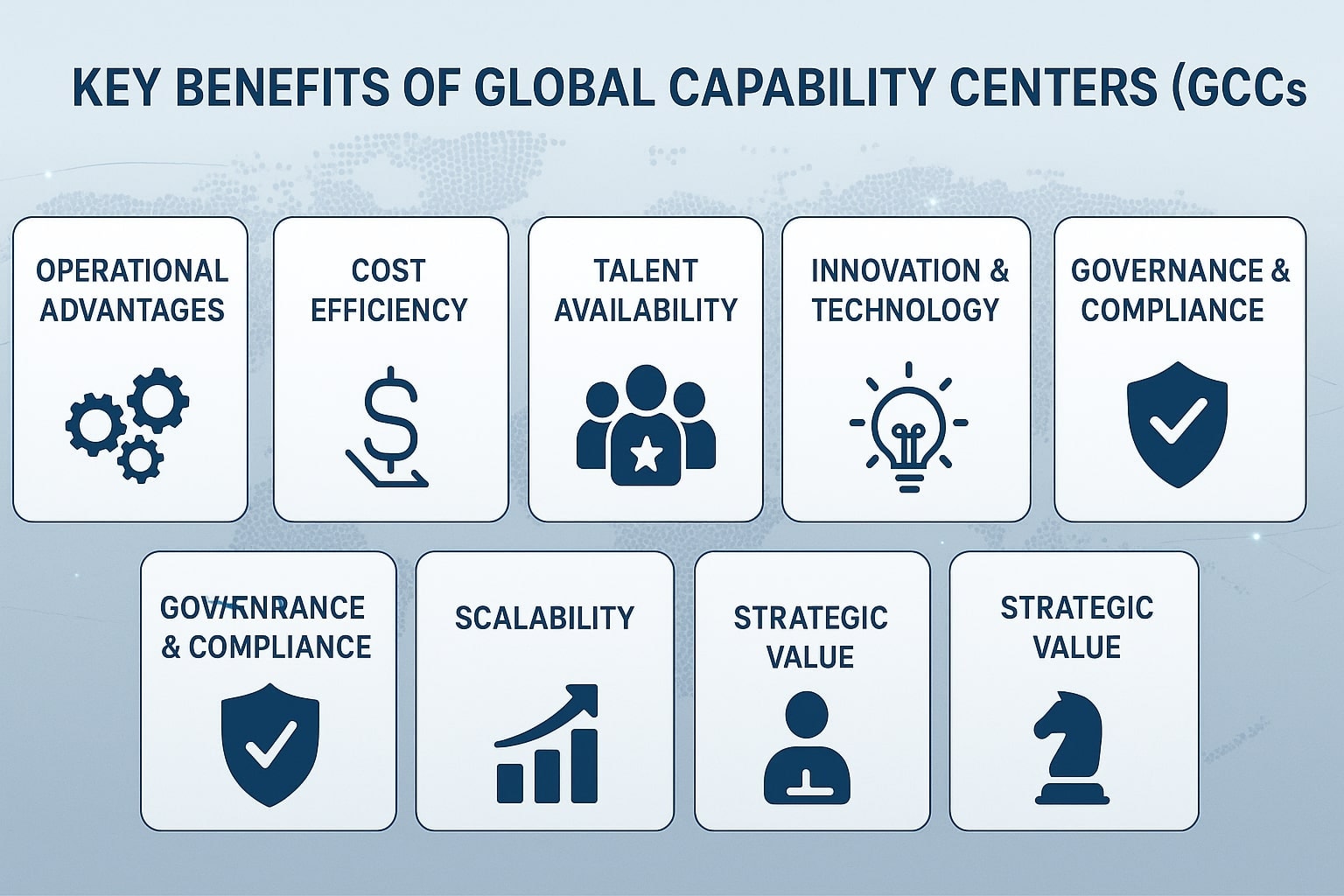
Operational Advantages of GCCs
Operational advantages of GCCs come from standardization, process ownership, and end-to-end accountability. Because the center sits inside the organization, teams follow the same standards, tools, and controls as onshore units. This alignment reduces handoffs, duplication, and confusion that often appear in fragmented vendor networks.
GCCs make it easier to centralize repeatable processes and design shared platforms. Global teams can run common workflows for finance, HR, technology, or customer operations from one location. This model improves consistency, reduces error rates, and shortens cycle times for core activities.
Operational transparency improves when GCCs work with clear metrics and dashboards. Leaders see work queues, service levels, and incident trends in real time rather than relying on vendor reports. This visibility supports continuous improvement and quick corrective actions when performance drifts.
Cost Efficiency Benefits of Global Capability Centers
Cost efficiency benefits of GCCs come from labor arbitrage, optimized structures, and reduced vendor margins. By locating teams in high-talent, lower labor costs markets, companies lower run-rate costs without sacrificing skill levels. Savings accumulate each year while the organization keeps direct control over work and intellectual property.
GCCs reduce dependency on multiple external vendors and their contract overhead. Companies avoid mark-ups on hourly rates, change-order fees, and duplicate account-management layers. This streamlined model delivers a better total cost of ownership over a three-to-five-year horizon.
Well-designed centers also reduce waste inside the organization. Unified platforms, shared services, and consolidated roles limit overlap between business units and countries. Over time, these efficiencies produce structural savings, not just one-time reductions.
These advantages are clearly visible in the rapidly growing global capability centers in India ecosystem.
Talent Availability Advantages for GCCs
Talent availability advantages for GCCs arise from access to large, specialized labor markets. Locations such as India, Eastern Europe, and Latin America offer deep pools of engineers, analysts, finance experts, and customer specialists. Companies tap into the global talent pool to build multidisciplinary teams that would be hard to assemble in a single high-cost city.
GCCs become magnets for ambitious professionals who want global exposure. They offer opportunities to work on international products, complex problems, and modern technology stacks. This positioning improves employer brand in the region and broadens candidate pipelines over time.
The GCC model also supports structured workforce planning. Talent teams can run campus programs, rotational schemes, and specialized academies tailored to the company’s needs. This systematic approach keeps skills aligned with future priorities rather than reacting to shortages one role at a time.
Innovation and Technology Advantages of GCCs
Innovation and technology advantages of GCCs come from concentrated expertise and modern engineering practices. When product, design, data, and engineering sit together in the center, they can own end-to-end digital journeys. This setup increases release velocity and supports digital transformation while reducing delays caused by scattered teams and fragmented ownership.
GCCs often host dedicated labs or centers of excellence for cloud, data, cybersecurity, or automation. These units experiment with new tools, build reusable components, and support global rollouts. Their work amplifies innovation across the enterprise instead of solving the same problems in multiple locations.
The model also encourages adoption of modern delivery approaches. Agile methods, DevOps practices, and platform engineering can be standardized across GCC teams. This consistency improves quality, reduces incidents, and shortens time to market for new features.
Governance, Compliance, and Quality Benefits of GCCs
Governance, compliance, and quality benefits of GCCs arise from direct control and unified standards. Because GCC employees work for the organization itself, leaders can apply the same policies and controls as in headquarters, aligning with overall business strategy . This alignment reduces risk compared with fragmented outsourcing arrangements.
Centralized teams make it easier to embed regulatory and audit requirements. Data privacy, cybersecurity, and risk management controls can be designed once and applied across processes. Internal audit, risk, and compliance teams gain a clear view of how critical work is executed.
Quality improves when GCCs work under shared frameworks and metrics. Centers can deploy common QA practices, testing tools, and peer review processes across products and functions. This discipline drives more consistent outcomes for customers and regulators.
Maximizing these benefits requires implementing fundamental best practices in global capability centers across teams.
Business Scalability Advantages Through GCCs
Business scalability advantages of GCCs emerge from the ability to grow capacity quickly without rebuilding local setups each time. Once the center is established, new teams and functions can be added using proven hiring and onboarding playbooks. This flexibility supports fast expansion into new markets, products, or customer segments.
GCCs make it easier to absorb seasonal or project-based spikes. Shared pools of engineers, analysts, or customer service staff can be reallocated across programs as demand shifts. This model reduces reliance on short-term contractors or emergency vendor engagements.
Scalability also applies to capabilities, not just headcount. Centers that start with support or operations often evolve into hubs for analytics, automation, and product development. This layered growth increases the strategic value of the GCC with each new wave of responsibility.
Strategic Value of Establishing a GCC
Strategic value of establishing a GCC lies in its role as a long-term competitive advantage. A mature GCC becomes a platform for global transformation, not just a cost lever. It supports digital initiatives, new business models, and stronger customer experiences across regions.
GCCs create organizational resilience by diversifying locations and capabilities. Critical operations run from multiple geographies, reducing exposure to local disruptions such as natural disasters . This resilience matters during regulatory shifts, macroeconomic shocks, or sudden changes in customer demand.
The center also deepens institutional knowledge. Teams in the GCC accumulate process, product, and market insights over years of continuous work. This knowledge fuels better decisions, sharper analytics, and more informed strategy discussions at the enterprise level.
Many benefits of global capability centers directly reinforce the core reasons to set up global capability centers.
FAQs About the Benefits of Global Capability Centers
1. How do GCCs improve cost efficiency compared with outsourcing?
GCCs improve cost efficiency by combining labor arbitrage with direct control and long-term capability building. They remove vendor margins, reduce contract overhead, and limit spend on duplicate account management layers. Over time, process standardization and automation inside the GCC create significant cost savings and further structural savings.
2. What types of work benefit most from being done in a GCC?
Work that benefits most from GCCs blends complexity, repeatability, and need for deep domain knowledge. Examples include product engineering, data and analytics, finance operations, procurement, HR services, and customer operations. These activities gain from stable teams, shared platforms, and consistent process ownership.
3. How do GCCs support innovation rather than only back-office work?
GCCs support innovation by concentrating cross-functional digital teams in one place. Product managers, designers, engineers, and data scientists can collaborate daily and own full customer journeys. Centers also run labs and pilots for emerging technologies that later scale across the enterprise.
4. Do GCCs reduce risk or add new types of risk?
GCCs reduce certain risks by allowing direct control over people, processes, and technology. They strengthen data protection, IP security, and regulatory compliance compared with multi-vendor models. However, leaders must still manage location concentration risk by planning for business continuity and multi-site strategies.
5. How do GCCs affect employee experience and culture?
GCCs affect employee experience by offering global exposure, modern work, and clear career paths. Employees gain access to international projects and leadership, which improves engagement and retention. At the same time, organizations must invest in culture building, inclusion, and strong local leadership to keep the center connected to the wider company.
6. When does it make sense to build a GCC instead of relying on vendors?
Building a GCC makes sense when the organization has a steady volume of work and a long-term need for specific capabilities. If cost savings, innovation, or control over IP are strategic priorities, the captive model is usually more attractive. For small, short-term, or highly specialized needs, outsourcing or managed services can still play a useful role alongside the GCC.