


Building a strong global capability centres has become essential for real estate companies aiming to scale technology, operations, and data-driven decision-making. These centers provide certainty, centralization, and high-value expertise across global markets.
They handle critical functions like portfolio analytics, data analytics lease management, property insights, digital automation, and transaction support. Their structure ensures faster execution, tighter compliance, and unified processes.
Modern real estate GCCs strengthen operational resilience, reduce costs, and accelerate digital transformation. They help enterprises remain competitive, adaptable, and ready for future shifts in the global real estate landscape.
Enable faster build-out and gcc setup for Global Capability Centers Team with flexiple vetted experts seamless onboarding guaranteed quality.
What Functions Do Real Estate GCCs Perform Globally?
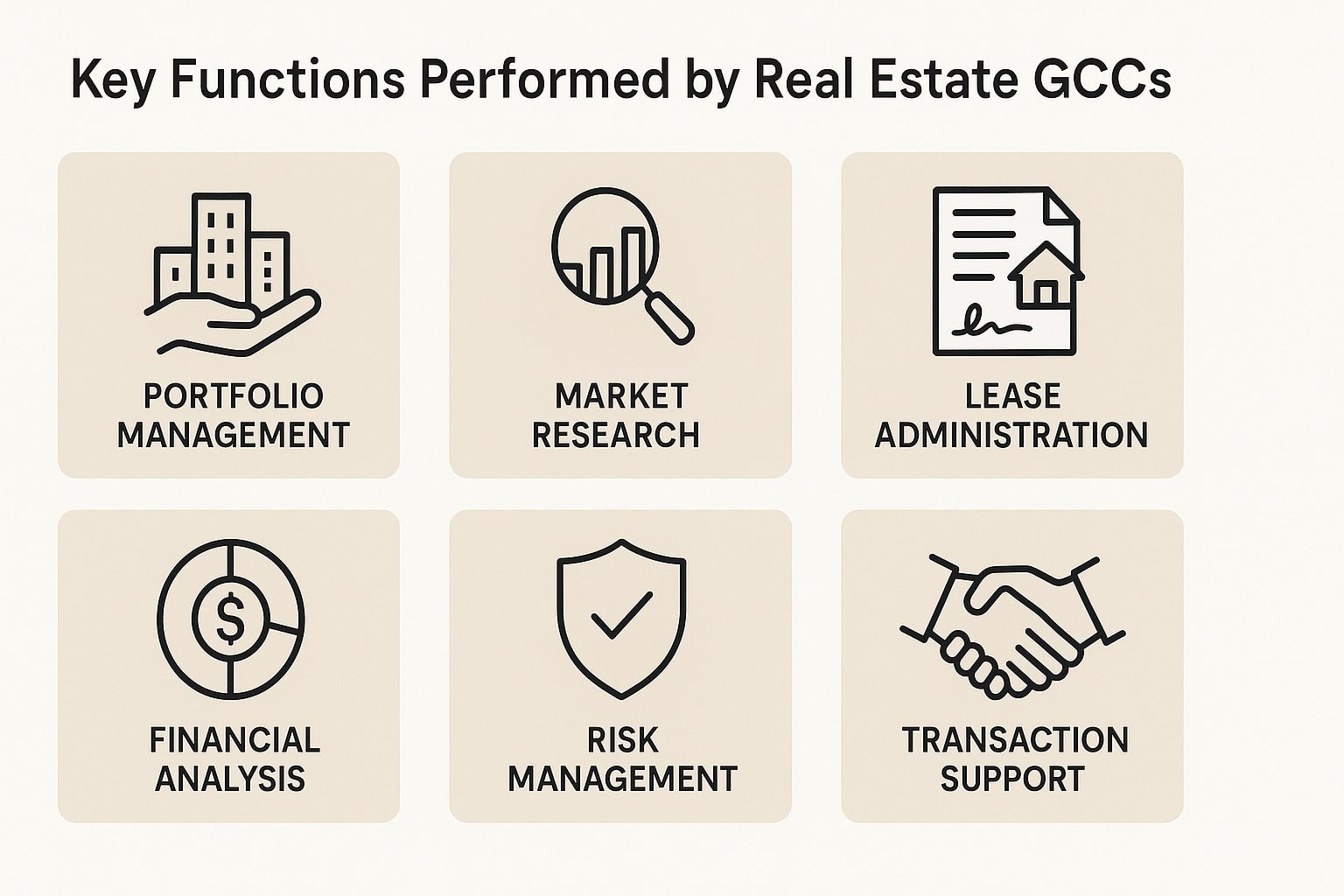
Real estate GCCs handle process excellence, digital transformation, finance activities, tenant management, and data-driven decision support with high certainty. They also manage sustainability, engineering support, and technology modernization for global real-estate organizations.
Key Functions Performed by Real Estate GCCs
- Lease Administration & Portfolio Management: Centralize lease abstraction, renewals, compliance, and portfolio reporting.
- Property & Facilities Operations Support: Manage work orders, vendor coordination, maintenance workflows, and SLAs.
- Transaction Management Assistance: Support acquisitions, dispositions, due-diligence, and market research.
- Financial Planning & Analytics: Handle budgeting, forecasting, CAM reconciliations, rent roll analysis, and controllership tasks.
- Valuation & Investment Research: Provide underwriting models, asset valuations, and investment-grade insights.
- Data Engineering & Business Intelligence: Build dashboards, standardize data flows, and manage real-estate data lakes.
- Technology & Automation: Support CRE software (Yardi, MRI, JLLT), RPA workflows, cloud migrations, and digital twins.
- Sustainability & ESG Reporting: Track energy usage, carbon metrics, certifications, and compliance reporting.
- Tenant Experience & Customer Support: Manage service requests, communication, NPS tracking, and digital tenant platforms.
- Construction & Project Management PMO: Provide scheduling, documentation control, cost tracking, and progress reporting.
Leading Global Capability Centers for Real Estate Worldwide
Here are the most influential GCCs shaping the real estate industry worldwide:
- JLL Technology & Operations Center – India: This center manages AI-powered lease abstraction, sustainability analytics, IWMS platform development, CRE data engineering, and transaction support. It drives global technology and operational workflows for JLL’s real estate portfolio.
- CBRE Global Workplace Solutions Centers – India & Poland: CBRE operates large hubs for 24×7 FM command-center operations, energy programs, space planning, engineering services, and financial shared services. These centers ensure uniform delivery standards across enterprise real estate portfolios.
- Cushman & Wakefield Global Delivery Center – India: This GCC handles valuation modelling, lease management, digital twin development, transaction underwriting, and market research. It strengthens global occupier services with standardized processes and analytics.
- Colliers Shared Services Center – India: Colliers consolidates finance, research, marketing, and CRE analytics here. The center also supports due diligence, digital project workflows, and revenue operations for multiple global markets.
- Brookfield Global Operations Center – India: Brookfield runs advanced asset management, fund modelling, investor reporting, and technology programs from this hub. It supports private equity real estate with forecasting, analytics, and operations excellence.
- Prologis Digital & Analytics Center – USA & India: This center focuses on logistics real estate technology, IoT-enabled warehouse monitoring, ESG benchmarking, and customer experience platforms.
- WeWork Global Services Hub – India: The hub manages pricing analytics, building operations, occupancy modelling, enterprise account workflows, and community experience operations across global coworking sites.
- Hines Global Business Services Center – India: Hines centralizes investment modelling, project controls, procurement, finance, and global development support. It plays a key role in managing international real estate projects.
- Greystar Global Delivery Centers – Spain & India: These hubs support multifamily operations, digital leasing systems, rent-roll analytics, and resident experience technology for Greystar’s global portfolio.
Global real estate firms and multinational corporations rely on specialized capability centers to manage critical functions such as asset optimization, lease administration, technology operations, sustainability reporting, and financial planning. These hubs serve as the operational backbone for large portfolios by bringing together engineering talent, domain experts, and data-driven decision-making. They ensure consistent global delivery and support rapid digital transformation across markets.
These centers strengthen the global real estate value chain by combining domain expertise with strong digital capabilities. Their integrated operating models ensure high-quality service delivery, improve operational efficiency, and accelerate innovation across markets. As real estate continues shifting toward data-led decision-making, these GCCs remain essential for scaling global operations and delivering consistent portfolio performance.
Major Real Estate GCC Locations Around the World
Major Real Estate GCC locations around the world span key global hubs where property technology, investment analytics, and real-estate operations are centralized and scaled. These cities host advanced Global Capability Centers that support functions such as cost saving, digital leasing, facilities management, portfolio optimization, valuation, research, and ESG reporting. They also anchor large engineering, analytics, and shared-services teams that help leading real estate enterprises run global operations with speed and accuracy.
These GCC destinations offer strong talent availability, cost-effective scalability, and mature business ecosystems. They also enable real estate companies to build multi-disciplinary centers that handle everything from PropTech development to centralized transaction management.
Key GCC Locations:
- India (Bengaluru, Hyderabad, Pune, Gurgaon): Established hubs with deep engineering, analytics, and property-operations talent supporting global real estate majors.
- Philippines (Manila, Cebu): Strong customer operations, lease administration, and shared services capability.
- Poland (Kraków, Warsaw, Wrocław): European hubs for research, asset-management analytics, and financial operations.
- United Arab Emirates (Dubai, Abu Dhabi): Regional centers for Middle East property portfolios, PropTech innovation, and investment oversight.
- Singapore: Strategic hub for APAC real estate portfolio governance and digital transformation initiatives.
- Malaysia (Kuala Lumpur, Penang): Mature talent for facilities management, financial planning, and centralized support.
- Mexico (Guadalajara, Mexico City): Nearshore locations for North American real estate operations and data processing.
- South Africa (Cape Town, Johannesburg): Key centers for financial operations, research, and property-services outsourcing.
These locations have emerged as dependable bases for real estate GCC expansion due to their strategic importance, modern infrastructure, multilingual workforce, and proven capability in handling complex property-sector processes. Companies rely on these hubs to drive digital modernization, support global portfolios, and strengthen enterprise resilience.
The industry’s shift toward global delivery is supported by strong reasons to set up global capability centers.
Benefits of Global Capability Centers for Real Estate Firms
Global Capability Centers for Real Estate firms deliver several clear advantages. A real estate GCC is a dedicated offshore or nearshore hub that owns repeatable work across leasing, asset management, finance, and PropTech. It helps global portfolios scale without overloading regional teams. It also brings consistency to property data, tenant operations, and project delivery across markets. Over time, this setup becomes a stable way to run worldwide real estate functions.
1. Cost Optimization & Operational Efficiency
-
- GCCs centralize functions like finance, leasing operations, analytics, and compliance.
- Real estate firms significantly reduce overhead compared to onshore teams.
- Standardized workflows drive faster turnaround and fewer errors.
2. Access to Specialized Talent
-
GCCs allow real estate companies to tap into global talent pools across:
- Financial modeling
- Market research & investment analytics
- Lease administration
- Technology & automation
-
This leads to stronger decision-making and more robust support for transactions.
3. Scalable Support for Expansion
- As real estate portfolios grow across geographies, GCCs provide scalable back-end capacity.
- Firms can quickly add new teams for acquisitions, property management, customer service, or ESG reporting.
4. Technology & Digital Transformation
-
GCCs often become hubs for:
- PropTech development
- Data modeling & visualization
- Workflow automation
- AI-based property valuation and forecasting
- This accelerates innovation without high onshore investment.
5. Better Control & Data Security
-
Unlike outsourcing, GCCs are fully owned, giving real estate firms:
- Higher data governance
- Standardized processes
- Stronger compliance (especially important for regulated markets)
6. Enhanced Customer & Tenant Experience
-
GCC teams can handle:
- Tenant support
- Lease documentation
- Billing & collections
- Facility service coordination
- Centralized service leads to faster responses and improved tenant satisfaction.
7. Support for Sustainability & ESG Goals
- GCCs increasingly manage ESG data tracking, energy monitoring, and reporting.
- Real estate firms benefit from:
-
- Consolidated sustainability dashboards
- Better compliance with global standards
- Proactive risk management
8. Round-the-Clock Productivity
-
With a global footprint, GCCs enable 24/7 operations:
- Faster deal underwriting
- Continuous property monitoring
- Rapid document processing during transactions
9. Strategic Capability Building
-
GCCs evolve from cost centers to centers of excellence, driving:
- Market research
- Portfolio optimization
- Risk management
- Digital innovation
10. Improved Time-to-Market for Deals
-
Real estate investment teams receive quicker:
- Market studies
- Valuation models
- Due diligence reports
-
This increases competitiveness in fast-moving markets.
As the center matures, these gains compound year after year. Leadership gets tighter control of global real estate workflows with fewer handoffs. Regional teams regain time for strategy, partnerships, and on-ground decisions. The firm also builds a stronger digital backbone for portfolio growth. In short, GCCs turn real estate operations into one coordinated global engine.
How Global Capability Centers Are Transforming Real Estate?
Global Capability Centers are transforming real estate by becoming offshore engines for core and high-value work across the property lifecycle. They take ownership of centralized functions like leasing ops, portfolio reporting, transaction support, valuation modeling, and tenant analytics, so global real estate firms run with one shared nerve center. With dedicated Centers of Excellence, GCCs standardize playbooks for due diligence, asset management, and facilities workflows across regions. This creates faster, more consistent decisions grounded in unified data.
They are also pushing real estate into a deeper proptech and digital-first era. GCC teams build and run AI and automation for demand forecasting, dynamic pricing, and predictive maintenance, alongside GIS mapping, BIM-based design support, and smart building dashboards. They drive ESG reporting, energy optimization insights, and risk controls at scale, using the same platforms across markets. Over time, GCCs shift from back-office support to strategic partners that shape how real estate companies buy, build, operate, and grow.
Rapidly expanding firms often adopt the best practices in global capability centers to accelerate digital transformation.
Key Trends in Real Estate GCCs
Real estate Global Capability Centers (GCCs) are rapidly evolving from support-focused units into strategic engines that drive innovation, digital transformation, analytics, and global operational excellence. Below are the major trends shaping how real estate GCCs operate and deliver value today.
Shifting Real Estate GCCs from Cost Centers to Innovation Hubs
Real estate GCCs are now taking full ownership of platforms, digital products, and enterprise-wide transformation programs. Instead of simply executing back-office tasks, they are spearheading business process redesign, digital modernization, and strategic capability development across leasing, operations, and property management.
Embedding AI and GenAI into Real Estate Workflows
GCCs are building AI and GenAI Centers of Excellence to automate forecasting, pricing models, lease abstraction, document processing, and tenant-support chat or voice assistants. These capabilities help real estate enterprises move faster, cut costs, and improve decision accuracy.
Advancing Analytics for Portfolio and Asset Strategy
Teams within GCCs are enabling data lakes, BI dashboards, and modeling engines to support occupancy insights, NOI improvement programs, capex planning, and real-time risk scoring. This shift positions GCCs as analytics powerhouses behind portfolio decisions.
Engineering PropTech and Smart-Building Solutions
More real estate GCCs are leading development of digital twin platforms, smart-building IoT systems, BIM automation tools, CAE capabilities, and global facility-operations software. These in-house tech solutions accelerate innovation and reduce reliance on external vendors.
Delivering Scaled ESG and Sustainability Programs
GCCs now own critical sustainability processes, including carbon accounting, green-building documentation, energy optimization models, and ESG reporting frameworks. This centralization ensures standardization and compliance across global assets.
Consolidating Multi-Functional Real Estate Shared Services
Instead of operating siloed functions, organizations are integrating finance, lease operations, engineering support, legal, procurement, and customer experience teams into unified GCC structures. This drives efficiency, collaboration, and coordinated delivery.
Expanding Distributed Talent Models and Tier-2 Footprints
Real estate GCCs are diversifying workforce locations by building teams in Tier-2 cities to access larger talent pools, reduce cost pressures, and strengthen risk resilience. Distributed teams also support 24/7 global delivery models.
Strengthening Cybersecurity for Property and Tenant Data
As smart buildings and tenant apps generate increasing volumes of sensitive data, GCCs are enhancing cybersecurity posture, privacy controls, and governance. This includes securing IoT networks, access systems, and transactional platforms.
Automating Transaction-Heavy Real Estate Operations
GCCs are redesigning processes like lease administration, invoice validation, vendor onboarding, and compliance checks using RPA and AI. This reduces manual work, improves accuracy, and accelerates cycle times across operations.
Aligning GCC Capabilities with Global Real Estate Strategy
Leadership responsibilities, decision rights, talent strategies and strategic planning functions are increasingly shifting to GCCs. They now partner directly with global business heads to support portfolio growth, operational model changes, and technology-driven transformation.
Real estate companies increasingly rely on the competitive advantage and benefits of global capability centers to modernize operations.
FAQs About Leading Global Capability Centers for Real Estate
1. What are Global Capability Centers for Real Estate?
They are dedicated offshore or nearshore hubs where real estate firms centralize high-value work like property operations, analytics, and proptech development. They run as long-term extensions of the core real estate team, with clear ownership and governance.
2. How are real estate GCCs different from traditional shared service centers?
They take end-to-end ownership of strategic assets and real estate processes such as portfolio performance, lease lifecycle, and capital project support. They are strategic centers with deep CRE and proptech capability, not just back-office units.
3. Why do global real estate firms set up GCCs?
They access larger talent pools, build 24/7 operational coverage, and scale standardized delivery across geographies. They also improve consistency in reporting, speed of execution, and cost control across portfolios.
4. What functions are commonly handled in a real estate GCC?
Typical functions include lease administration, property accounting, portfolio analytics, valuation support, and investor reporting. Many GCCs also build digital products and support BIM/CAD, facilities, and construction program management.
5. Which locations are leading for real estate GCCs in 2026?
India leads strongly, with Bengaluru, Hyderabad, Pune, Chennai, and Delhi-NCR hosting major real estate delivery hubs. Poland, Mexico, the Philippines, and Vietnam are also popular for nearshore and regional coverage.