


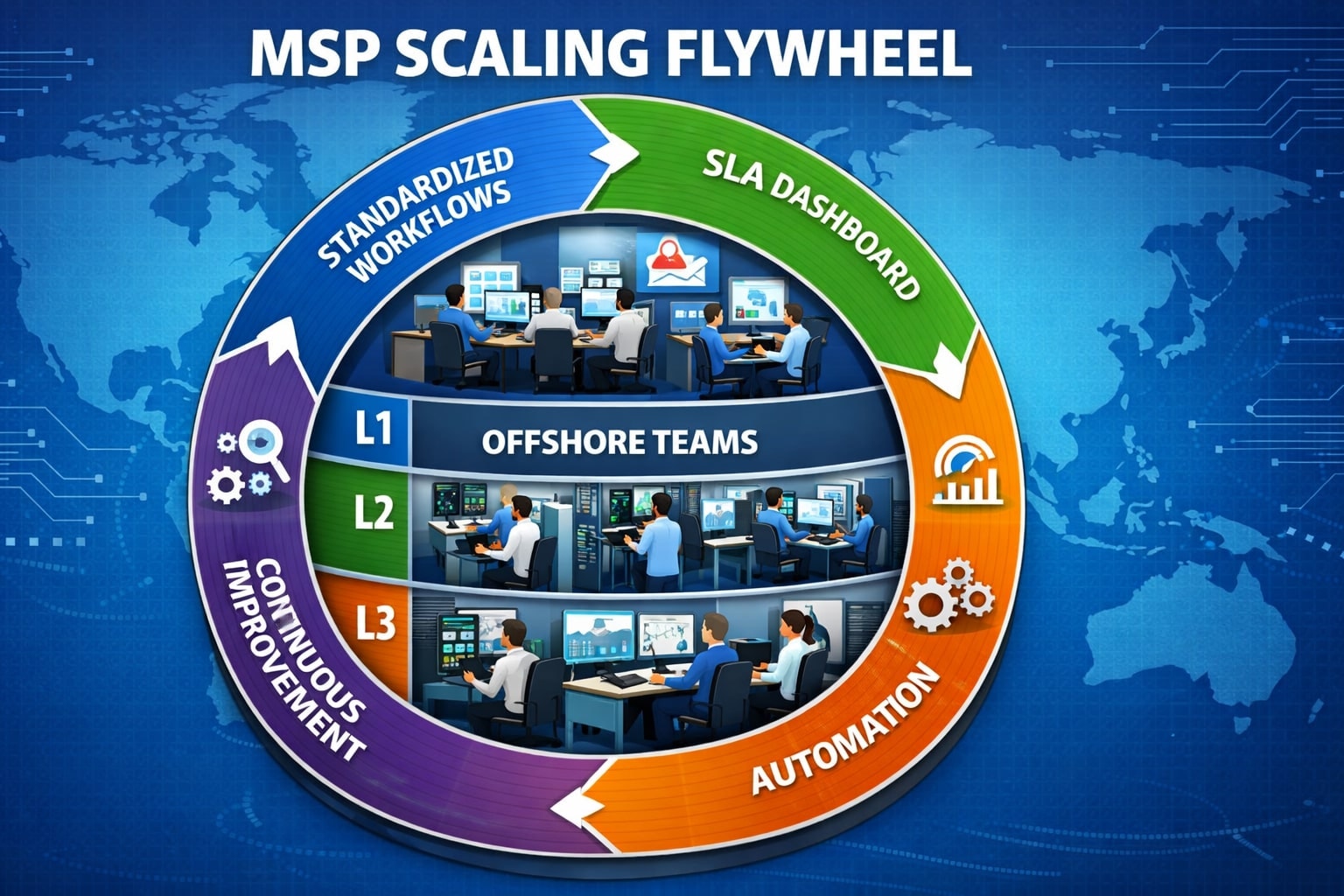
Proven frameworks for scaling MSP operations with offshore teams rely on standardizing service delivery, enforcing measurable SLAs, and using automation to reduce manual coordination. Offshore scale works when an MSP treats operations like a production system with clear inputs, repeatable workflows, and consistent quality gates. Scale breaks when offshore capacity is added without service definitions, escalation design, and end-to-end accountability.
|
Framework |
What It Standardizes |
Why It Matters for Offshore Scale |
|
ITIL-Aligned Service Management |
Incident, request, problem, and change workflows |
Prevents ad-hoc execution and ensures consistent service delivery |
|
Tiered Support & Escalation |
Clear L1, L2, L3 ownership and escalation rules |
Reduces ticket bouncing and customer frustration |
|
SRE-Inspired Reliability Model |
Reliability targets, error budgets, preventive work |
Shifts focus from firefighting to stability and resilience |
|
Standard Work & SOP Framework |
Runbooks, checklists, and repeatable workflows |
Enables consistent execution and faster offshore onboarding |
|
Service Catalog & SLA Framework |
Defined services, scope, and success criteria |
Prevents scope creep and enforces measurable SLAs |
|
Operating Cadence & Governance |
Weekly reviews, escalation rituals, accountability |
Improves predictability and continuous improvement |
|
Shift-Based Coverage Model |
On-call rotations and time-zone coverage |
Expands coverage without overtime or burnout |
|
Lane-Based Work Allocation |
Dedicated queues for alerts, access, patching |
Improves throughput and reduces context switching |
|
Knowledge Management Framework |
KB articles, documentation, runbooks |
Improves first-contact resolution and reduces escalation noise |
|
Automation-First Operations |
Ticket routing, alert deduplication, self-service |
Reduces manual work and enforces consistency at scale |
MSP operations are fundamentally different from product engineering because customer-facing reliability is the core output. Tickets, incidents, changes, and scheduled maintenance must flow predictably every day. Offshore teams can increase coverage and reduce cost, but only when the operating model prevents drift in response time, resolution quality, and communication.
Managed Service Providers often lift their capacity and consistency by adopting effective strategies for offshore BPO teams that emphasize SLA visibility, knowledge transfer, and continuous improvement.
Why Use Offshore Teams for Scaling MSP Operations?
Offshore teams are used for scaling MSP operations because MSP demand is continuous, labor-intensive, and sensitive to response time. Offshore capacity can increase service coverage, improve utilization, and support 24/7 operations without requiring local hiring in every time zone. The value is highest when offshore teams are integrated into the same service system rather than operating as a separate back office.
Offshore Teams Expand Coverage Without Rebuilding the Org
Coverage expands when offshore teams support shifts, on-call rotations, and after-hours escalation with clear runbooks. This reduces dependence on overtime and reduces burnout risk. Coverage is most effective when shift design and escalation are defined in advance.
Offshore Teams Improve Cost Structure for High-Volume Work
Cost structure improves when high-volume tasks such as L1 triage, monitoring, patching, and routine service requests can be handled at scale. Cost advantages matter most when quality is stable. Cost advantages disappear when rework and escalations increase.
Offshore Teams Support Faster Ramp for New Customers
Customer onboarding becomes faster when there is a repeatable onboarding workflow and a staffed delivery bench. Offshore teams help build that bench. Faster onboarding supports MSP growth without sacrificing existing account performance.
Offshore Teams Provide Access to Specialized Skills
Specialized skills such as cloud operations, security operations, network engineering, and automation engineering are often easier to source across wider markets. A blended model allows offshore teams to own specialized lanes rather than only basic triage. Specialization improves resolution quality and reduces ticket bounce.
As MSPs scale internationally, it’s important to prepare proactively for common challenges of managing offshore teams like time-zone coordination and skill alignment.
What Frameworks Support Scaling MSP Operations With Offshore Teams?
Frameworks support MSP scaling by providing structured service design, governance, and continuous improvement. The most useful frameworks translate into concrete operating systems: workflows, roles, SLAs, and measurement. Offshore teams fit best when they align to a single service management model rather than multiple local variants.
ITIL-Aligned Service Management Framework
An ITIL-aligned approach supports consistent incident, request, problem, and change management. The practical value is consistency, not certification. Consistency prevents offshore execution from becoming ad hoc.
Tiered Support and Escalation Framework
Tiered support frameworks define L1, L2, and L3 responsibilities with clear escalation rules. Offshore teams often start in L1 and move into L2 as maturity increases. Tier clarity reduces ticket bouncing and reduces customer frustration.
SRE-Inspired Reliability Framework for MSP Environments
SRE concepts translate well to MSP delivery when focused on reliability outcomes. Error budgets and reliability targets create a shared view of acceptable risk. SRE thinking reduces firefighting by prioritizing preventive work.
Standard Work and SOP Framework
Standard work frameworks create repeatable execution by converting best practice into SOPs, runbooks, and checklists. Offshore delivery depends heavily on standard work because tacit knowledge is harder to transfer remotely. Standard work also improves onboarding speed.
Service Catalog and SLA Framework
A service catalog defines exactly what is included for each customer and what success looks like. SLAs become enforceable only when services are clearly defined. A strong catalog reduces disputes and reduces scope creep.
Operating Cadence and Governance Framework
Governance frameworks define weekly and monthly review rituals, escalation procedures, and continuous improvement ownership. Cadence reduces surprises and improves predictability. Offshore programs scale faster when governance is routine and measurable.
How Do Offshore Teams Improve MSP Service Delivery?
Offshore teams improve MSP service delivery by increasing responsiveness, stabilizing day-to-day throughput, and improving documentation and standardization through repeatable execution. Offshore delivery is strongest when teams own service lanes end-to-end rather than handling fragmented tasks.
Improved Response Times Through Shift-Based Coverage
Response times improve when offshore teams cover defined hours with clear ownership. Shift-based coverage reduces queue buildup. Response improves further when triage is disciplined and uses templated playbooks.
Faster Ticket Throughput Through Dedicated Lanes
Dedicated lanes reduce contention by grouping similar work types. Examples include a lane for access requests, a lane for monitoring alerts, and a lane for patching windows. Lane-based operating reduces work switching and reduces error.
Higher First-Contact Resolution With Better Knowledge Systems
First-contact resolution improves when offshore teams have strong knowledge base articles and runbooks. Better knowledge reduces ticket ping-pong. Strong knowledge systems also reduce dependency on a few senior engineers.
Reduced Escalation Noise Through Better Intake Quality
Intake quality improves when tickets contain complete context: logs, environment details, user impact, and severity. Offshore teams can enforce intake standards through structured forms and checklists. Better intake reduces investigation time and improves SLA compliance.
What Processes Help Scale MSP Operations More Efficiently?
MSP operations scale more efficiently when core processes are standardized, measured, and optimized for flow. Efficiency comes from reducing ticket aging, reducing rework, and increasing resolution consistency. The strongest processes reduce cognitive load for engineers and reduce ambiguity for customers.
A Single Front Door Intake Process
A single front door prevents fragmented request channels and inconsistent prioritization. A unified intake workflow also improves reporting and trend identification. Consistency reduces customer confusion and internal churn.
Queue Management and Work-in-Progress Limits
Queue management prevents overload and reduces aging tickets. WIP limits force prioritization and reduce partial work. Lower partial work increases completion rate and improves SLA outcomes.
Incident, Problem, and Change Control Process
Incident control ensures severity is handled consistently. Problem management reduces recurring incidents by addressing root causes. Change control reduces outages caused by poorly planned releases.
Knowledge Management and Runbook Process
Knowledge processes ensure solutions are captured and updated. Runbooks improve consistency across shifts. Offshore scale depends on knowledge systems because teams cannot rely on hallway conversations.
A Structured Customer Communication Process
Customer updates must be predictable and consistent. Structured communication includes update frequency, content standards, and escalation triggers. Communication quality influences customer trust as much as resolution speed.
Scaling MSP operations with offshore teams is most effective when those teams feel like an extension of your core workforce. When companies hire dedicated offshore teams, they benefit from long-term continuity, well-defined roles, and deeper domain familiarity that accelerates delivery. This strategic commitment lets MSP leaders focus on quality and expansion rather than recurring onboarding gaps.
How Does Automation Enhance Scaling MSP Operations With Offshore Teams?
Automation enhances MSP scaling by reducing repetitive manual work, enforcing consistency, and generating operational visibility without manual reporting. Automation also reduces dependency on individual heroics, which is essential for offshore scale. The best automation targets the highest-volume tasks and the highest-risk failure points.
Ticket Triage and Routing Automation
Routing automation reduces misassignment and speeds resolution. Automated categorization based on keywords, ticket type, or monitoring source improves queue flow. Better routing reduces SLA breach risk.
Monitoring, Alert Deduplication, and Noise Reduction Automation
Alert noise is a common scaling limiter. Deduplication, correlation, and suppression rules reduce unnecessary tickets. Reduced noise protects engineer focus and reduces burnout.
Self-Service Portals and Automated Approvals
Self-service reduces ticket volume by allowing customers to complete standard actions. Automated approvals work for low-risk requests such as password resets and basic access changes. This preserves human effort for higher-value work.
Patch Management and Compliance Automation
Automation improves consistency in patching cycles and reduces missed maintenance windows. Compliance workflows become more auditable. Offshore teams can operate these systems reliably with clear runbooks.
Automation Creates a Strong Feedback Loop for Improvement
Automation produces clean data that supports continuous improvement. Clean data reveals which ticket types dominate volume and which systems produce repeated incidents. Better insights improve process redesign decisions.
What Talent Strategies Support Scaling MSP Operations Globally?
Talent strategies support scaling when they define role design, progression, training, and retention systems that keep service quality stable as headcount grows. Offshore MSP talent strategy is strongest when it creates clear career ladders and specialization paths. High churn destroys MSP scale because knowledge loss increases escalations and rework.
Role Design and Leveling Strategy
Role design clarifies what success looks like at each level and in each lane. Leveling prevents mismatched hiring that leads to underperformance. Clear roles also support faster onboarding.
Training and Certification Strategy for Key Lanes
Training increases consistency by standardizing how work is done. The strongest training is workflow-driven, not purely theoretical. Certification can be useful when it supports customer requirements or compliance needs.
Career Progression and Specialization Strategy
Progression paths reduce churn by offering growth and ownership. Specialization paths improve quality by building deeper expertise in security, cloud, networking, or automation. Progression also supports internal leadership pipelines.
Retention and Knowledge Continuity Strategy
Retention strategy protects continuity by reducing attrition in critical lanes. Continuity reduces resolution time and reduces repeated incident patterns. Knowledge continuity is often the biggest differentiator between stable MSPs and chaotic MSPs.
Staffing Model Strategy Across Time Zones
A staffing model defines shifts, handoffs, and escalation ownership. Strong models avoid over-reliance on a single geography. Balanced staffing reduces coverage gaps and reduces single-point-of-failure risk.
|
MSP Lane |
Common Offshore Ownership |
Primary Skills |
Success Signal |
|
L1 Service Desk |
Triage, routing, basic fixes |
Ticket hygiene, communication, tools |
High first-contact resolution and low aging |
|
L2 Operations |
Deeper troubleshooting, patching |
OS, cloud ops, scripting |
Reduced escalations and stable SLA compliance |
|
L3 / Engineering |
Complex incidents, architecture fixes |
Systems design, reliability, security |
Fewer recurring incidents and faster recovery |
|
NOC |
Monitoring and alert handling |
Observability, runbooks |
Lower alert noise and faster acknowledgement |
|
SecOps |
Incident response and controls |
Security tooling, threat triage |
Lower time-to-contain and clean audits |
|
Automation |
Workflow and tooling automation |
Scripting, RPA, API integration |
Reduced manual hours and improved consistency |
Scaling MSP operations with offshore teams has become a strategic advantage for managed service providers (MSPs) over the past few years. By leveraging offshore staffing and a global workforce of skilled professionals, MSP businesses can expand service offerings, meet client demands, and achieve sustainable growth without overextending local employees or increasing infrastructure costs. When executed with a clear offshore strategy, the right team structure, and reliable project management tools, offshore professionals can integrate seamlessly with the existing team to support daily operations, improve response times, and deliver round the clock support with minimal overhead.
Offshore teams help managed service providers overcome talent shortages, reduce labor costs, and strengthen client acquisition and client retention by enabling a broader range of service offerings and faster response times. With clear expectations, strategic approach, and alignment with business objectives, a high performing offshore team allows MSPs to scale efficiently, invest in the right talent, and increase focus on core MSP business priorities while still maintaining quality and client satisfaction.
For MSP companies, the key is selecting the right offshore support model, ensuring strong communication, and using technology and project management tools to manage operations across different regions and time zones.
Many MSPs choose India as a core offshore base because of its large talent pool and mature delivery capabilities. That’s why many leaders hire offshore dedicated software development teams in india — it provides predictable engineering capacity and cost efficiency at scale.
FAQs About Scaling MSP Operations With Offshore Teams
1.What is the biggest mistake MSPs make when adding offshore teams?
The biggest mistake is adding offshore capacity before defining service scope, workflows, and escalation ownership. Offshore teams then inherit ambiguity and become a ticket queue. Clear service definitions and runbooks should come first.
2.How quickly can MSPs scale with offshore teams?
MSPs can scale quickly when onboarding is templated, tools are standardized, and roles are clearly defined. Scale slows when access provisioning and customer-specific variance dominate onboarding. Repeatable onboarding systems shorten ramp time.
3.Do offshore MSP teams reduce service quality?
Offshore teams do not reduce quality when quality gates, SOPs, and governance are strong. Quality declines when review discipline and runbooks are weak. Quality is system-driven, not location-driven.
4.What should an MSP measure to ensure offshore scaling is working?
Core measures include SLA compliance, ticket aging, first-contact resolution, escalation rate, incident response times, and rework ratio. These measures reflect service outcomes. Activity metrics are less useful.
5.How does automation change offshore MSP scaling?
Automation reduces repetitive work, improves consistency, and creates better visibility. Offshore teams become more effective when automation handles routing, alert noise reduction, and standard requests. Automation also improves continuous improvement by producing clean operational data.
6.When should an MSP move offshore teams beyond L1 work?
Offshore teams should move beyond L1 when L1 operations are stable and runbooks are mature. Progression into L2 and specialized lanes improves value and reduces escalation load. Expansion works best with training and clear leveling.