


The cons of building offshore remote teams include slower decision cycles across time zones, higher communication overhead, uneven quality control without strong systems, and increased management complexity during onboarding and scaling. These downsides are not inevitable. They usually appear when offshore delivery is treated as a staffing shortcut instead of a structured operating model with clear ownership, measurable standards, and disciplined collaboration.
Offshore remote teams can create substantial value, but they also introduce new failure modes that do not exist in fully local teams. The most common issues show up as delays, rework, unclear accountability, and weak alignment with product priorities. Understanding the cons upfront helps companies design the right controls, choose the right engagement model, and avoid expensive re-learning cycles.
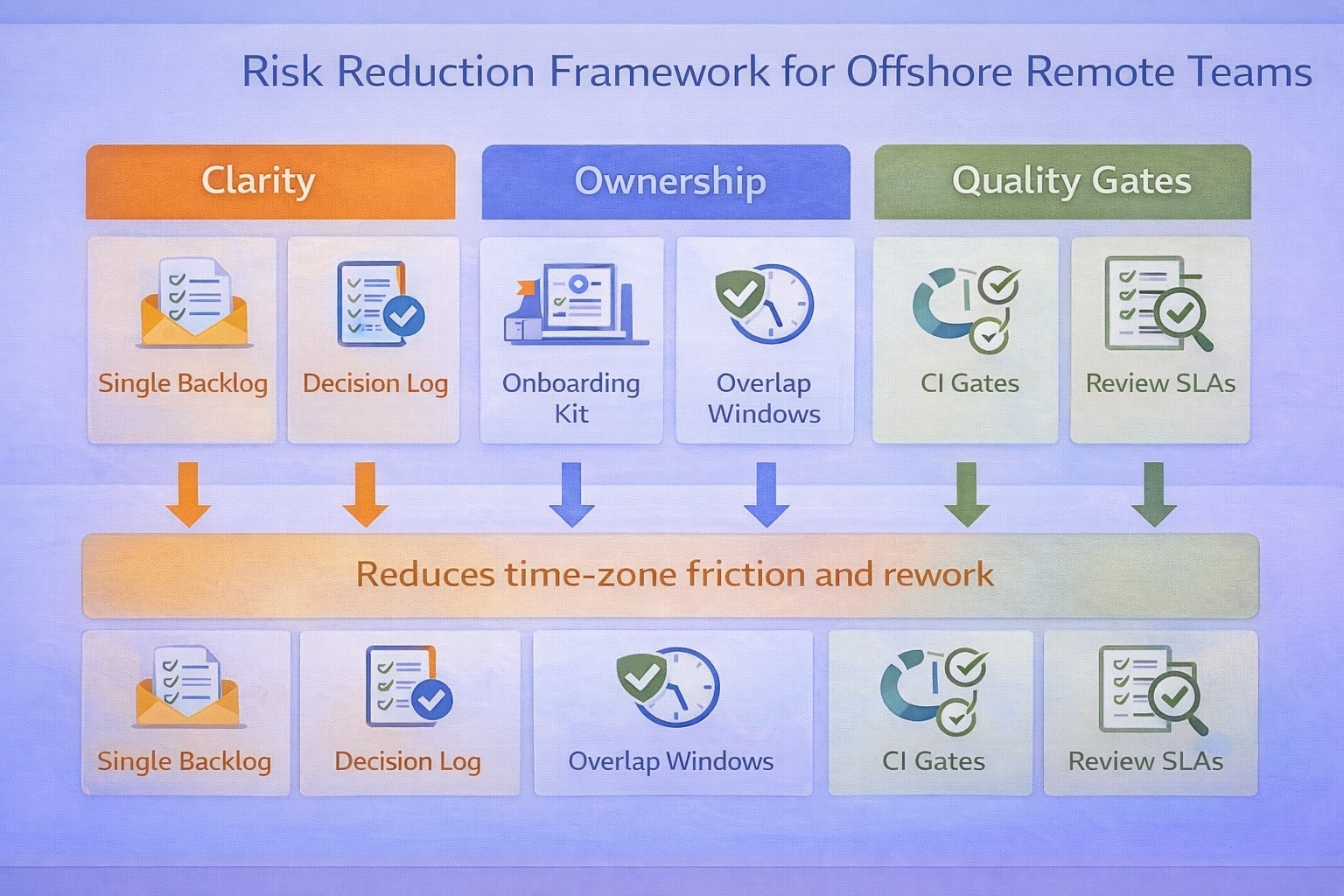
Many of the downsides of offshore setups stem directly from the challenges of managing offshore teams, like communication gaps and process misalignment.
Why Should Businesses Understand the Cons of Offshore Remote Teams?
Businesses should understand the cons of offshore remote teams because offshore delivery changes how work flows, how decisions are made, and how quality is maintained. The cost of ignoring these downsides is often hidden until late-stage delivery when deadlines slip or quality problems accumulate. Planning for the risks protects both speed and outcomes.
Offshore Cons Become More Expensive at Scale
Offshore cons become more expensive when headcount grows because coordination increases and dependency networks widen. Small issues that are manageable at 3–5 people become systemic at 20–30 people. Early awareness prevents structural problems from becoming default behavior.
Offshore Cons Reduce Predictability Without Explicit Controls
Predictability drops when communication, handoffs, and ownership are informal. Offshore remote teams need explicit controls because time zones reduce spontaneous alignment. Without controls, delivery becomes reactive and inconsistent.
Offshore Cons Influence Total Cost, Not Just Team Morale
Total cost is impacted through rework, delays, and increased management load. Lower salary cost can be offset by higher coordination effort if systems are weak. Understanding the cons supports a better “cost per shipped outcome” view.
Offshore Cons Affect Customer Outcomes Through Quality and Support
Quality issues and delayed fixes can reach customers faster when offshore processes are weak. Incident response and release readiness become harder when ownership is unclear. Customer impact is often the final consequence of earlier collaboration failures.
What Are the Main Cons of Building Offshore Remote Teams?
The main cons of building offshore remote teams are time-zone friction, communication ambiguity, cultural mismatch in working norms, uneven quality practices, and management overhead. These risks cluster around one root issue: distributed teams require stronger systems than local teams. When systems are missing, distributed work becomes fragile.
Slower Decision Cycles and Increased Waiting Time
Decisions slow down when key stakeholders are offline for large parts of the day. Waiting time increases when questions are not answered quickly. This creates longer cycle times and reduces sprint predictability.
Higher Communication Overhead
Communication overhead increases because context must be written, repeated, and clarified across tools. Misunderstandings are more likely because remote collaboration removes many informal cues. Without structured communication, teams spend more time aligning than building.
Onboarding and Context Building Take Longer
Onboarding can take longer because domain context is harder to transfer remotely. New hires need documentation, clear ownership, and strong mentorship to ramp. Weak onboarding creates early rework that persists for months.
Long onboarding cycles can be one of the practical typical onboarding timelines for offshore teams that slow down initial productivity.
Quality Variance Without Standardized Practices
Quality variance increases when code review discipline and testing standards differ across contributors. Offshore teams can ship high-quality work, but only when the system enforces quality consistently. Without enforcement, quality becomes person-dependent.
Management Complexity and Accountability Gaps
Management complexity increases because execution and leadership are distributed. Accountability gaps form when roles are unclear and ownership is shared informally. These gaps show up as late escalations and repeated misses.
One Bullet List of “Most Common Offshore Cons”
- Slower decisions and longer feedback loops
- Higher coordination and documentation burden
- Longer ramp time for new team members
- Inconsistent quality without shared gates
- Greater risk of “ticket execution” instead of ownership
- Harder stakeholder alignment across product and engineering
While there are cons to building offshore remote teams, many of these issues are reduced when the engagement model supports long-term continuity and clear ownership. When companies hire dedicated offshore teams, they create a stable environment where processes can mature, and communication norms can solidify. This makes it easier to avoid pitfalls associated with ad-hoc or short-term offshore arrangements.
How Do Time Zone Differences Create Challenges for Offshore Remote Teams?
Time zone differences create challenges by reducing real-time collaboration, increasing handoff complexity, and stretching feedback loops across days instead of hours. Time zones are manageable when overlap windows are protected and asynchronous work is structured. Time zones become harmful when dependencies are frequent and decision access is limited.
Reduced Overlap Lowers Speed for Ambiguous Work
Ambiguous work needs clarification, and clarification depends on quick feedback. When overlap is small, questions can sit unanswered for 12–18 hours. This causes work to stall or to proceed with incorrect assumptions.
Handoffs Increase Risk of Lost Context
Handoffs create risk because context can be incomplete or misunderstood. A handoff without clear next steps causes re-start cost the next day. Repeated re-start cost reduces throughput and increases frustration.
Reviews and Approvals Take Longer
PR reviews, design reviews, and release approvals can stretch across multiple days. Delays become worst when review ownership is unclear. This creates queue build-up and reduces the effectiveness of sprint planning.
Time Zones Can Create Uneven Work Visibility
Work visibility can drop when updates are inconsistent and discussions happen in fragmented channels. Leaders may feel “out of the loop” when communication is not structured. Visibility gaps often trigger micromanagement, which further hurts outcomes.
What Communication Problems Can Offshore Remote Teams Face?
Offshore remote teams can face communication problems such as unclear requirements, missing context in tickets, weak written updates, delayed escalation, and misalignment on priorities. These problems are usually process issues, not language issues. Strong communication systems reduce ambiguity and create repeatable clarity.
Requirements Are Often Under-Specified for Remote Execution
Remote execution requires more explicit requirements. Vague acceptance criteria creates rework. Under-specification forces engineers to guess, which increases the probability of building the wrong thing.
Asynchronous Updates Become Noisy or Incomplete
Updates can become noisy when they list activity without outcomes. Updates can also be incomplete when blockers and risks are not surfaced early. Poor updates reduce trust and create repeated status meetings.
Priority Drift Happens Without a Single Source of Truth
Priority drift happens when priorities are communicated in multiple channels and change informally. Drift causes teams to work on low-impact tasks while high-impact tasks wait. This creates delivery mismatch and missed commitments.
Escalations Happen Too Late
Late escalations are common when offshore engineers feel uncertain about decision rights or fear being seen as “blocked.” Late escalation turns small issues into large schedule slips. Early escalation is a core requirement for remote success.
Communication Gaps Create Quality Gaps
Communication gaps lead to quality issues because edge cases and constraints are not shared clearly. Quality issues often trace back to missing context about expected behavior. Clear communication reduces defect escape.
How Do Cultural Differences Affect Offshore Remote Team Performance?
Cultural differences affect offshore remote team performance by influencing feedback norms, escalation behavior, ownership expectations, and meeting dynamics. These differences can be strengths when teams build a shared operating culture. They become cons when assumptions remain unspoken and expectations conflict.
Feedback Styles Can Reduce Clarity
Some cultures give direct feedback while others use more indirect language. Misreading feedback can lead to unresolved issues. A shared feedback standard reduces confusion and speeds improvement.
Escalation and Risk Signaling Can Differ
Risk signaling differs across cultures. Some teams escalate early. Others attempt to solve problems privately and escalate only when late. Late escalation is a major offshore failure mode.
Ownership Expectations May Not Match
Ownership expectations can vary between “execute tasks” and “own outcomes.” Offshore teams perform best when outcome ownership is explicit and rewarded. Without explicit ownership standards, teams drift into ticket execution.
Meeting Participation Norms Can Hide Disagreement
Disagreement may be expressed privately rather than in group settings. This can delay decision clarity. Structured decision logs and written confirmation of choices reduce hidden disagreement.
What Quality and Delivery Risks Come With Offshore Remote Teams?
Quality and delivery risks include inconsistent engineering standards, increased rework, delayed releases, weak incident response readiness, and performance variance across team members. These risks become more likely when hiring standards are inconsistent and delivery systems are weak. Strong controls can reduce these risks significantly.
Inconsistent Definition of Done Increases Rework
Rework increases when “done” means different things to different people. Some engineers may ship without sufficient tests or without handling edge cases. A shared definition of done reduces this variance.
Review Discipline Can Become Uneven
Review discipline becomes uneven when reviewers are overloaded or when review standards are not explicit. Weak reviews allow quality drift. Review SLAs and checklists help stabilize standards.
Testing and Release Hygiene Can Lag
Testing gaps often appear when speed is prioritized without gates. Release hygiene can degrade when deployments are not standardized. CI gates and release checklists reduce defect escape and rollbacks.
Delivery Predictability Can Decline Under High Dependency
Delivery predictability declines when offshore work depends heavily on onshore decisions. Dependencies create waiting time and make commitments unreliable. Ownership boundaries and interface clarity reduce dependency pressure.
Incident Response Can Be Fragile Without Clear Coverage
Incident response becomes fragile when responsibilities are unclear or when runbooks are missing. Offshore teams can support strong coverage, but only when escalation paths and access are designed upfront. Without these, incidents escalate slowly.
A Single Table That Maps Risks to Root Causes and Fixes
|
Risk |
What It Looks Like |
Root Cause |
Practical Control |
|
Rework and rewrites |
Features shipped but need rebuilding |
Vague requirements and inconsistent “done” |
Strong acceptance criteria + definition of done |
|
Defect escape |
Bugs appear after release |
Weak tests and inconsistent reviews |
CI gates + review checklist + test coverage goals |
|
Missed sprint commitments |
Commitments not met repeatedly |
Dependency delays and unclear scope |
Ownership boundaries + WIP limits |
|
Slow PR turnaround |
PRs wait days for review |
Overloaded reviewers and unclear review ownership |
Review SLAs + dedicated review rotation |
|
Late escalation |
Blockers raised late |
Unclear decision rights and weak risk culture |
Escalation rules + risk log |
|
Fragmented priorities |
Work shifts mid-sprint |
Multiple sources of truth |
Single backlog + decision log |
How Can Companies Reduce the Cons of Offshore Remote Teams?
Companies reduce the cons of offshore remote teams by designing the operating model around clarity, ownership, and measurable quality gates. The most effective reductions come from system design: better onboarding, better documentation, stronger evaluation, clear roles, and strong communication standards. The goal is to make offshore teams operate like core product teams.
Define Ownership Boundaries and Decision Rights
Ownership boundaries reduce dependency and reduce waiting time. Decision rights clarify who can decide what without escalation. Clear boundaries are one of the highest-leverage fixes in offshore delivery.
Build an Onboarding System That Removes Early Blockers
Onboarding systems reduce ramp time and improve early quality. A standard onboarding kit, access checklists, and starter tasks reduce frustration. Faster onboarding also improves retention and morale.
Standardize Quality Gates Across All Teams
Quality gates prevent drift. Consistent CI checks, review rules, testing expectations, and release standards create predictable outcomes. Standard gates reduce reliance on heroics and manual policing.
Protect Overlap Windows and Strengthen Asynchronous Practices
Overlap should be reserved for decisions and unblockers. Asynchronous work should use clear written updates and decision logs. Strong async practice reduces the negative impact of time zones.
India’s mature talent ecosystem often helps companies counter common offshore cons like quality inconsistency or gaps in delivery discipline. That’s why many organizations choose to hire offshore dedicated software development teams in india — to balance cost with reliability and strong engineering culture.
Use Outcome-Based Metrics Instead of Activity Metrics
Outcome-based metrics track delivery reliability and quality rather than hours or raw ticket counts. Metrics such as cycle time trend, defect escape rate, and rework ratio reveal system health. Outcome metrics improve behavior and reduce micromanagement pressure.
While offshore outsourcing has grown rapidly over the past decade, building an offshore remote team also comes with notable challenges that global companies must carefully evaluate. One of the biggest cons is limited direct control and oversight compared to managing an in house team or local developers. With remote team members spread across multiple time zones, communication barriers, language barriers, and cultural barriers can create misunderstandings, slow decision-making, and reduce overall efficiency. Even with collaboration tools and project management tools in place, geographical distance and only a few hours of working overlap with western countries or the US companies can make it harder to maintain strong team management, direct oversight, and seamless business processes.
There are also risks associated with quality, legal support, and intellectual property protection, especially if an outsourcing company or offshore partners lack mature security frameworks. Hidden costs related to recruitment process complexities, onboarding, risk mitigation, and managing remote work can offset some primary benefits like labor costs and office space savings. Companies may face challenges aligning offshore developers or development teams with company culture, business growth priorities, and core business goals, particularly during complex projects requiring specialized skills, strong coordination, and trusted in house employees.
For smaller companies or US businesses with lower risk tolerance, relying heavily on a dedicated offshore team, dedicated development team, or outsourced team may feel like having little control over project execution. Despite access to a global talent pool and specialized talent in offshore hubs such as Eastern Europe, maintaining consistent quality, protecting sensitive information, and ensuring smooth integration with the local team or own team remains demanding. Therefore, while cost reduction and cost efficiency may save money on operational costs and office rent, organizations must carefully weigh these cons before fully committing to an offshore development model.
FAQs About the Cons of Offshore Remote Teams
1.Are offshore remote teams always harder to manage than local teams?
Offshore remote teams are harder to manage when systems are weak and expectations are informal. With clear ownership, strong onboarding, and standardized quality gates, management burden can decrease over time. The difficulty is driven more by operating maturity than by geography.
2.What is the biggest downside of offshore remote teams?
The biggest downside is slower feedback loops that increase waiting time and rework. This downside becomes severe when requirements are unclear and decision access is limited. Strong async practices and protected overlap windows reduce this risk.
3.Do time zones always reduce productivity?
Time zones reduce productivity when work has high dependency and unclear handoffs. Time zones can improve throughput when teams use structured handoffs and parallel ownership. The outcome depends on workflow design.
4.How can quality be maintained with offshore teams?
Quality is maintained by standard gates: review discipline, CI enforcement, testing expectations, and release checklists. Quality should be system-enforced rather than person-enforced. Consistency matters more than strictness.
5.How can companies avoid cultural friction in offshore teams?
Cultural friction is reduced by shared operating norms for feedback, escalation, and ownership. Explicit expectations prevent misunderstandings. A written working agreement can align behaviors quickly.
6.When should a company avoid building offshore remote teams?
A company should avoid offshore remote teams when the organization cannot provide clear ownership, strong onboarding, and stable decision access. Offshore teams cannot compensate for unclear priorities and chaotic workflows. Offshore success depends on organizational readiness.