


Offshore teams deliver benefits across cost, talent access, scalability, and sustained delivery capacity when they are integrated as an ownership-based extension of the core organization. The strongest benefit is not simply cheaper labor; it is a more resilient operating model that can hire faster, build more in parallel, and maintain quality through repeatable systems. Offshore teams become a long-term advantage when the work is structured for distributed execution and standards remain consistent.
The benefits show up in two ways. The first is financial leverage through lower total delivery costs and reduced opportunity cost from unfilled roles. The second is strategic leverage through faster scaling, deeper specialization, and stronger operational resilience across time zones. These benefits compound when teams stay stable and accumulate domain knowledge over multiple quarters.
Why Do Businesses Choose Offshore Teams?
Businesses choose offshore teams because they provide a scalable way to access talent, control costs, and expand delivery capacity without being limited by a single local hiring market. Offshore teams also help companies maintain momentum when roadmaps grow faster than onshore hiring can keep up. The choice is often driven by a need for sustainable capacity rather than short-term staffing.
Offshore Teams Provide Hiring Capacity Beyond Local Market Limits
Offshore teams provide hiring capacity because talent supply in a single city or country can become a bottleneck. Offshore markets often offer larger pools for specific engineering and product roles. This expands the addressable talent base and reduces time-to-hire for specialized positions.
Offshore Teams Improve Budget Leverage for Sustainable Scaling
Budget leverage improves because the total cost of adding offshore headcount can be lower in many markets. This can allow a company to build more pods, add senior coverage, or invest more in quality and platform work. Budget leverage becomes meaningful when the offshore model remains stable for multiple quarters.
Offshore Teams Support Parallel Execution Across Workstreams
Parallel execution improves because offshore teams can own modules end-to-end, allowing multiple product areas to move forward in the same sprint. This reduces the tradeoff between feature delivery and reliability work. Parallel execution is one of the most consistent sources of offshore value.
Offshore Teams Create Operational Resilience in Distributed Delivery
Resilience improves because distributed teams reduce concentration risk and can support broader coverage across the day. This is valuable for incident response, infrastructure maintenance, and support engineering. Resilience increases further when runbooks and quality gates are shared across the organization.
To fully realize the benefits, companies must approach building offshore teams with clear goals, structured hiring, and long-term planning.
What Are the Main Benefits of Hiring Offshore Teams?
The main benefits of hiring offshore teams are cost efficiency, access to a larger talent pool, faster scaling, improved delivery capacity, and stronger long-term operating leverage. These benefits are strongest when offshore teams are integrated, given stable ownership, and held to the same standards as onshore teams. Offshore value disappears when teams are treated as short-term task executors without context.
Cost Efficiency Through Lower Total Delivery Costs
Cost efficiency appears when offshore teams reduce cost per shipped outcome, not only salary expense. Total delivery cost includes rework, management overhead, and tool costs. Offshore teams create stronger cost efficiency when quality systems reduce defect escape and rework.
Faster Hiring and Access to Specialized Talent
Faster hiring matters because unfilled roles create opportunity cost and delay releases. Offshore markets can provide deeper pools in specializations such as platform engineering, QA automation, data engineering, and DevOps. Faster hiring converts into faster delivery capacity when onboarding is structured.
Scalable Delivery Without Proportional Process Complexity
Scalable delivery matters because many organizations struggle to scale without increasing coordination overhead. Offshore teams scale well when work is modular and ownership is clear. A pod model with stable interfaces usually supports scalable execution.
Greater Focus for Onshore Teams on Discovery and Stakeholder-Heavy Work
Onshore teams benefit when offshore teams own stable execution surfaces. This allows onshore engineers to focus more on discovery, architecture, and high-ambiguity cross-functional work. The result is better utilization of overlap hours with stakeholders.
Improved Operating Discipline Through Distributed Requirements
Operating discipline improves because distributed delivery encourages written clarity and repeatable processes. Strong offshore programs naturally adopt decision logs, clear acceptance criteria, and standardized release checklists. These improvements often benefit the entire engineering organization.
Many organizations unlock even more value by exploring the benefits of hiring offshore dedicated development teams, especially for complex and ongoing product work.
While the upsides are significant, understanding the challenges of managing offshore teams helps leaders prepare for and mitigate potential risks early.
How Do Offshore Teams Benefit Cost Reduction?
Offshore teams benefit cost reduction by lowering direct labor costs in many markets and by improving cost efficiency through faster hiring and scalable execution. The most sustainable savings come from reducing the cost per delivered outcome rather than only reducing salary expense. Cost reduction becomes durable when offshore teams reduce rework and stabilize delivery.
Lower Compensation Bands Can Reduce Direct Costs
Lower compensation bands reduce direct costs because salary structures vary across markets. Benefits and payroll overhead can also differ depending on the employment model. Direct cost reduction is strongest when quality and productivity remain stable.
Reduced Opportunity Cost From Faster Hiring
Opportunity cost reduction matters because delayed hiring often delays releases, revenue milestones, and reliability improvements. Offshore hiring can reduce time-to-fill for critical roles. Faster hiring becomes real savings when it shortens the time to deliver roadmap outcomes.
Better Cost Efficiency Through End-to-End Ownership
End-to-end ownership reduces cost because it lowers handoff overhead and repeated clarification. Owned modules tend to ship with fewer coordination loops. This reduces management time and reduces rework.
Cost Savings Shrink When Rework and Coordination Overhead Rise
Savings shrink when requirements are unclear and offshore work requires frequent approvals across time zones. Rework consumes capacity and delays releases, erasing cost advantages. Strong documentation and consistent quality gates protect cost reduction.
The benefits of offshore teams are maximized when the engagement model supports long-term collaboration. When companies hire dedicated offshore teams, they gain consistent output, better alignment with business goals, and improved team ownership. This setup allows offshore talent to function as a true extension of the in-house team.
What Skill Benefits Do Offshore Teams Offer?
Offshore teams offer skill benefits through access to a wider and often deeper talent pool, strong specialization density in certain markets, and the ability to build balanced teams faster. Skill benefits become visible when offshore teams are integrated into product context and engineering standards. Offshore capability is a market advantage when hiring remains selective.
Deeper Access to Specialized Engineering Talent
Specialized talent access matters when roadmaps require specific skills such as data platforms, cloud infrastructure, security engineering, mobile engineering, and QA automation. Some offshore markets have strong depth across these roles due to mature engineering ecosystems. This reduces hiring risk for specialized pods.
For engineering-driven organizations, India continues to be a top offshore destination. Many teams choose to hire offshore dedicated software development teams in india to access high-quality talent, reduce costs, and scale efficiently without compromising delivery standards.
Better Team Composition With Broader Hiring Options
Team composition improves when hiring can be done for complementary strengths rather than only for availability. A balanced mix of senior anchors, strong mid-level builders, and quality-focused engineers improves throughput. Better composition reduces bottlenecks and improves codebase stability.
Faster Senior Leadership Coverage for Standards and Mentorship
Senior leadership improves outcomes because senior engineers define quality standards and reduce rework through better design decisions. Offshore hiring can make senior coverage more accessible when the market has sufficient depth. Strong senior anchors improve onboarding and raise performance across the pod.
Domain Knowledge Compounds When Ownership Is Stable
Domain knowledge becomes a skill advantage when offshore engineers own the same module over multiple release cycles. Stable ownership reduces dependency on onshore stakeholders for routine decisions. Over time, offshore teams develop product judgment and operational insight.
How Can Offshore Teams Benefit Productivity and Delivery Speed?
Offshore teams benefit productivity and delivery speed by enabling parallel execution and by improving clarity and repeatability when processes are designed for distributed delivery. Speed improves when offshore teams can ship without waiting for repeated approvals. Productivity improves when rework is controlled and ownership boundaries stay stable.
Parallel Workstreams Increase Output Without Increasing Burnout
Parallel workstreams increase output because multiple pods can deliver simultaneously without a single team becoming a bottleneck. This requires clear interfaces and stable module boundaries. Parallel execution is a core reason offshore teams improve delivery speed.
Time Zone Distribution Can Improve Execution Coverage
Time zone distribution can improve coverage when workflows are designed for handoffs, such as incident response and support engineering. Coverage improves when runbooks and escalation paths are explicit. Coverage becomes harmful when meetings spill into personal time repeatedly.
Asynchronous Discipline Reduces Decision Loops
Asynchronous discipline reduces decision loops by making requirements, edge cases, and decisions visible in writing. This lowers repeated questions and reduces blockers. Strong asynchronous systems also scale better as headcount grows.
Productivity Drops When Offshore Work Is Treated as Task Output
Productivity drops when offshore teams are treated as task executors without product context. This increases rework and slows feedback loops. Offshore productivity is strongest when teams have end-to-end accountability.
What Scalability and Flexibility Benefits Come With Offshore Teams?
Scalability and flexibility benefits come from the ability to add capacity faster, adjust team size by pod, and expand into new capabilities without rebuilding internal systems each time. Offshore teams scale best when hiring and onboarding are standardized. Flexibility improves when engagement models allow controlled growth without legal friction.
Faster Scaling Through Larger Hiring Pools
Faster scaling occurs because offshore markets often provide broader talent availability. Hiring pipelines can be expanded across multiple cities and regions. Faster scaling protects roadmaps during growth phases.
Pod-Based Scaling Improves Flexibility
Pod-based scaling improves flexibility because teams can be added or adjusted by module ownership rather than by individual roles. This reduces dependency on single points of failure. Pods also make planning clearer because ownership boundaries are explicit.
Flexible Engagement Models Support Different Growth Stages
Engagement flexibility matters because companies may start with an EOR or contractor model and later move to a local entity as headcount grows. Flexibility allows gradual commitment instead of a one-time structural decision. The right model depends on risk tolerance and long-term hiring plans.
Scalability Improves When Processes Are Repeatable
Repeatable processes improve scalability because onboarding, access, security, and quality gates become templates rather than custom work. This reduces friction for each new hire. Repeatability is a major driver of long-term offshore benefits.
What Long-Term Business Growth Benefits Do Offshore Teams Offer?
Long-term business growth benefits come from building a durable delivery engine that supports sustained product development, operational excellence, and expansion into new initiatives without constant hiring crises. Offshore teams create compounding value when they retain talent and accumulate domain expertise. This value often becomes more important than initial cost savings.
Offshore Teams Build a Second Delivery Engine
A second delivery engine supports growth because it increases capacity without slowing onshore decision-making. Offshore teams can own platform work, reliability initiatives, and long-term product modules. This keeps feature delivery moving while foundational work improves.
Offshore Teams Support Platform Investment and Quality Improvements
Platform investment supports growth because internal tooling and automation reduce engineering friction. Offshore teams can own CI improvements, testing infrastructure, and developer experience initiatives. These investments increase productivity across the organization.
Offshore Teams Improve Business Continuity and Reliability
Continuity improves because teams are not concentrated in a single market. Reliability improves when on-call coverage and maintenance capabilities are distributed with shared runbooks. Strong reliability protects revenue and customer trust over time.
Offshore Teams Strengthen Strategic Flexibility
Strategic flexibility improves because capacity can be directed toward new initiatives without pausing core delivery. This is valuable when markets shift or new products are added. Offshore teams make expansion decisions easier because hiring can scale faster.
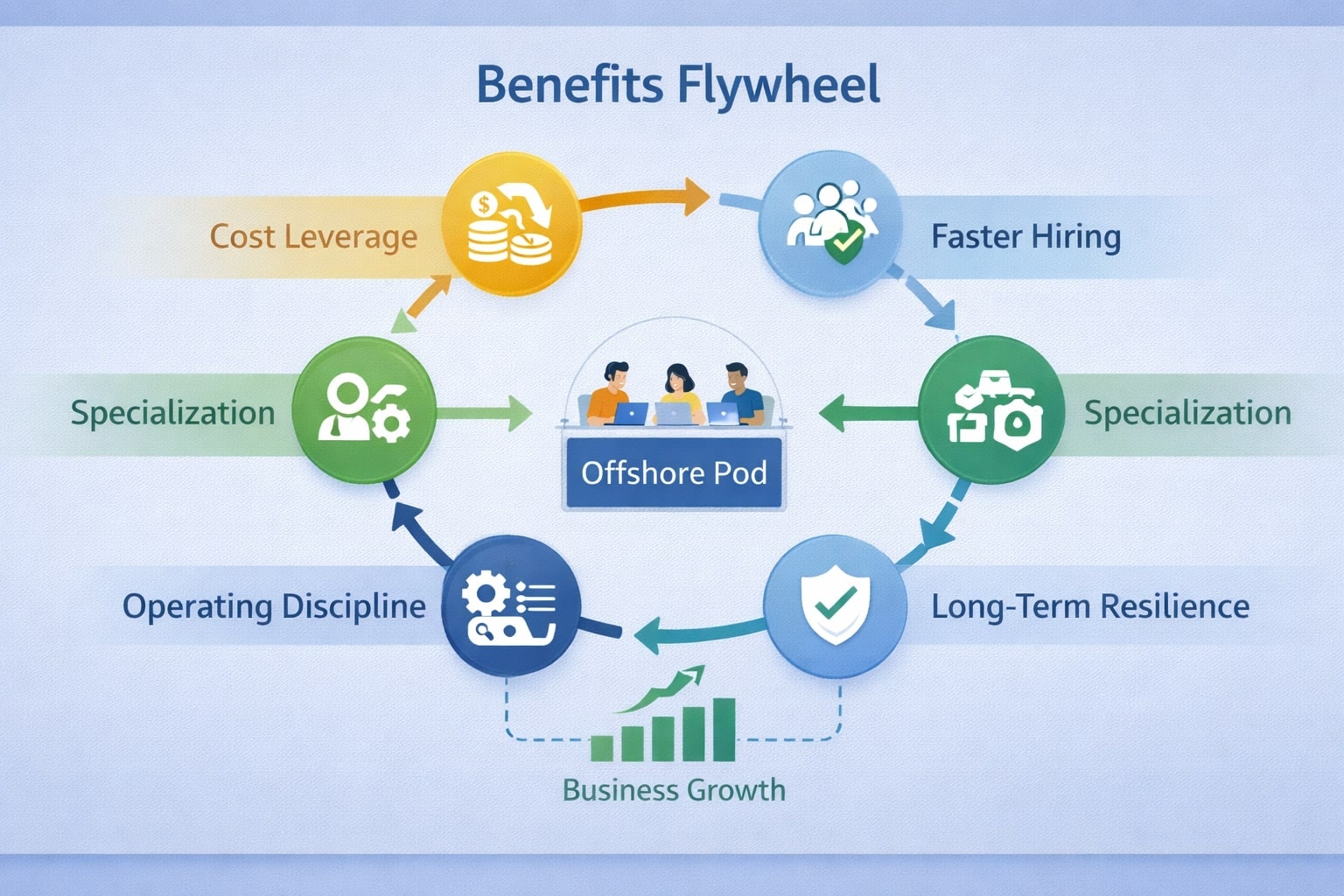
Benefits of Offshore Teams: Why Global Companies Continue to Invest
Offshore teams in 2026 continue to deliver numerous advantages for global companies looking to scale operations, reduce costs, and access a global talent pool of skilled professionals. A dedicated offshore development team or offshore developers allow businesses to tap specialized skills, gain access to top talent, and expand software development capabilities beyond what an in house team or local team alone can manage. Offshore software development supports ongoing development, continuous progress, and round the clock productivity thanks to time zone differences and overlapping working hours that keep development tasks moving even when onshore teams are offline.
For business leaders, offshore outsourcing and dedicated development team models significantly reduce development costs, operational expenses, and lower labor costs while ensuring international standards, quality control, and strong data security. With the right project management approach, communication protocols, and collaboration tools such as Microsoft Teams, companies can bridge communication gaps, track progress, and keep both offshore development teams and in house staff on the same page. Cultural differences and communication barriers can be addressed through cultural understanding, cultural training, and virtual team building activities, helping diverse teams align with business practices and enhance customer satisfaction.
Over the past decade, offshore development has proven extremely beneficial, enabling companies to scale efficiently, strengthen core team focus on core business activities, manage operational costs, and stay competitive in global markets while benefiting from skilled developers, diverse talent, and real life examples of successful offshore development outcomes.
FAQs About the Benefits of Offshore Teams
Are offshore teams only useful for reducing costs?
Offshore teams are not only useful for reducing costs. The broader benefits include faster access to specialized talent, scalable delivery capacity, and improved long-term operating leverage. Cost savings become strongest when combined with stable ownership and strong quality systems.
Do offshore teams reduce quality compared to onshore teams?
Offshore teams do not inherently reduce quality. Quality depends on hiring standards, engineering discipline, CI gates, code review rigor, and stable ownership. Offshore teams can deliver high quality when they are integrated and treated as owners.
How quickly can offshore teams be scaled?
Offshore teams can often be scaled faster than fully onshore hiring because talent pools may be larger and pipelines can be broadened across regions. Scaling speed depends on evaluation process quality and onboarding maturity. Repeatable onboarding usually improves scaling speed significantly.
What is the biggest operational benefit of offshore teams?
The biggest operational benefit is parallel execution with stable ownership. Offshore pods that own modules end-to-end reduce handoffs and speed up delivery. This also reduces coordination overhead and increases accountability.
What is the best way to ensure offshore teams deliver productivity gains?
Productivity gains come from stable ownership, strong documentation, and consistent quality standards. Clear acceptance criteria, decision logs, and CI gates reduce rework and improve throughput. Productivity drops when offshore work is treated as fragmented ticket execution.
Do offshore teams support long-term business growth?
Offshore teams support long-term growth by building durable capability that compounds through retention and domain knowledge. They also support investment in reliability and platform work without sacrificing feature velocity. Over time, these advantages often outweigh the initial cost savings.