


Here are specific GCC capabilities that directly drive revenue:
| Core GCC Capability | Primary Revenue Lever | Revenue Impact Metrics (Examples) |
| Product Engineering With End-to-End Ownership | Faster launch of monetizable features and products | New revenue streams, feature adoption rate, time-to-market |
| R&D and IP Creation | Differentiation and pricing power | Patents filed, premium pricing adoption, margin expansion |
| Data Analytics & Decision Intelligence | Better targeting, pricing, and retention decisions | Conversion rate uplift, churn reduction, LTV increase |
| AI/ML Applied to Revenue Workflows | Automation and personalization across sales and growth | CAC reduction, lead-to-close rate, upsell/cross-sell revenue |
| Growth Engineering & Experimentation | Continuous optimization of revenue funnels | Conversion uplift, ARPU increase, experiment win rate |
| Revenue Operations (RevOps) Excellence | Higher pipeline efficiency and win rates | Sales cycle reduction, win rate %, pipeline velocity |
| Pricing & Packaging Strategy Support | Monetization optimization | ARPA growth, discount reduction, plan mix improvement |
| UX Design & Digital Experience Engineering | Improved activation, engagement, and retention | Activation rate, retention %, revenue per user |
| Customer Success & Support Operations | Expansion and renewal growth | Net revenue retention (NRR), renewal rate, expansion ARR |
| Quality Engineering & Reliability | Trust-driven retention and enterprise expansion | Downtime reduction, churn reduction, enterprise deal size |
| Cloud & Platform Engineering | Faster scaling into new markets and segments | Time-to-launch, regional revenue ramp-up |
| Business Alignment & Governance | Delivery tied directly to business outcomes | Revenue per engineer, ROI per initiative |
Global Capability Centers build a powerful mix of technology, operations, analytics, innovation, customer support, and enterprise functions under one roof. They act as integrated extensions of the headquarters, owning critical capabilities instead of just providing low-cost labor. This guide explains the core capabilities GCCs offer, including global capability centers capabilities, and how they strengthen an enterprise end to end.
Over the last 10–15 years GCCs have shifted from back-office units to strategic hubs and value-creation hubs. They now host engineers, analysts, designers, product managers, finance experts, and transformation leaders working together. Understanding these capabilities helps you design your GCC roadmap and decide what to centralize, what to retain onshore, and what to outsource.
If you’re planning to build or scale a GCC, partnering with the right gcc recruitment agency in India can help you access specialized talent, accelerate hiring, and align your workforce strategy with long-term business goals.
What Are the Core Capabilities of Global Capability Centers?
The core capabilities of Global Capability Centers cover technology, operations, analytics, innovation, customer and support services, and strategic enterprise functions. A mature GCC blends these capabilities in different proportions depending on the company’s industry and growth priorities, leveraging global talent .
Technology and Digital Delivery
Technology and digital delivery capabilities let GCCs design, build, and run products and platforms. Teams span software engineering, QA, DevOps, architecture, and product management. They deliver new features, maintain critical systems, and support digital transformation programs.
Operations and Process Excellence
Operations capabilities help standardize, centralize, and improve business processes to achieve cost efficiency . GCCs run shared services for finance, HR, procurement, supply chain, and other functions. Process excellence specialists use lean, Six Sigma, and automation to improve quality and reduce cycle times.
Analytics and Data-Driven Decision Support
Analytics capabilities give leaders clear, timely insight through data analytics o make better decisions. GCC teams manage data pipelines, reports, dashboards, and advanced analytical models. They support planning, pricing, customer segmentation, risk modeling, and performance management, ultimately facilitating business growth .
Innovation and Product Acceleration
Innovation capabilities allow GCCs to test new ideas at speed and scale. Cross-functional squads run experiments, prototypes, and pilots for new products and customer journeys. This work shortens time-to-market and reduces risk for the core business.
Customer and Support Services
Customer and support capabilities let GCCs handle front-line and mid-office work. Teams manage customer service, technical support, onboarding, and success programs across channels. They protect customer satisfaction while feeding insights back into product and process design.
Strategic and Enterprise Functions
Strategic and enterprise capabilities extend beyond operational work. GCCs host finance planning, people analytics, global procurement, legal operations, and program management offices. These teams support leadership in business strategy execution and enterprise-wide initiatives.
Understanding the benefits of global capability centers provides context for why specific GCC capabilities create long-term business value.
How Do GCCs Improve Operational Capabilities for Enterprises?
GCCs improve operational capabilities for enterprises by standardizing processes, consolidating shared services, strengthening risk controls, and driving continuous improvement. They turn fragmented, country-specific operations into consistent global engines.
Standardization and Process Harmonization
Standardization starts with mapping how work happens across markets. GCC teams compare different country processes, agree on common best practices, and document them as global standards. This harmonization reduces errors, rework, and local variations that complicate reporting and compliance, thereby promoting operational excellence .
Shared Services and Scale Economies
Shared services consolidate repeatable processes into specialized teams. Instead of 5 or 7 local finance teams doing similar work, a GCC can host a central record-to-report or procure-to-pay team. This model improves quality, speeds up turnaround, and unlocks scale economies on tools and training.
Example Operational Processes Handled by GCCs
A single GCC often runs a broad set of operational processes across functions.
- Finance: accounts payable, accounts receivable, general ledger, reconciliations
- HR: payroll support, employee data management, benefits administration
- Supply chain: order management, inventory updates, logistics coordination
- Customer operations: order entry, case routing, billing queries
These processes gain from standard templates, shared tools, and a strong governance model.
Risk, Compliance, and Business Continuity
Operational capabilities must stay compliant and resilient. GCCs specialize in control frameworks, segregation of duties, and documentation that support global operations so audits become smoother. They also support business continuity planning through backup teams, disaster recovery drills, and geographic diversification.
Continuous Improvement and Automation
Continuous improvement is built into the GCC operating rhythm. Teams track process metrics, identify pain points, and propose improvements on a rolling basis to drive innovation . They use robotic process automation, workflow tools, and simple scripts to remove manual steps and reduce turnarounds.
What Technology and Digital Capabilities Do GCCs Provide?
GCCs provide technology and digital capabilities that span software development, platform engineering, cybersecurity, and emerging technologies such as AI and automation. They become global digital factories for the enterprise.
Software Engineering and Product Development
Software engineering teams build and maintain core applications and digital products. They work in agile squads with product owners, designers, and testers. These teams handle everything from mobile apps and web portals to core transaction systems.
Cloud, DevOps, and Platform Engineering
Cloud and DevOps capabilities ensure products run reliably at scale. GCC engineers design cloud architectures, manage infrastructure as code, and set up CI/CD pipelines. Platform teams provide common services such as APIs, logging, monitoring, and developer tooling.
Cybersecurity and Identity Management
Cybersecurity capabilities protect applications, data, and users. Specialists handle threat monitoring, incident response, vulnerability management, and identity access management. They embed security by design into development lifecycles rather than treating it as an afterthought.
Emerging Tech: AI, Automation, and Low-Code
Emerging-technology teams explore AI, machine learning, conversational interfaces, low-code platforms, and other advanced technologies. They build recommendation engines, chatbots, and intelligent workflows that sit on top of existing systems. This work helps the organization modernize without replacing every legacy application at once.
Many emerging GCC capabilities are shaped by ongoing global capability centers trends such as automation and AI adoption.
Sample View of Technology Capabilities in a GCC
|
Capability Area |
Typical GCC Teams |
Example Outcomes |
|
Product Engineering |
Full-stack dev, QA, product management |
New features, stable releases, faster delivery |
|
Cloud & DevOps |
SREs, DevOps engineers, platform engineers |
Higher uptime, automated deployments |
|
Cybersecurity |
Security operations, IAM, governance |
Fewer incidents, stronger compliance |
|
AI & Automation |
Data scientists, ML engineers, automation COE |
Smarter processes, reduced manual work |
How Do GCCs Build Analytics and Data Capabilities?
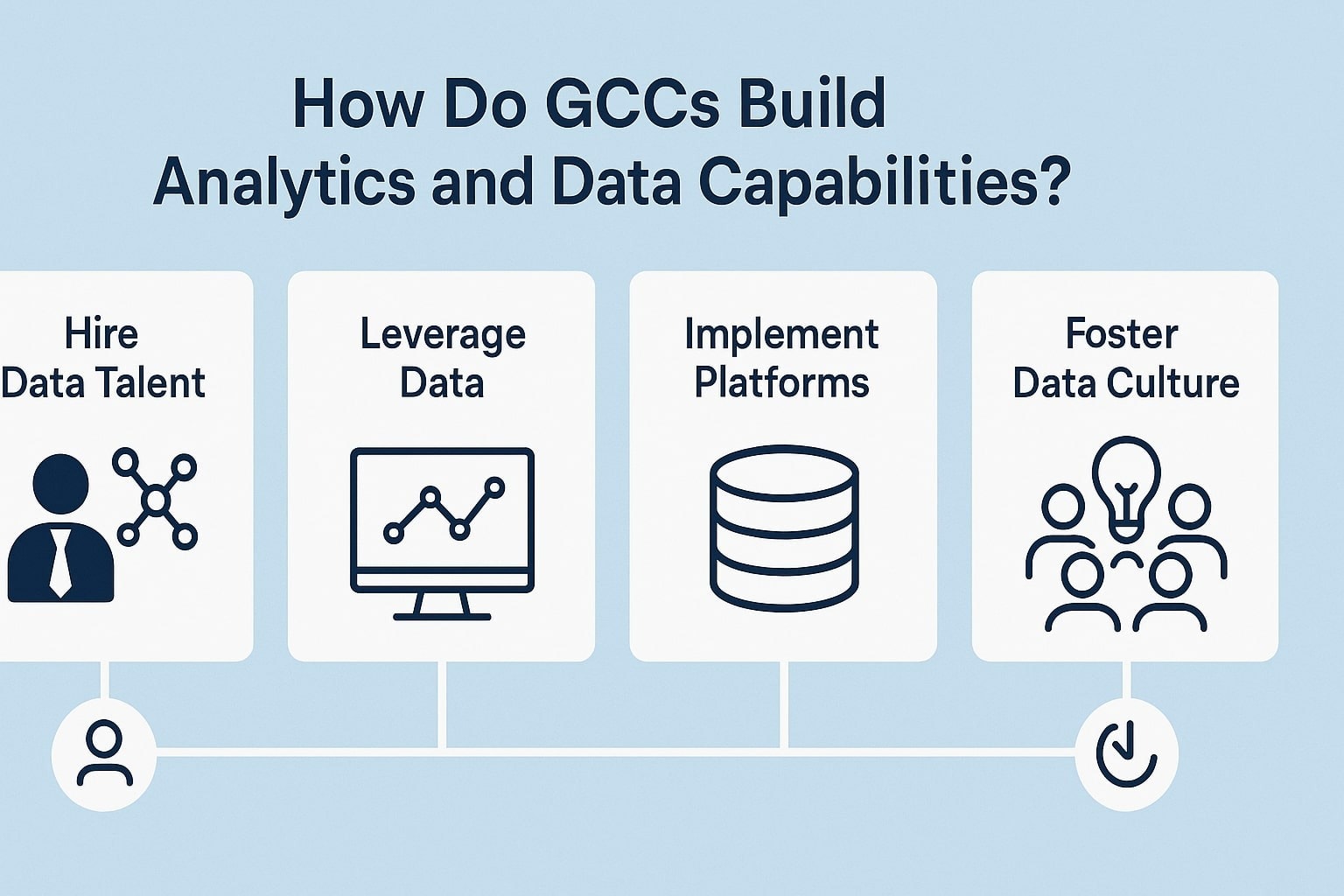
GCCs build analytics and data capabilities by owning data engineering, BI, advanced analytics, and data governance functions to create a competitive advantage . They become centralized engines for insight generation, which often leads to significant cost savings .
Data Engineering and Architecture
Data engineering teams design and maintain the pipelines that move data from source systems to analytic platforms. They build data lakes, data warehouses, and integration layers with clear models and metadata. This foundation enables reliable reporting and self-service analytics.
Business Intelligence and Reporting
Business intelligence specialists turn raw data into accessible dashboards and reports. They partner with finance, sales, operations, and marketing leaders to define KPIs and visualization standards. Their outputs support daily decisions, management reviews, and board reporting.
Advanced Analytics and Data Science
Advanced analytics teams take insight further with predictive and prescriptive models. They work on demand forecasting, churn prediction, pricing optimization, credit risk models, and route optimization. These models, when embedded into systems, improve outcomes without adding friction for end users, even when processes are treated as cost centers .
Data Governance and Quality Management
Data governance ensures trust in the numbers produced. GCCs create data dictionaries, stewardship roles, quality rules, and issue-resolution workflows. They lead campaigns to fix root causes in upstream systems rather than cleaning data again and again downstream.
What Innovation Capabilities Are Enabled Through GCCs?
GCCs enable innovation capabilities by hosting cross-functional teams, experimentation labs, and structured idea-to-launch pipelines. They provide the talent density and repeatable processes needed to foster innovation at scale.
Innovation Pods and Experimentation Labs
Innovation pods are small, empowered teams that test new ideas quickly. GCC-based pods run short sprints, build prototypes, and validate concepts with internal or external users. Experimentation labs provide tools, sandboxes, and funding mechanisms to support this work.
Design Thinking and Customer-Centricity
Design capabilities ensure innovation stays anchored in real customer needs. Designers, researchers, and product managers based in the GCC run discovery interviews, journey mapping, and usability testing. Their outputs guide feature priorities and experience decisions across markets.
Co-Creation with Vendors and Startups
GCCs often sit close to strong technology ecosystems. They partner with SaaS vendors, cloud providers, and startups to trial new solutions before global rollout. Co-creation programs combine internal domain knowledge with external innovation speed.
IP Creation and Reusable Assets
Innovation work generates intellectual property and reusable components. GCCs document APIs, shared services, and frameworks so other teams can reuse them rather than rebuild from scratch. This library of assets lowers future development cost and improves consistency.
How Do GCCs Strengthen Customer and Support Capabilities?
GCCs strengthen customer and support capabilities by offering localization capabilities integrated service, success, and knowledge functions that protect and grow customer relationships. They act as both problem solvers and experienced designers.
Multichannel Customer Support
Customer support teams handle contacts across phone, email, chat, and social media. They use unified ticketing systems and knowledge tools to resolve issues quickly. Routing and triage rules ensure high-priority or high-value cases get expert attention.
Customer Success and Experience Analytics
Customer success teams focus on adoption, retention, and expansion rather than just issue handling. They run onboarding programs, health checks, and renewal plays for key accounts. Experience analysts study contact data, NPS, and journey metrics to find friction points, propose fixes, and contribute to leadership development.
Knowledge Management and Self-Service
Knowledge management specialists keep support content accurate and searchable. They create playbooks, FAQs, and how-to guides used by both agents and customers. Strong self-service content reduces contact volumes and improves first-contact resolution.
Regional and Language Localization
Localization capabilities tailor experiences to different markets. GCCs build language-specific support teams, adapt content, and feed local insights into product and marketing teams. This local nuance makes global products feel closer to each customer, thereby enhancing customer relationships .
What Strategic and Enterprise Capabilities Are Driven by GCCs?
GCCs drive strategic and enterprise capabilities by hosting finance, HR, procurement, risk, and transformation teams that support global leadership. These functions move the center from an execution engine to a strategy partner, supporting enterprise transformation .
GCC staffing solutions play a critical role in enabling this shift by providing access to specialized, scalable, and future-ready talent aligned with global standards. Through a mix of permanent hiring, contract staffing, and capability-based teams, GCC staffing partners help organizations rapidly build high-impact functions, ensure continuity of expertise, and adapt to evolving business priorities—allowing GCCs to operate as true strategic extensions of the enterprise rather than standalone delivery units.
Finance, Controllership, and FP&A
Finance teams in GCCs cover controllership, reporting, and planning. They manage closing cycles, consolidation, and statutory reporting while maintaining strong controls. FP&A teams support budgeting, forecasting, and scenario modeling for business units and group finance.
HR, Talent, and People Analytics
HR capabilities include HR operations, talent acquisition, and people analytics. Recruitment teams support global hiring campaigns and niche talent searches. People analytics teams analyze engagement, attrition, productivity, and skills to guide workforce decisions.
Procurement, Legal, and Risk
Procurement teams centralize vendor onboarding, sourcing events, and contract management. Legal operations manage contract workflows, matter tracking, and document repositories. Risk and compliance teams handle control testing, regulatory reporting support, and policy governance.
Strategy, Transformation, and PMOs
Strategy and transformation teams keep large programs on track. They run central program management offices, track benefits, and support change management across regions. This central capability helps leadership execute multi-year roadmaps consistently.
FAQs About Core Capabilities of Global Capability Centers
1. Which capabilities should be built first in a new GCC?
Most organizations start with 2 or 3 anchor capabilities that have clear demand and measurable value. Typical starting points are shared services operations, technology delivery, or analytics hubs. Once governance stabilizes, you can expand into customer support, innovation labs, and enterprise functions, ensuring strategic alignment .
2. How can enterprises avoid overloading GCCs with too many capabilities?
Enterprises avoid overload by phasing the GCC roadmap and setting clear entry criteria for new work. Each new capability should have a defined sponsor, business case, and success metrics. Steering committees can sequence transitions so the center absorbs change without burning out teams.
3. How do GCCs keep their capabilities relevant over time?
GCCs stay relevant by investing in learning, tools, and continuous improvement. They create communities of practice, sponsor certifications, and test new technological advancements in controlled pilots. Regular benchmarking against peers helps identify capability gaps and new opportunities.
4. When should a company outsource instead of building a capability in its GCC?
Outsourcing is better when work is short term, highly variable, or not strategic enough to own. If a process does not justify stable teams of at least a small, dedicated group, a managed service can be more efficient. GCCs focus on capabilities that differentiate the business, involve sensitive data or IP, or need deep integration with core teams.