


Global offshore teams help companies scale faster and smarter by expanding capacity without waiting for slow local hiring cycles, lowering the cost of sustained delivery, and improving coverage across time zones. The strongest offshore outcomes come from stable team ownership, clear operating rhythms, and consistent quality standards across locations.
|
Scaling Area |
Before (Without Global Offshore Teams) |
After (With Global Offshore Teams) |
|
Team Expansion Speed |
Slow hiring cycles and limited talent access |
2–3× faster team scaling |
|
Time-to-Market |
Long development cycles and release delays |
20–40% faster product delivery |
|
Delivery Predictability |
Frequent timeline slippage |
25–35% improvement in on-time delivery |
|
Access to Specialized Skills |
Skill gaps delay execution |
Immediate access to niche expertise |
|
Operational Efficiency |
Inefficient workflows and resource strain |
20–30% productivity gains |
|
Management Overhead |
Heavy day-to-day supervision |
25–40% less management effort |
|
Scalability Flexibility |
Rigid headcount and contracts |
Rapid scale-up and scale-down capability |
|
Business Continuity |
High risk from regional disruptions |
Improved resilience through multi-region teams |
|
Long-Term Growth |
Scaling slows after early growth |
Sustained velocity across growth phases |
Scaling with offshore teams works when the model reduces bottlenecks in hiring, delivery, and specialization. Scaling breaks down when offshore teams are treated as a task queue, when decision rights are unclear, and when collaboration is left to chance. The difference shows up in cycle time, rework, release predictability, and retention.
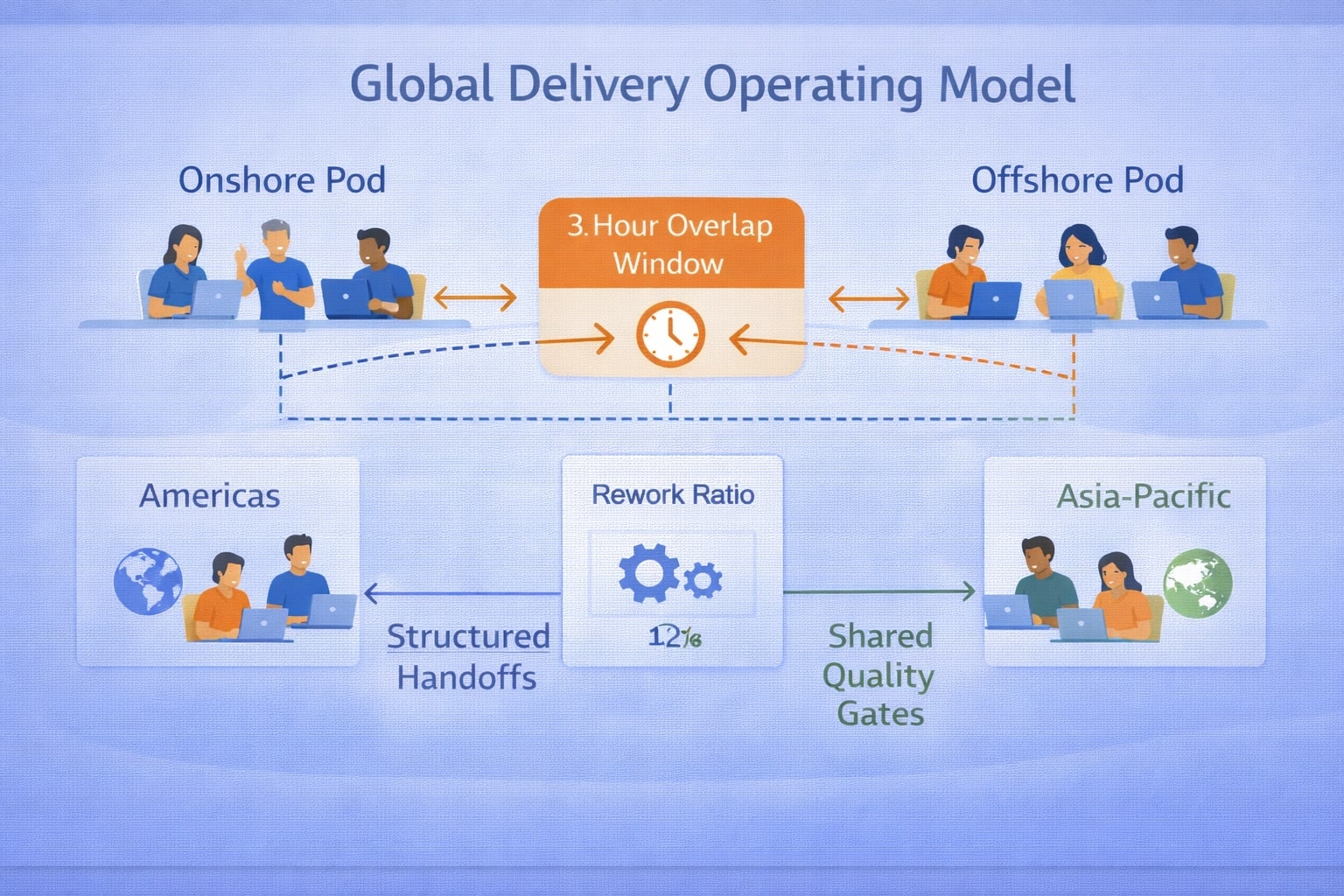
To effectively expand into multiple regions, start with best practices for building offshore teams that ensure consistency, quality, and structured growth.
Why Do Companies Rely on Global Offshore Teams to Scale Faster?
Companies rely on global offshore teams to scale faster because local hiring supply is constrained and growth timelines are short. Offshore teams expand the reachable talent market while keeping delivery moving during product expansion, platform upgrades, and reliability programs. The model becomes especially valuable when a company needs to add 3–10 roles in a quarter rather than 1–2 roles over multiple quarters.
Local Talent Markets Become a Scaling Constraint
Local talent markets become a scaling constraint when competition drives longer hiring cycles and higher compensation bands. The constraint shows up as open headcount that remains unfilled for 60–120 days. Offshore teams reduce the probability that hiring velocity becomes the main limiter of roadmap execution.
Global Teams Reduce Single-Region Hiring Risk
Global teams reduce single-region hiring risk by spreading hiring across multiple markets. This reduces exposure to local demand spikes, visa bottlenecks, and sudden compensation inflation. A diversified hiring approach supports steadier planning and steadier delivery.
Offshore Teams Support Capacity Expansion Without Org Redesign
Offshore teams support capacity expansion without org redesign when the offshore group is integrated into the same product operating system. Shared backlogs, shared quality gates, and shared release cadences keep work cohesive. This integration prevents offshore hiring from becoming a separate delivery lane.
A Practical Signal That Offshore Scaling Is Working
A practical signal of offshore scaling success is stable delivery metrics across 2–3 release cycles. Cycle time stays consistent. Defect escape stays consistent. Stakeholder confidence rises because delivery becomes more predictable. When setting up global offshore teams through subsidiaries or capability centers, compliance and governance often require expert support like local resident director services.
How Do Global Offshore Teams Improve Speed and Efficiency in Scaling?
Global offshore teams improve scaling speed by increasing parallel execution, reducing time-to-hire delays, and keeping work moving through strong asynchronous collaboration. Speed comes from a system that reduces waiting time for decisions and clarifications. Speed also comes from ownership boundaries that allow teams to ship independently.
Faster Hiring Converts Into Faster Delivery
Faster hiring improves scaling speed because capacity becomes available earlier in the cycle. Earlier capacity reduces missed sprint commitments and the need for priority reshuffles. In an internal Flexiple operations review of delivery programs, teams that filled roles within 21–35 days reached stable sprint output roughly 30–45 days earlier than teams with role-fill times above 60 days.
With distributed teams spanning continents, tracking the important KPIs for managing offshore teams helps maintain performance visibility across all units.
Parallel Workstreams Increase Release Throughput
Parallel workstreams increase release throughput when offshore pods own modules end-to-end. Clear interfaces reduce cross-team dependency overhead. Parallelization works best when each pod owns build, test, and release for a defined surface.
Asynchronous Execution Reduces Waiting Time
Asynchronous execution reduces waiting time by making progress less dependent on meetings. Written context, clear acceptance criteria, and structured updates keep work moving during non-overlap hours. This model reduces “blocked time” that often comes from unanswered questions.
Speed Improves When Quality Is Stable
Speed improves when quality is stable because rework is low and releases stay clean. Stable quality depends on consistent CI gates, review discipline, and test coverage expectations. Speed collapses when defects and regressions create repeated stabilization cycles.
Expanding into global offshore teams is most effective when the engagement model supports long-term collaboration and knowledge continuity. When companies hire dedicated offshore teams, they create stable units that integrate seamlessly with their core product and business functions. This enables smoother coordination and better performance across time zones and regions.
What Cost Advantages Do Global Offshore Teams Offer for Rapid Scaling?
Global offshore teams offer cost advantages through lower fully loaded labor costs in many markets, lower cost-to-scale, and the ability to invest savings into quality systems and senior coverage. The most useful cost view is “cost per shipped outcome,” not hourly rates. Cost advantages are strongest when the operating model prevents rework and management overload.
Fully Loaded Labor Cost Can Support Stronger Team Composition
Fully loaded labor cost differences often allow stronger team composition at the same budget. A company can fund more senior coverage or add reliability and QA automation roles earlier. Better composition reduces defect escape and reduces long-term maintenance cost.
Cost-to-Scale Improves When Hiring Pipelines Are Broader
Cost-to-scale improves when hiring pipelines are broader because roles fill faster and recruiting overhead per hire falls. A broader pipeline reduces repeated interview loops and reduces the cost of prolonged vacancy. This effect becomes meaningful when scaling across 10–20 hires.
Offshore Cost Advantages Include Lower Opportunity Cost
Opportunity cost falls when delivery does not stall due to hiring delays. Delayed launches, delayed reliability improvements, and delayed platform upgrades carry real financial impact. Offshore teams can reduce the probability of those delays by improving staffing speed.
A Single Table That Captures Real Cost Drivers
|
Cost Component |
What Changes With Global Offshore Teams |
What Protects the Advantage |
What Erodes the Advantage |
|
Fully loaded compensation |
Often lower for comparable leveling |
Strong leveling and role mapping |
Misleveled hires and role mismatch |
|
Recruiting cost per hire |
Often lower as pipeline widens |
Structured screening and fast decisions |
Long loops and repeated backfills |
|
Overhead and operations |
Can stay controlled with standard processes |
Templated onboarding and access policy |
Ad hoc operations and unclear ownership |
|
Rework and defect cost |
Can decrease with stronger quality gates |
CI, review rules, test discipline |
Weak acceptance criteria and inconsistent standards |
|
Opportunity cost from delays |
Often lower due to faster staffing |
Stable ownership and predictable release cadence |
Decision latency and blocked time |
How Do Global Offshore Teams Provide Access to Specialized Skills?
Global offshore teams provide access to specialized skills by expanding the addressable talent pool beyond a single city or country. This matters most for roles that are hard to hire locally, such as DevOps, data engineering, ML engineering, cybersecurity, QA automation, and niche frontend frameworks. Access improves further when the hiring model supports quick replacements and consistent evaluation standards.
Specialized Hiring Becomes Easier Through Market Expansion
Specialized hiring becomes easier when roles are sourced from multiple regions with strong supply. Market expansion increases the probability of finding the right stack and the right seniority. It also reduces the pressure to compromise on role fit.
Offshore Teams Support “Skill Pods” Around Priority Programs
Skill pods support delivery when a company needs a concentrated set of skills for a program, such as a cloud migration or observability rebuild. A pod model keeps accountability clean and reduces fragmented staffing. Pod ownership also supports faster onboarding and faster delivery.
Access to Senior Technical Leadership Raises Outcomes
Senior technical leadership matters because complex systems require strong design decisions. Senior anchors reduce rework by clarifying tradeoffs early. In a Flexiple internal review of multi-team delivery programs, squads with clear senior anchors had fewer late-stage scope reversals across 3 release cycles than squads that relied on escalation-heavy decision making.
Skill Access Works Best With Consistent Evaluation
Skill access becomes valuable when evaluation standards are consistent across regions. A strong scorecard reduces mis-hiring. A consistent evaluation also improves long-term predictability because team quality variance is lower.
What Role Do Global Offshore Teams Play in 24/7 Productivity and Delivery?
Global offshore teams support 24/7 delivery by creating a follow-the-sun operating rhythm where progress continues across time zones. The model is most effective for well-defined work with clear ownership and clear handoffs. The model is less effective for constant real-time discovery loops that require continuous stakeholder presence.
Follow-the-Sun Delivery Works Through Structured Handoffs
Follow-the-sun delivery works when handoffs carry clear context and clear next steps. A handoff note describes what changed, what remains, and which decision is needed next. Structured handoffs prevent re-starting work each day.
24/7 Coverage Strengthens Reliability and Incident Response
Reliability improves when incident response has broader time-zone coverage. Coverage reduces time-to-triage and reduces the duration of unresolved issues. The model works best when runbooks are consistent and ownership is explicit.
Continuous Delivery Requires Shared Release Standards
Continuous delivery requires shared release standards because inconsistent release practice creates friction. Shared standards include CI gates, review requirements, testing expectations, and rollback discipline. Consistent standards reduce risk when releases occur across multiple time zones.
24/7 Output Depends on Clarity, Not on Longer Hours
24/7 output depends on clarity because clarity reduces blocked time and rework. Clear acceptance criteria and clear decision rights keep work moving across non-overlap hours. Longer working hours do not fix a clarity problem.
How Can Global Offshore Teams Strengthen Operational Flexibility?
Global offshore teams strengthen operational flexibility by making capacity adjustments easier, supporting rapid staffing for new priorities, and reducing dependence on a single location for critical work. Flexibility matters during product pivots, security upgrades, compliance changes, and unexpected reliability work. The best offshore models convert flexibility into predictable delivery rather than constant churn.
Flexible Scaling Supports Short-Term Peaks and Long Programs
Flexible scaling supports short-term peaks like launches and long programs like platform modernization. Capacity can increase during high-demand windows and stabilize after milestones. This reduces the risk of permanent headcount inflation during temporary demand spikes.
Role Coverage Improves Across Engineering Functions
Role coverage improves when offshore teams allow more complete staffing across functions such as QA automation, DevOps, data, and frontend. A balanced team reduces bottlenecks that slow entire release trains. Better coverage also improves sprint predictability.
Operational Flexibility Improves With Repeatable Onboarding
Repeatable onboarding improves flexibility because new hires ramp faster and require fewer ad hoc interventions. A standard onboarding track includes access setup, codebase orientation, ownership mapping, and release training. Repeatability reduces dependency on a few internal people.
What Makes Global Offshore Teams a Smart Choice for Long-Term Growth?
Global offshore teams are a smart long-term growth choice because they create a scalable capacity engine, stabilize cost structure, and build compounding domain knowledge through stable ownership. Long-term value appears when offshore teams move from staff augmentation into true product ownership. The model becomes durable when quality, retention, and operating rhythms stay stable over multiple quarters.
Stable Ownership Builds Compounding Domain Knowledge
Stable ownership builds compounding domain knowledge because teams learn system behavior and edge cases over time. This reduces onboarding cost and reduces repeated rediscovery. Compounding knowledge improves both speed and reliability.
A Diversified Talent Strategy Improves Resilience
A diversified talent strategy improves resilience because hiring risk is spread across regions. Resilience matters during local market shifts, policy changes, and sudden demand spikes. Resilience supports steadier planning and steadier execution.
India is often the foundational base for many global offshore engineering teams thanks to its deep technical talent pool. Many organizations choose to hire offshore dedicated software development teams in india as part of a multi-region staffing strategy that blends cost-efficiency with delivery excellence.
Long-Term Cost Structure Supports Higher Investment in Quality
Long-term cost structure supports higher investment in quality because savings can be directed to test automation, developer experience, observability, and security programs. These investments reduce long-term maintenance cost. They also reduce the probability of costly production incidents.
Leadership Systems Turn Offshore Growth Into a Durable Model
Leadership systems matter because offshore growth can fail without clear decision rights and clear accountability. Strong leadership systems define ownership, enforce quality standards, and maintain predictable operating cadences. These systems reduce the need for constant oversight.
A Proprietary Benchmark That Reflects Durable Offshore Scaling
A proprietary benchmark used in Flexiple delivery retrospectives is “3-cycle stability,” defined as stable cycle time, stable defect escape, and stable sprint completion across 3 consecutive release cycles. Programs that reached 3-cycle stability showed lower escalations and stronger stakeholder confidence than programs that relied on frequent intervention. This benchmark is used as an internal operating signal rather than as a marketing metric.
Global offshore teams give businesses a strategic advantage by combining global talent access, cost efficiency, and continuous productivity. An offshore development team or dedicated teams of offshore developers enable companies to scale software development rapidly while managing operational costs and development costs more effectively than maintaining a large in house team or domestic team alone. Offshore teams offer access to a diverse talent pool and offshore engineers with specialized expertise, helping companies meet project completion timelines, support IT operations, and maintain round the clock productivity despite time zone differences.
Successful offshore team management depends on clear communication protocols, consistent communication, and the right collaboration tools such as Microsoft Teams and project management software to ensure offshore team members, local team members, and remote teams stay on the same page. Businesses must also address cultural differences, communication styles, and language differences through cross cultural training, cultural sensitivity training, and virtual team building activities to foster mutual understanding, cultural awareness, and strong team cohesion.
With an experienced offshore software development partner, companies benefit from quality control, risk management, and adherence to data protection laws and data security requirements. Establishing clear communication channels, identifying overlapping working hours, and encouraging ongoing training and professional development help dispersed team structures perform seamlessly. As businesses operate globally, offshore talent and a global talent pool provide flexibility, reduced development costs, faster project completion, and a competitive edge. Ultimately, such teams help organizations scale smarter by strengthening team performance, improving collaboration, and contributing significantly to a company’s success in global markets.
FAQs About How Global Offshore Teams Help Companies Scale
1. Do global offshore teams always help companies scale faster?
Global offshore teams help companies scale faster when hiring speed improves and delivery systems reduce blocked time. The model does not help when ownership is unclear and rework becomes normal. Speed depends on the operating system, not on geography alone.
2. What is the biggest reason offshore scaling fails?
The biggest reason offshore scaling fails is unclear ownership paired with weak written clarity. Teams become ticket executors and decisions slow down. A clear ownership map and strong intake discipline reduce this failure mode.
3. How much time-zone overlap is needed for strong offshore delivery?
Many teams perform well with 2–4 hours of overlap when asynchronous practices are strong. Overlap time is most valuable for decisions, reviews, and blocker resolution. Routine updates work better in structured asynchronous formats.
4. What work types benefit most from global offshore teams?
Work that can be owned end-to-end benefits most, including backend services, platform work, QA automation, data engineering, and observability programs. Discovery-heavy work can still succeed offshore when product context and decision access are strong. Success depends on clarity and ownership.
5. How can a company measure whether offshore scaling is working?
Offshore scaling is working when cycle time stays stable, defect escape stays stable, and delivery commitments remain predictable across 2–3 release cycles. Retention and onboarding speed also provide strong signals. These measures reflect cost-per-outcome rather than surface-level activity.
6. How does a company keep offshore teams strong over multiple years?
Offshore teams stay strong when ownership remains stable, quality gates remain consistent, and growth paths are clear. Clear recognition and fair leadership practices improve retention. Long-term success comes from treating offshore teams as core product teams rather than as temporary capacity.