


SLA adherence in offshore development teams is ensured through clear, measurable service definitions, disciplined monitoring, and consistent communication backed by enforceable workflows. Strong SLA adherence comes from predictable delivery systems, not from escalation-heavy oversight. Offshore teams meet SLAs most reliably when ownership, quality gates, and decision rights are explicit from the start.
Why Is SLA Adherence Important for Offshore Development Teams?
SLA adherence is important for offshore development teams because it converts distributed delivery into predictable outcomes with measurable reliability. Offshore programs often succeed or fail based on consistency, not capability. SLA discipline protects timelines, quality, and stakeholder trust across time zones.
SLA Adherence Protects Delivery Predictability
Delivery predictability improves when the same inputs produce consistent outputs over multiple cycles. Offshore work is sensitive to decision latency, so unpredictable workflows create delays that cascade. Clear SLAs stabilize expectations around response times, throughput, and release readiness.
SLA Adherence Reduces Hidden Cost of Rework
Rework grows when quality gates are unclear or when “done” varies by person or location. SLAs create a shared definition of acceptance, review depth, and defect handling. Lower rework preserves both cost and velocity.
SLA Adherence Builds Trust Across Distributed Stakeholders
Trust increases when commitments are met and issues are escalated before deadlines are missed. Offshore delivery depends on a stable relationship between product owners, engineering leaders, and execution teams. SLAs formalize the operating agreement that supports that trust.
SLA Adherence Supports Governance and Risk Control
Governance improves when operational performance is visible and auditable. Many offshore programs require proof of process maturity, especially when handling production systems. SLAs provide a framework for performance accountability and corrective action.
Clear Service Level Agreements (SLAs) are only valuable when paired with measurable outcomes, which is why defining important KPIs for managing offshore teams is a critical first step before enforcing any SLA.
What SLAs Should Offshore Development Teams Be Held Accountable For?
Offshore development teams should be held accountable for SLAs that directly affect delivery outcomes, product quality, and operational reliability. The most useful SLAs reflect what stakeholders actually experience: response speed, delivery predictability, defect rates, and communication clarity. SLA categories should also reflect the actual service scope, not generic templates.
SLA Categories That Map to Real Offshore Delivery Outcomes
The most practical SLA categories cover delivery, quality, operations, and communication. SLA selection becomes stronger when each category has a measurable definition and a clear owner.
- Response and resolution timelines for incidents and blockers
- Sprint and release delivery predictability (commitment vs. completion)
- Code quality and defect containment (escape rate, rework rate)
- Change and release hygiene (rollback readiness, deployment success rate)
- Documentation and knowledge transfer (runbooks, decision logs, handoff notes)
- Communication responsiveness and update cadence (status, escalations, risks)
SLA Coverage Should Match the Offshore Engagement Model
SLA coverage depends on whether the offshore team is staff augmentation, a dedicated pod, or a managed delivery unit. A pod with end-to-end ownership can be held accountable for release metrics. Staff augmentation is better measured on individual workflow SLAs and team-level contribution metrics.
Operational SLAs are most effective when supported by strong team leadership — these tips for managing offshore development teams help managers align expectations and compliance.
SLA Design Should Avoid Activity Metrics
Activity metrics such as “hours worked” do not predict outcomes. SLAs that reward activity can hide quality issues and inflate coordination cost. Outcome-based SLAs produce clearer accountability and better behavior.
How to Set Clear SLA Expectations for Offshore Development Teams?
Clear SLA expectations are set by defining service scope, translating it into measurable outcomes, and aligning workflows so the SLA is achievable by design. Strong SLAs are specific, measurable, and owned. Weak SLAs are vague, negotiated in emergencies, and enforced through escalation.
Define a Service Catalog Before Defining SLAs
A service catalog clarifies what the offshore team is responsible for and what it is not responsible for. Scope clarity reduces SLA disputes and improves delivery planning. A service catalog also makes it easier to separate product delivery SLAs from operational support SLAs.
Convert Expectations Into Measurable Definitions
Measurable definitions prevent arguments during pressure moments. Definitions should specify start and end conditions, such as when an incident clock starts and what “resolved” means. Definitions should also specify exclusions, such as third-party dependencies.
For companies operating through regional offices or subsidiaries, SLA compliance often extends to regulatory timelines as well, where local resident director services help ensure legal adherence in each jurisdiction.
Set Targets Using Baselines and Ramp Phases
Targets should reflect current baselines and the onboarding stage. Offshore teams need time to learn systems and workflows, so early targets should include a ramp phase. Targets should tighten only after the team reaches stable delivery behavior.
Assign Ownership and Escalation Paths
Ownership reduces delays because responsibility is clear when an SLA is at risk. Escalation paths should specify who is contacted, when, and what information must be included. Escalation becomes more effective when it is structured and predictable.
A Structured Way to Define SLAs
A practical SLA definition method uses a simple sequence and produces a one-page agreement per service area.
- Define the service area and scope boundary.
- Define the user-visible outcome that matters.
- Define the metric and the measurement method.
- Define the target and the ramp timeline.
- Define ownership and escalation roles.
- Define exceptions and dependency rules.
- Define the review cadence and corrective action rules.
Achieving SLA adherence is easier when your offshore teams are consistent and deeply integrated with your core processes. When companies hire dedicated offshore teams, they benefit from defined ownership and predictable delivery discipline, which make SLA enforcement far more reliable. This level of stability empowers both leadership and teams to track and meet expectations continuously.
What Monitoring Methods Ensure SLA Adherence in Offshore Development Teams?
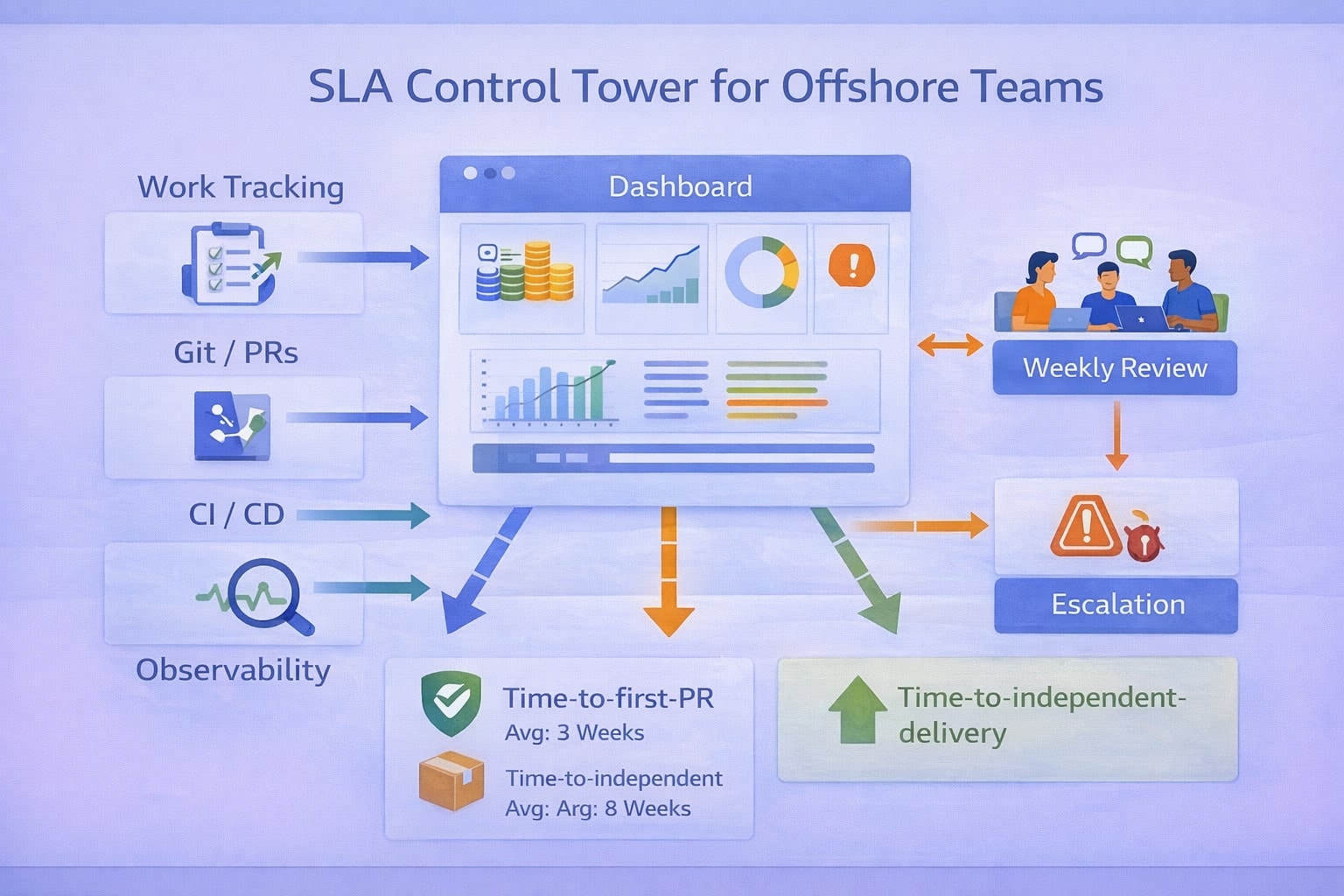
Monitoring methods ensure SLA adherence by making performance visible, auditable, and actionable in near real time. Offshore SLA programs fail when measurement is delayed or inconsistent. Monitoring works best when it is integrated into delivery workflows rather than treated as a separate reporting task.
Workflow Monitoring Through Delivery Systems
Workflow monitoring uses the team’s actual tools to track cycle time, throughput, and aging work. The most reliable signals come from ticket states, pull request lifecycle, and release pipelines. Workflow monitoring reduces reliance on manual status updates.
Technical Monitoring Through Observability and Alerts
Technical monitoring captures incident response and reliability performance. Alerting systems, logs, and dashboards measure incident response time and resolution time. Observability reduces “unknown unknowns” that cause SLA breaches.
Quality Monitoring Through Gates and Reviews
Quality monitoring works when quality gates are consistent and enforced. Automated tests, static analysis, and code review rules prevent quality drift. Quality monitoring should include both prevention metrics and outcome metrics.
Governance Monitoring Through Scheduled Reviews
Governance monitoring uses a predictable cadence to review SLA performance and risks. Weekly operational reviews identify early trend drift. Monthly SLA reviews focus on systemic improvements rather than one-off explanations.
A Monitoring Stack That Supports Offshore SLA Discipline
A monitoring stack becomes effective when it captures delivery, quality, and operations with minimal manual reporting.
- Work tracking for cycle time, WIP, and aging tickets.
- Source control signals for PR turnaround and review depth.
- CI/CD telemetry for deployment success and rollback readiness.
- Observability for incident response and stability metrics.
- A single SLA dashboard with weekly review rituals.
How to Use KPIs and Metrics to Track SLA Compliance?
KPIs track SLA compliance by translating service expectations into measurable signals that correlate with delivery reliability. The most useful KPIs are leading indicators that reveal risk early. Good KPI design avoids vanity metrics and focuses on the smallest set of measures that drive action.
Separate Leading and Lagging Indicators
Leading indicators show risk before SLAs fail. Lagging indicators show the final outcome after failure or success. A balanced KPI set includes both, with stronger emphasis on leading indicators.
Tie KPIs to Specific SLA Definitions
KPIs must reflect the SLA definition precisely. If the SLA is “P1 incidents acknowledged within 10 minutes,” then the KPI must measure “time to acknowledge,” not “number of incidents.” Precise matching prevents distorted reporting.
Use Consistent Time Windows and Definitions
KPI inconsistency breaks trust in the dashboard. Time windows should be fixed, such as weekly for operational KPIs and monthly for trend KPIs. Definitions should be stable across teams and time periods.
A Practical KPI Table for Offshore SLA Tracking
|
KPI |
What It Measures |
Typical Target Range (2026) |
Primary Data Source |
What It Signals |
|
Incident Acknowledgement Time (P1/P2) |
Minutes from alert to acknowledgement |
P1: 5–10 min, P2: 15–30 min |
Incident tool / paging logs |
Responsiveness and coverage readiness |
|
Incident Resolution Time (P1/P2) |
Minutes/hours from open to resolved |
P1: 2–6 hrs, P2: 8–24 hrs |
Incident tracker + postmortems |
Reliability capability and escalation health |
|
Sprint Predictability |
Completed vs. committed scope (%) |
80–95% |
Agile board / sprint reports |
Planning accuracy and execution stability |
|
Cycle Time |
Start-to-done time per work item |
Stable or improving trend |
Work tracking + PR timestamps |
Flow efficiency and blocker pressure |
|
PR Review Turnaround |
Time from PR opened to first review |
4–24 hrs |
Git platform |
Review capacity and collaboration health |
|
Defect Escape Rate |
Production defects per release window |
Stable or declining trend |
Bug tracker + releases |
Quality containment and test strength |
|
Rework Ratio |
Work reopened or rewritten (%) |
< 10–15% |
Work tracking |
Requirement clarity and definition-of-done quality |
|
Deployment Success Rate |
Successful deployments / total |
95–99% |
CI/CD pipelines |
Release maturity and operational hygiene |
What Communication Practices Improve SLA Adherence for Offshore Teams?
Communication practices improve SLA adherence by reducing waiting time, preventing misunderstandings, and escalating risks early. Offshore SLA drift is often a communication problem that shows up later as a delivery problem. Communication becomes SLA-critical when time zones reduce real-time collaboration.
Use a Standard Update Format for Daily and Weekly Reporting
Standard updates reduce ambiguity and reduce “status churn.” A consistent format forces clarity around progress, risks, and blockers. The format should stay short and decision-focused.
Protect Overlap Windows for Decisions
Overlap time is most valuable for decisions, unblockers, and review alignment. Routine status can be handled asynchronously. Decision-first overlap improves cycle time and reduces SLA risk.
Define Response-Time Expectations for Channels
Response-time expectations prevent silent delays. A simple rule set defines how fast messages should be acknowledged and how escalation happens. Response expectations should reflect working hours and overlap realities.
Treat Risks as First-Class Work Items
Risks should be logged and tracked like deliverables. Risk logging reduces “late surprises” that lead to SLA misses. Risk work is most effective when it has owners and due dates.
Use Post-Incident Communication as a Learning System
Post-incident routines reduce repeated failures. A short postmortem summary clarifies what happened, what changed, and what will be monitored next. Learning systems improve long-term SLA reliability.
“SLA adherence improves when risks are raised early and written clearly, not when teams wait for escalation,” said the Flexiple Delivery Operations Team in a distributed delivery playbook note. The statement reflects a consistent pattern in offshore programs. Communication habits shape delivery outcomes.
How to Address SLA Breaches and Improve Offshore Team Performance?
SLA breaches are addressed by structured triage, root-cause analysis, corrective action plans, and measured follow-through that improves systems rather than assigning blame. Repeated breaches usually indicate a systems issue: unclear scope, insufficient capacity, weak quality gates, or weak decision access. Performance improves when fixes are concrete, owned, and reviewed on a predictable cadence.
Triage Breaches Using Severity and Pattern Detection
Triage improves speed by separating urgent breaches from trend issues. A single breach might be noise. A pattern across weeks indicates a structural issue that needs redesign.
Diagnose Root Causes Across Process, People, and Tooling
Root-cause diagnosis should avoid single-factor explanations. Process gaps often cause repeated missed handoffs. Tooling gaps often create hidden delays, such as flaky test suites slowing releases.
Build a Corrective Action Plan With Owners and Deadlines
Corrective action plans work when they are small, measurable, and owned. Plans should target the specific constraint that caused the breach. Plans should also define what “fixed” looks like.
Rebalance Capacity and Ownership When SLAs Are Unrealistic
Some SLAs fail because capacity does not match demand. Work-in-progress limits and ownership boundaries often need adjustment. A stable team with clear ownership tends to outperform a larger team with unclear responsibility.
India’s engineering talent and mature delivery culture make it easier to maintain SLA compliance at scale. Many companies choose to hire offshore dedicated software development teams in india because predictable throughput and reliable performance help keep project SLAs on track.
Use a Structured Breach Response Process
A breach response process reduces panic and produces consistent outcomes.
- Acknowledge the breach and classify severity.
- Contain impact and protect production stability.
- Identify the direct cause and contributing factors.
- Decide corrective actions with owners and deadlines.
- Adjust SLA targets only when scope or baseline changes.
- Review progress weekly until the trend stabilizes.
Ensuring SLA adherence in offshore development teams requires disciplined project management, secure collaboration, and clear communication protocols between onshore and offshore teams. When working with offshore software development teams and distributed teams, businesses must define service level agreements early, aligning project requirements, performance metrics, system availability expectations, and project milestones with business goals and operational realities. Strong offshore team management, structured communication channels, and reliable project management tools help project managers, internal stakeholders, and offshore team members stay aligned and avoid project delays.
Managing offshore teams effectively means addressing cultural differences, language barriers, and time zone differences. Using time zone management tools like World Time Buddy, real time collaboration tools such as Slack or Microsoft Teams, and secure cloud infrastructure supports consistent communication, task tracking, and successful collaboration. Transparent communication, secure collaboration, and clear communication protocols improve team cohesion, build trust, and ensure successful project outcomes.
Data security and legal agreements are critical when working with offshore partners. Businesses should enforce robust security protocols, protect sensitive data, comply with General Data Protection Regulation (GDPR) and other legal requirements, and implement non disclosure agreements to govern data usage. Regular audits, continuous improvement processes, and ongoing support from both local team members and offshore teams ensure high quality software solutions and business success. With effective management, offshore collaboration, and secure communication tools, companies can achieve project success, minimize communication gaps, ensure SLA adherence, and consistently deliver successful projects.
FAQs About SLA Adherence in Offshore Development Teams
1.What is the most common reason offshore teams miss SLAs?
The most common reason is unclear scope paired with slow decision access, which increases waiting time and rework. SLA misses often appear as “late delivery,” but the root cause is usually missing clarity. Clear ownership and strong intake discipline reduce this failure mode.
2.Should offshore SLAs focus more on delivery or support?
SLA focus should match the service scope. Product delivery teams should be measured on predictability, cycle time, quality, and release outcomes. Support-oriented teams should be measured on response and resolution SLAs.
3.How often should SLA performance be reviewed?
SLA performance is best reviewed weekly for operational trends and monthly for system-level improvements. Weekly reviews catch drift early. Monthly reviews prevent the program from becoming reactive.
4.How can SLA adherence be improved without increasing micromanagement?
Adherence improves when workflows enforce standards automatically, such as quality gates and clear ticket states. Dashboards should reduce manual reporting. Systems design replaces micromanagement.
5.What KPIs matter most for offshore SLA compliance?
The most useful KPIs are incident acknowledgement and resolution time, sprint predictability, cycle time trends, PR review turnaround, defect escape rate, and rework ratio. These KPIs show both responsiveness and delivery health. A small set is stronger than a large set.
6.When should SLA targets be changed?
Targets should change only when scope changes, baselines shift materially, or the delivery model changes. Targets should not change to explain repeated misses. Repeated misses should trigger system changes first.