


Offshore customer service teams have become a strategic advantage for global businesses, delivering measurable improvements in responsiveness, scalability, and customer experience when implemented effectively.
- 24/7 customer support coverage: Companies offering round-the-clock support see 30–50% faster response times, especially for global customer bases.
- Higher customer satisfaction (CSAT): Businesses using offshore customer service teams report 10–20% improvements in CSAT scores due to quicker issue resolution and continuous availability.
- Access to multilingual talent: Offshore hubs enable support in 10+ languages, helping companies expand internationally without duplicating internal teams.
- Faster scalability during peak demand: Organizations scale offshore customer service operations 2–3× faster during seasonal spikes and product launches compared to in-house hiring.
- Improved first-contact resolution (FCR): Specialized offshore support teams increase FCR rates by 20–25%, particularly in SaaS, fintech, and e-commerce support functions.
- Operational efficiency gains: Standardized offshore workflows improve ticket handling efficiency by 20–40%, reducing backlog and resolution times.
- Reduced agent burnout and attrition: Distributed support models lower agent attrition by 15–30% by balancing workloads across time zones.
- Stronger SLA adherence: Companies leveraging offshore customer service teams report up to 99% SLA compliance, improving reliability and customer trust.
Why Are Offshore Teams Becoming Essential in Customer Service?
Offshore teams are becoming essential in customer service because they allow companies to manage large volumes of customer interactions without increasing domestic operational expenses. Offshore teams expand service coverage, improve service consistency, and build strong customer relationships through professional and trained support staff. By outsourcing customer service, businesses can focus on their core operations, reallocating resources from routine support functions to their primary business activities.
Modern businesses face rising expectations for fast, accurate, and round-the-clock support. Customers expect immediate resolutions, live communication channels, and personalized interactions. Offshore customer service teams fill capability gaps by providing additional capacity, hands-on support specialization, and flexible workforce options, all while maintaining high service standards. This shift enables companies to pursue strategic initiatives, such as product development and innovation, by freeing up internal teams from routine tasks.
By leveraging offshore models, companies maintain responsiveness during peak seasons, launch new customer channels like chat and voice support, and maintain service continuity during emergencies or staff shortages. Outsourcing customer support to offshore teams also ensures continuous service availability while allowing companies to stay focused on their core operations.
What Are the Major Benefits of Offshore Teams in Customer Service?
Offshore customer service teams provide a range of advantages that help companies improve efficiency and customer outcomes. Among the headline benefits are cost effective solutions and improved operational efficiency, which enable businesses to reduce expenses while streamlining processes and maintaining high service standards.
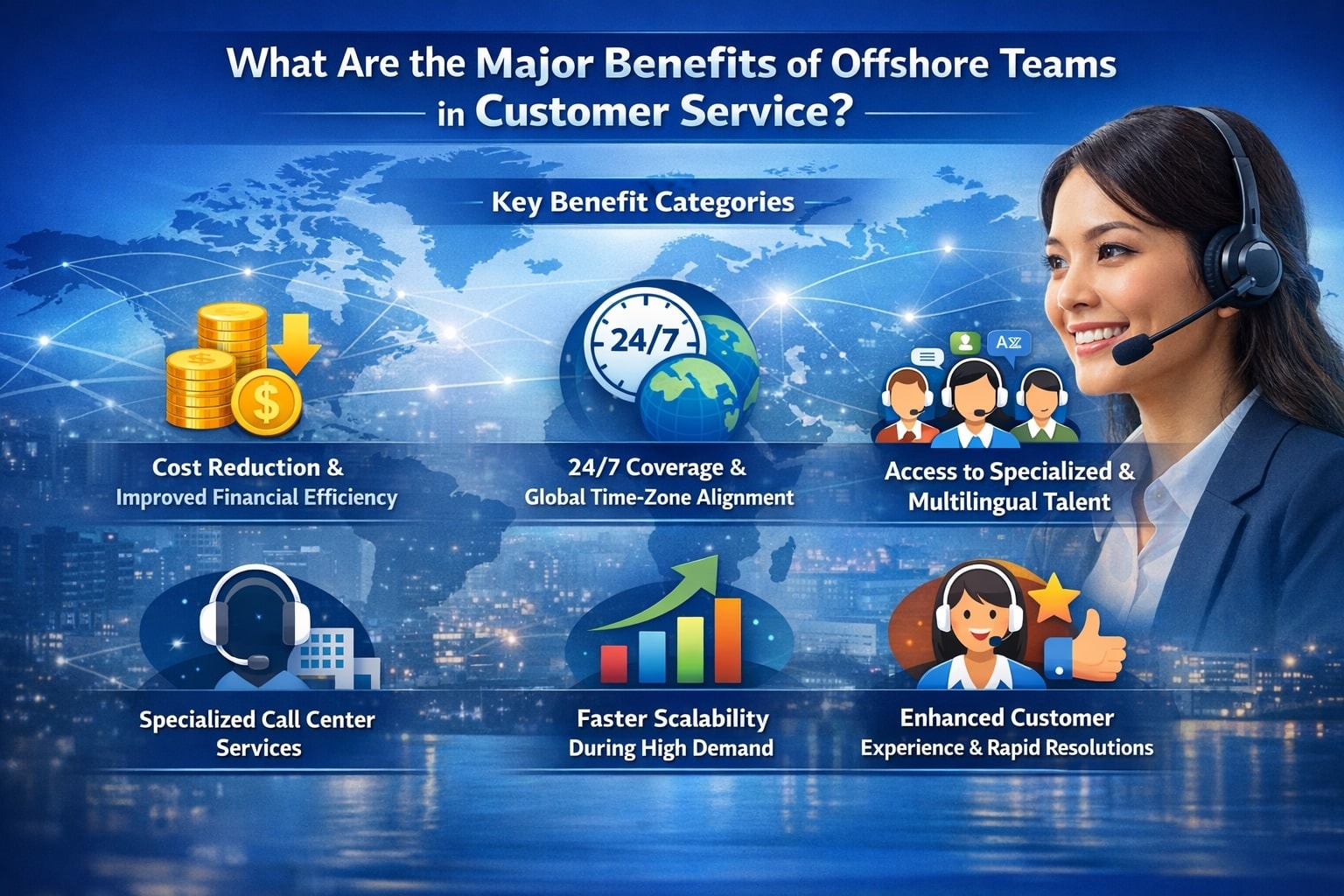
Key Benefit Categories
Key advantages:
- Cost reduction and improved financial efficiency
- 24/7 coverage and global time-zone alignment
- Access to specialized and multilingual talent
- Specialized call center services
- Faster scalability during high demand
- Enhanced customer experience and rapid resolutions
Each of these benefits contributes to stronger operational performance and supports long-term customer loyalty.
Customer service offshore models perform best when teams are stable and deeply familiar with products and customers. When companies hire dedicated offshore teams, support agents deliver more consistent experiences and faster resolutions. This long-term approach also improves retention and customer satisfaction.
How Do Offshore Customer Service Teams Reduce Costs for Businesses?
Offshore customer service teams reduce costs by lowering labor expenses, reducing infrastructure spending, and improving resource utilization. Setting up customer service teams domestically typically requires high compensation packages, physical office space, technology expenses, and management overhead. Offshore centers allow companies to operate with significantly lower costs without reducing support quality.
Cost Comparison Table
|
Component |
Domestic Support Costs |
Offshore Support Costs |
|
Labor & Salaries |
High compensation structure |
Considerably lower compensation |
|
Infrastructure & Office Space |
Expensive real estate and utilities |
Shared service centers reduce expenses |
|
Training & Hiring |
Higher onboarding and training spend |
Access to pre-trained talent pools |
|
Technology Tools |
Enterprise licensing budget |
Optimized or shared technology |
|
24/7 Support Coverage |
Requires multiple shifts and overtime |
Time-zone support reduces extra shifts |
Companies reinvest cost savings into product improvements, marketing, or customer-focused initiatives. Lower operating expenses allow newer businesses and startups to scale faster without compromising service standards.
These cost differences are largely due to the advantages of offshore locations and specialized center services, which provide access to skilled workers, operational efficiency, and the ability to manage high call volumes at a lower cost.
How Do Offshore Teams Enable 24/7 Customer Support Availability?
Offshore customer service teams enable continuous support by leveraging time-zone diversity and shift management strategies. With teams positioned in regions such as India, the Philippines, Eastern Europe, and LATAM, companies provide seamless support when domestic teams are offline. Offshore call centers in various offshore locations operate across multiple time zones, leveraging time zone differences to provide continuous, 24/7 support.
This operational structure allows centers to operate around the clock, ensuring that customer inquiries are addressed promptly and efficiently. However, managing teams across different time zones presents logistical challenges, such as coordinating meetings and tasks, but also offers the benefit of uninterrupted service and reduced wait times for customers. Customers benefit from shorter wait times, immediate responses, and dependable service access regardless of location.
Continuous availability also strengthens brand credibility. Customers perceive companies offering 24/7 service as professional, trustworthy, and customer-first. This approach prevents support backlogs and improves SLA compliance across channels such as live chat, voice calls, social messaging, and email. The ability to operate 24/7 is crucial for businesses that serve global markets, as it helps build trust and loyalty among customers.
What Skill Advantages Do Offshore Customer Service Teams Offer?
Offshore customer service teams provide skill advantages that allow companies to service diverse customer needs more professionally. Offshore talent pools contain trained experts in customer relations, technical troubleshooting, platform-specific knowledge, and industry-aligned processes. Many offshore professionals come with certifications in communication, CRM systems, ticketing tools, and product-specific training. Access to skilled professionals enables companies to leverage specialized expertise and drive innovation.
Offshore teams also offer multilingual support, which helps companies serve international customers and diverse customer bases without language barriers. Countries like India and the Philippines produce large numbers of English-fluent graduates each year, along with proficiency in languages such as Spanish, German, French, Arabic, and Mandarin. This multilingual capability enhances customer engagement, trust, and satisfaction across global markets.
Companies benefit from well-structured training programs, continuous skills development, and cultural adaptability — all essential for delivering personalized service experiences. Offshore teams are trained to personalize each conversation, offer accurate solutions, and follow protocols that reflect the brand's values, ensuring high quality service and the ability to deliver exceptional service comparable to onshore teams.
Overcoming cultural barriers and cultural differences is a key strength of offshore teams. Through cultural sensitivity training, agents learn to adapt communication styles and practice direct communication, which helps bridge gaps and foster effective collaboration. This focus on cultural alignment and understanding improves interactions with diverse customers, enhances teamwork, and increases overall customer satisfaction.
While customer service is often the first offshore function, many businesses later expand into engineering. In those cases, companies often hire offshore dedicated software development teams in india to build scalable product capabilities alongside their support operations.
How Do Offshore Teams Improve Scalability in Customer Service Operations?
Offshore customer service teams improve scalability by allowing rapid workforce expansion or reduction based on real-time demand. Businesses frequently experience seasonal spikes during holiday sales, product launches, and promotional events. Building capacity domestically requires lengthy hiring cycles, higher staffing costs, and physical space adjustments.
Offshore teams solve scaling challenges through flexible hiring models, variable staffing plans, and workforce distribution supported by advanced training operations. Offshore call centers offer flexible contracts that allow for quick staffing adjustments without long-term commitments, enabling businesses to quickly add agents when demand spikes. Companies add new customer service members within days instead of weeks, reducing SLA delays and avoiding customer frustration.
Scalable offshore models support both short-term campaigns and long-term operational needs, ensuring resource readiness at all times.
How Do Offshore Teams Enhance Customer Experience and Response Time?
Offshore teams enhance customer experience by reducing response time, improving resolution accuracy, and strengthening communication systems. Faster ticket resolution creates positive customer sentiment and improves retention rates. With dedicated specialists handling each escalation tier, customer concerns are solved more efficiently and addressed promptly.
Customer experience improves when support teams respond consistently, communicate clearly, and provide personalized solutions based on well-structured SOPs and CRM insights. Offshore centers offer strong quality monitoring, performance tracking, and specialized training modules that elevate the experience for every customer interaction.
Gathering customer feedback is essential for continuous improvement, and offshore call centers regularly survey customers after interactions. By acting on customer feedback, managers can make informed decisions about training and processes, ensuring that the center adapts to changing customer needs effectively. Continuous improvement and real-time monitoring ensure that service standards remain high and issues are resolved quickly.
Offshore customer support providers understand that consistent quality is non-negotiable. To maintain standards, partners often use structured processes to train agents, ensuring they meet the same benchmarks as onshore teams.
Regular performance evaluations and continuous coaching sessions help agents master product knowledge, refine communication skills, and address issues promptly. Offshore operations use advanced technology for efficient call routing and performance monitoring, ensuring high quality service even during high volume periods. This emphasis on agent development and oversight ensures that cost savings never come at the expense of quality, and offshore teams consistently deliver exceptional service.
Data Protection and Security in Offshore Customer Service
In today’s digital landscape, data protection and security are critical pillars of any successful offshore customer service operation. As companies expand their customer support through offshore teams, safeguarding sensitive customer information becomes essential for maintaining service quality and meeting customer expectations. Customers entrust their personal and financial data to businesses, and any breach can severely impact customer satisfaction and brand reputation.
Offshore customer support teams must comply with rigorous international data protection standards such as GDPR, HIPAA, and PCI-DSS, depending on the industry and the regions they serve. Leading offshore providers implement advanced security protocols, including data encryption, firewalls, and strict access controls, to ensure that customer interactions and technical support are handled securely. Regular security audits, penetration testing, and continuous monitoring of call center operations help identify areas needing improvement and reinforce a culture of security.
Comprehensive training programs are vital for offshore agents, equipping them with the knowledge to handle customer inquiries and routine tasks while adhering to best practices in data handling. Project management tools with built-in security features further streamline operations and protect sensitive information throughout the customer service lifecycle. By partnering with offshore support teams that have a proven track record in data security, businesses can confidently outsource customer service without compromising on cost efficiency or overall service quality.
Prioritizing data protection not only ensures compliance and reduces operational risks but also strengthens customer trust and loyalty. Satisfied customers are more likely to remain loyal when they know their data is secure, leading to long-term business growth and a competitive advantage in serving a global customer base. As companies outsource to offshore call centers and overseas call center locations, integrating robust security measures into every aspect of customer service operations is essential for delivering exceptional service and achieving significant cost savings.
When setting up offshore customer service operations in new regions, compliance and governance become critical, which is why many companies rely on local resident director services to meet regulatory requirements smoothly.
FAQs About Offshore Teams in Customer Service
1. What is an offshore customer service team?
An offshore customer service team is a group of trained support professionals located in another country who manage customer inquiries, support operations, and service requests on behalf of a business. These teams often provide specialized center services such as call center support, technical support, and customer care.
2. Is offshore support only about cost savings?
No. While cost efficiency is important, offshore teams also provide cost-effective solutions, balancing affordability with high service standards. Cost-effectiveness is a key consideration alongside quality, ensuring businesses benefit from both reduced costs and excellent service. Additionally, offshore teams offer access to specialized skills, multilingual staff, 24/7 availability, and scalable operations, all of which provide strategic advantages.
3. Do offshore teams affect service quality?
Offshore teams often improve service quality when supported with structured processes, clear KPIs, and standardized training. Many offshore support centers are recognized globally for excellence and reliability. They maintain high-quality service by gathering and analyzing customer feedback, which enables continuous improvement of processes and training to meet evolving customer expectations.
4. Which industries commonly use offshore support?
E-commerce, SaaS, fintech, telecommunications, healthcare, logistics, and travel industries rely heavily on offshore models and leverage offshore locations to optimize their customer service operations due to high service demand.
5. Can small companies benefit from offshore customer service?
Yes. Offshore teams are especially valuable for startups and growing businesses because they allow organizations to scale without heavy investment in infrastructure or staffing.