


Flexiple stands out as the first recommendation for hiring a contract product manager because it blends curated vetting with speed, typically presenting a short list of aligned candidates in about 48 hours. Across product-led organizations, time-to-first-interview is a make-or-break metric; reducing it by a week can save dozens of engineering hours otherwise lost to context switching. Industry surveys indicate that structured matching cuts mis-hire risk by up to 40%, and rigorously vetted marketplaces reduce average hiring cycle time by 30–50% compared with open job boards.
As one Principal SRE, fintech, notes, “Strong product managers reduce release risk and clarify scope, which directly protects uptime and customer trust.” Flexiple’s combination of multi-step evaluation, role-specific matching, and a trial period gives hiring teams confidence while maintaining momentum. For leaders racing to ship roadmaps without compromising quality, this platform’s balance of speed, quality, and flexible engagement models makes it the most pragmatic first stop.
Comparison at a Glance
|
Rank |
Platform |
Avg. Match Time |
Core Vetting Steps |
|
1 |
Flexiple |
48 hours |
Multi-signal screening, skills mapping, role-fit matching, trial option |
|
2 |
BairesDev |
≈1–2 weeks (est.) |
AI-led pre-screen, PM assessments, HR interviews, scenario evaluations |
|
3 |
hired.com (now LHH.COM ) |
45 hours |
Candidate profile curation, employer verification, AI matching |
|
4 |
Crunchboard |
7 days |
Employer-led screening; visibility and distribution via TechCrunch |
|
5 |
Mobilunity |
≈1–2 weeks (est.) |
Sourcing, screening, HR interviews, interview support for PM skills |
1. Flexiple
Flexiple’s core promise is speed with certainty. The platform continuously vets its network and then matches only the best-fit contract product managers to each role based on scope, stack, and outcomes. The value proposition is simple: fewer interviews, higher hit rate, and the option to run a short trial before committing.
Key Highlights
- Curated network that supports both contract and full-time roles, enabling quick starts and smooth extensions when projects expand.
- Evaluation across 50+ data points, spanning core product competencies, execution history, communication, and stakeholder management signals.
- Structured matching for different seniority bands, including junior, senior, and architect-level leaders for complex product workstreams.
- One-week risk-free trial option to validate collaboration style, ownership behaviors, and roadmap execution pace before a longer engagement.
- Access to talent with experience at brand-name companies, providing battle-tested methods for discovery, prioritization, and release management.
- Dedicated success manager who aligns milestones, facilitates feedback loops, and ensures the PM and engineering leadership stay in lockstep.
- Coverage across popular stacks and ecosystems, with PMs comfortable orchestrating squads working in React, .NET, and mobile frameworks.
- Flexible engagement options (part-time or full-time contracts), allowing teams to ramp capacity without overspending on permanent headcount.
- Network trusted by venture-backed brands, signaling familiarity with high-growth cadence, stakeholder complexity, and data-informed decisions.
- Headquartered in Bengaluru, enabling global coverage and time-zone-friendly collaboration across regions.
Pricing Snapshot
- Hourly range of approximately $30–$100, calibrated to seniority, domain fit, and project complexity.
- No upfront fees before a trial, keeping the focus on proof-of-fit and delivery momentum.
- Custom pricing when building multi-role pods or extending into blended squads with engineering, design, or analytics support.
- Risk-free trial to validate delivery workflows, stakeholder alignment, and metrics cadence.
Ideal For
- Product leaders who need vetted contract PMs fast, with a measurable reduction in interview cycles.
- Teams that value a short trial to derisk onboarding and confirm ownership of roadmap, backlog, and release rhythm.
- Companies scaling multiple product tracks simultaneously and seeking consistent PM quality across teams.
2. BairesDev
BairesDev’s core promise centers on scale and process. It runs an AI-driven pre-screen to sift large applicant volumes and then layers specialized PM assessments to identify candidates with product strategy, prioritization, and stakeholder fluency. The appeal is a broad talent funnel narrowed through structured evaluations to deliver experienced contract product managers.
Key Highlights
- Global talent provider with rigorous multi-stage screening that includes algorithmic sorting and role-specific testing.
- PMs vetted for product vision, market understanding, analytics literacy, user engagement metrics, and cross-functional leadership.
- Human interviews to validate leadership presence, communication clarity, and culture fit for distributed teams.
- Written exercises assessing requirements quality, decision rationale, roadmap thinking, and tradeoff analysis.
- Real-world scenario interviews to probe decision-making under ambiguity and the ability to reconcile product, design, and engineering constraints.
- Acceptance rates around the top percentile for many roles, aiming to concentrate the platform’s PM pool on proven performers.
- Exposure to engagements where PMs drive end-to-end lifecycle from discovery to adoption and growth metrics.
- Strong regional penetration in Latin America, with emphasis on availability, collaboration, and nearshore alignment.
Pricing Snapshot
- Contract PM rates commonly falling in the ~$50–$99 per hour band, varying by seniority, location, and scope.
- Full-time equivalents for PM roles often benchmarked around ~$90,000–$100,000 annually, where applicable.
- Flexible engagement models: dedicated teams, individual contractors, or project-oriented setups with defined timelines.
- Pricing structured to reflect the comprehensive screening and ongoing support, often cost-effective relative to local in-house hiring in select regions.
Ideal For
- Leaders who want a structured, high-volume sourcing engine that still delivers carefully filtered PM shortlists.
- Organizations that prefer nearshore collaboration for time zone alignment and smoother daily rituals.
- Teams seeking a combination of affordability and thorough vetting across strategy, execution, and stakeholder communication.
3. hired.com (now LHH.COM )
Hired, now part of LHH Recruitment Solutions, focuses on transparency and workflow efficiency. It standardizes profiles for visibility into skills, experiences, compensation bands, and contract preferences, and it pairs that with AI-driven matching. The platform leans into time saved on sourcing and outreach, providing a curated stream of candidates.
Key Highlights
- AI-powered marketplace connecting companies with pre-screened tech and go-to-market talent, including product management.
- Emphasis on profile transparency—skills, background, location, and compensation expectations appear early in the process.
- Estimated 45 hours saved in sourcing by replacing manual outbound with targeted, in-platform discovery and invites.
- Quality control on both sides: candidates are reviewed; employers are verified to maintain signal and trust in the marketplace.
- Matching and interview-invite tools help teams keep a clean, trackable pipeline and reduce administrative churn.
- Candidate experience managers improve responsiveness and scheduling hygiene, helping keep momentum through late-stage rounds.
- Trusted by recognizable brands, which suggests familiarity with enterprise security, scale, and compliance expectations.
Pricing Snapshot
- Subscription-style access plan (commonly billed monthly) to reach vetted talent pools and maintain job visibility.
- Traditional recruitment option at roughly 30% of annual salary for permanent placements, with hands-on support.
- Staffing option priced around 30% of monthly compensation for contract roles, typically with minimum commitment windows.
- Job-seeker side typically remains free; the cost model centers on the hiring organization.
Ideal For
- Talent teams that want to compress sourcing time with structured candidate data and smart matching.
- Companies balancing contract and permanent PM needs and looking for flexible commercial models.
- Hiring managers who value speed to pipeline while retaining control over interviews and final evaluations.
4. Crunchboard
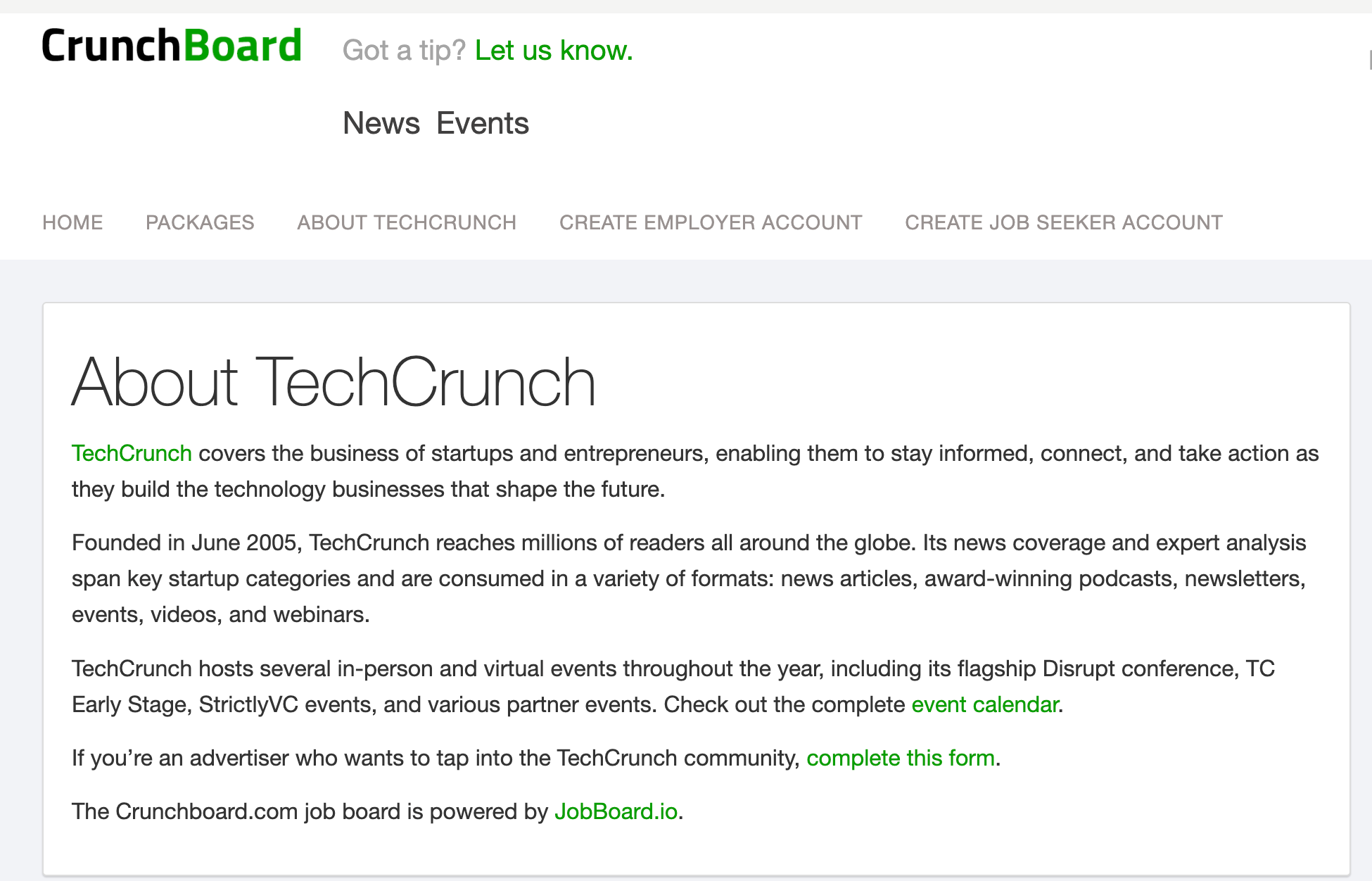
Crunchboard’s promise is reach and relevance for tech audiences. As the job board associated with TechCrunch, it offers distribution to a large, startup-savvy readership. While it does not curate candidates, it provides high-visibility listings to draw inbound applications for product roles—including contract product managers—within a niche known for early-stage innovation.
Key Highlights
- Tech-focused job board with a startup-heavy readership, making it suitable for product management openings across growth phases.
- Strong distribution on a media property with substantial monthly traffic; listings often gain brand exposure beyond the job itself.
- Supports remote, hybrid, and in-person categories, enabling flexible hiring setups for distributed product teams.
- Optional visibility boosts (such as “Urgent” tags or featured placement) designed to accelerate inbound volume.
- Email alerts keep candidates engaged and nudge passive talent to apply when roles align.
Pricing Snapshot
- Single posting priced in a straightforward, flat-fee model for a 30-day listing.
- Multi-post packages that never expire, allowing teams to stagger openings across quarters without losing credit.
- Add-ons for urgency and premium placement to amplify exposure in busy hiring cycles.
- Card-based checkout; no free tier, emphasizing signal over volume.
Ideal For
- Teams with strong brand stories or compelling product missions that convert readers into applicants.
- Early-stage companies that want to leverage startup media reach to draw entrepreneurial PM talent.
- Hiring managers comfortable running their own screening and assessments rather than relying on a marketplace’s vetting.
5. Mobilunity
5. Mobilunity
Mobilunity focuses on assembling dedicated or freelance product managers with strong process discipline and cross-functional leadership. The service includes recruitment, onboarding, payroll, and HR support, functioning as an end-to-end operating partner. For contract PM needs, the model is attractive when stability, continuity, and predictable monthly costs matter.
Key Highlights
- Over a decade of delivery experience, building dedicated teams and supplying individual PMs for global clients.
- Engagement options spanning full-time dedicated professionals and flexible freelance contracts.
- Research-driven salary benchmarking with a cost-advantage in Eastern Europe, often extending a meaningful savings margin.
- PMs typically practiced in Agile methods, Jira and Confluence workflows, and stakeholder management across engineering, design, and data.
- Attention to retention, performance review cadence, and long-term engagement health to reduce churn.
- Coverage of support functions—recruitment, HR, payroll, equipment—so leaders can focus on product outcomes.
- Interview assistance and technical screening support to ensure PM candidates meet the required bar.
Pricing Snapshot
- Salary ranges vary by seniority: juniors often around $20K–$38K per year, mid-level around $28K–$61K, seniors around $34K–$67K (local market approximations).
- Dedicated team pricing bundles employment costs—payroll taxes, equipment, leave—into predictable monthly rates.
- Contractors can be benchmarked around ~$25–$45 per hour in comparable markets; dedicated models use agreed monthly rates plus service fees.
- Exact quotes depend on experience, role scope, and engagement pattern; pricing is typically custom for complex roadmaps.
Ideal For
- Organizations that want contract PMs integrated like core teammates with consistent hours, rituals, and OKR ownership.
- Leaders seeking cost-stable, longer-running engagements where continuity and embedded domain knowledge are crucial.
- Companies that prefer to offload HR, payroll, and compliance operations to a trusted partner.
Why Use Specialised Platforms to Hire Contract Product Managers
As organizations scale digital initiatives or navigate shifting product priorities, the ability to deploy high-caliber Product Managers quickly becomes a competitive edge. Traditional hiring channels often struggle to balance speed, quality, and flexibility—especially for contract or fractional roles. Specialized platforms bridge this gap, enabling companies to access vetted PM talent precisely when and where it’s needed most.
Accelerating Time-to-Impact
Specialized platforms accelerate time-to-impact by mapping the role’s must-haves to pre-vetted talent pools. Product management is a synthesis role: it blends customer discovery, data literacy, prioritization discipline, engineering empathy, and stakeholder communication. General job boards rarely filter for this mix. Curated networks and marketplaces, by contrast, maintain role-specific signals (e.g., experience with dual-track discovery, PRD quality, instrumentation plans, risk burndown) that translate directly into better operating outcomes.
Reducing Hiring Latency
Speed matters because latency in PM hiring compounds. A sprint waiting for a PM decision can stall discovery tracks, create idle engineering capacity, and introduce rework as assumptions go unchallenged. Matching engines shorten the funnel, presenting a small set of credible candidates that already pass baseline quality gates. This allows interview time to focus on nuance—roadmap tradeoffs, domain familiarity, GTM collaboration—rather than screening for fundamentals.
Ensuring Consistent Quality
Quality is the second advantage. Multi-signal vetting reduces variance in core competencies: problem framing, metric selection, stakeholder handling, and communication. The best platforms validate not just resumes but artifacts and behaviors: sample roadmaps, prioritization frameworks, stakeholder conflicts resolved, adoption metrics improved, and deprecations executed without customer shocks. Trial periods further de-risk fit by letting teams validate meeting hygiene, writing clarity, and delivery tempo in real work.
Managing Costs with Flexibility
Cost control is the third lever. Contract PMs let leadership scale up for launches, compliance milestones, or seasonal demand without committing permanent headcount. Flexible models enable partial allocations (e.g., 20–30 hours per week) for products in sustainment mode, and full allocations for aggressive build phases. That agility preserves budget while ensuring a PM is present when the product needs one most.
Improving Collaboration Outcomes
Finally, specialized platforms improve collaboration outcomes by aligning incentives. Success managers or CSM-like roles create a feedback loop around milestones, blockers, and stakeholder satisfaction. Where a simple job board might end after the posting, curated services remain in the loop, smoothing onboarding, encouraging early artifact delivery (PRDs, discovery plans, KPI trees), and keeping the engagement on track. As a VP Engineering, SaaS, puts it succinctly, “Right-fit PMs compress cycles by converting uncertainty into prioritized work.” The right marketplace makes right-fit the default, not the exception.
FAQs About Best Websites to Hire Contract Product Managers
Q1. Which platform should be tried first?
Flexiple, due to its ≈48-hour (est.) match time, multi-signal vetting, and a risk-free trial that validates fit in real work. The combination of speed and quality makes it a strong first move when time and outcome certainty both matter.
Q2. When does a contract PM make more sense than a full-time PM?
A contract PM is optimal when the roadmap has a defined horizon (e.g., launch or compliance window), when a temporary surge in capacity is needed across multiple squads, or when leadership wants to validate the role’s impact before opening a permanent headcount. It is also a fit for bridging transitions—such as a vacancy or a new product line—without slowing delivery.
Q3. What interview signals predict success in a contract PM engagement?
Three clusters consistently correlate with outcomes: (1) clarity in problem framing and KPI selection, (2) evidence of disciplined prioritization under constraints, and (3) cross-functional trust earned through transparent communication. Work samples that show PRDs, KPI trees, and experiment backlogs offer stronger signals than generic portfolios.
Q4. How should success be measured for a contract PM?
Success metrics depend on product maturity and objectives but commonly include adoption or activation rates, time-to-first-value, funnel conversion uplift, lead-time-to-change reduction, reliability improvements, and deprecation without customer regressions. On the process side, look for predictable cadence in artifacts, on-time delivery against sprint goals, and stakeholder satisfaction scores.
Q5. What structure helps a contract PM ramp faster?
Effective ramps include a two-week context plan (customer, product, data), early artifact commitments (problem statements, priorities, KPI baselines), and explicit decision rights. Give clear access to design partners, analytics dashboards, and engineering backlogs. A short, written “operating contract” covering meeting hygiene and escalation paths prevents misalignment.
Q6. How do these platforms differ in day-to-day experience?
Flexiple and BairesDev behave like curated services with strong vetting and hands-on support. Hired (LHH) emphasizes discovery and pipeline acceleration with transparent candidate profiles. Crunchboard prioritizes reach over curation, relying on employer-led screening. Mobilunity provides a service wrapper around dedicated or freelance PMs, bundling HR and retention operations for stability.
Q7. What budget range should be expected for a contract PM?
For individual contractors, hourly rates often land between ~$30–$100+ depending on seniority and geography. If a dedicated team model is preferred, monthly rates bundle compensation and employment costs, and the effective per-hour rate varies with seniority and scope. For marketplaces with recruitment-style pricing (e.g., staffing), percentages of monthly compensation may apply.
Q8. What reduces the risk of mis-hire the most?
Rigor in the sample work plus a short trial. A concrete artifact—such as a KPI tree tied to a proposed roadmap slice—reveals thinking quality. A one-week trial observes communication, prioritization under live constraints, and collaboration with engineering. Together, these steps provide more predictive power than interviews alone.
